









Send Us A Message
Single-shaft or twin-shaft shredder for steel-reinforced rubber?
A shredder can look convincing on a specification sheet and still struggle when steel-reinforced rubber reaches the cutting chamber. Tough rubber resists cutting, embedded wire bridges between pieces, and an unexpected bead bundle can turn steady production into repeated reversals. For technical evaluators, the choice is not simply between one shaft and two. It is between different approaches to feeding, cutting, sizing, and managing metal.
A purpose-built twin-shaft shredder is generally the stronger starting point for bulky, variable steel-reinforced rubber; a single-shaft shredder becomes more attractive when feed is prepared and controlled output sizing matters. Neither conclusion should replace a representative material trial. Cutter design, drivetrain protection, and the downstream process can outweigh the shaft configuration itself.
Define the reinforcement before comparing machines
“Steel-reinforced rubber” covers materials with very different processing behavior. Passenger-tire sections, truck-tire beads, steel-cord conveyor belts, and industrial rubber offcuts should not be treated as equivalent feedstock.
Before requesting a quotation, document the following:
- Maximum feed dimensions and piece weight: Include occasional oversized pieces, not just the average.
- Steel form: Distinguish fine cords, loose exposed wires, concentrated bead bundles, and rigid metal attachments.
- Rubber condition: Record thickness, flexibility, contamination, and variation between batches.
- Required output: Specify acceptable size distribution, oversize limits, and residual steel requirements.
- Process destination: Decide whether the material goes to further size reduction, steel recovery, granulation, or another route.
A low average steel percentage can hide a severe cutting challenge if that steel is concentrated in thick bundles. Likewise, pre-cut rubber strips may be easier to feed but still contain long cords capable of wrapping around shafts or obstructing discharge.
How the two shredder designs change the decision
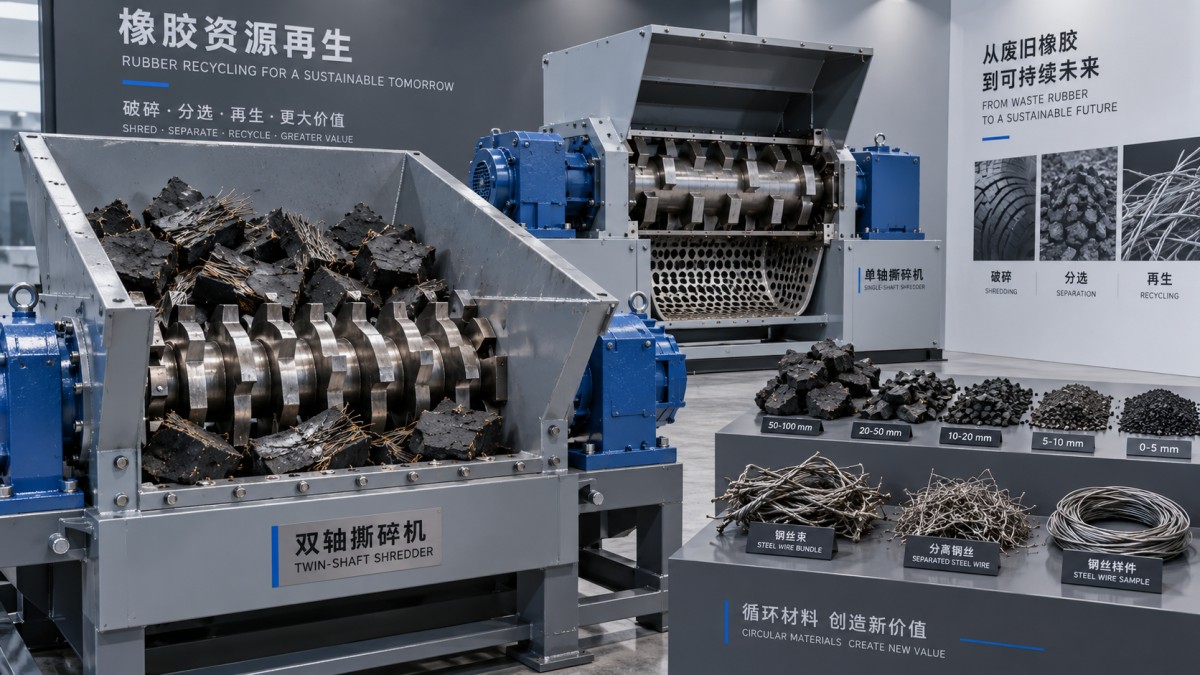
In a typical single-shaft arrangement, a hydraulic pusher presents material to a rotor that cuts against stationary knives. A screen retains material until it can pass through the openings. A typical twin-shaft machine uses two counter-rotating cutter shafts to grip and shear the feed, commonly at low speed and high torque.
These are broad design patterns, not guarantees. Specialized machines and configurations differ, so the comparison must apply to the actual equipment offered.
When twin-shaft is the more practical first stage
If incoming material includes bulky tire sections, thick rubber assemblies, or irregular reinforced offcuts, a twin-shaft shredder designed for that duty often offers the more forgiving primary stage. Its gripping action can reduce dependence on closely controlled presentation, while low-speed shearing suits difficult feed.
The important qualification is designed for that duty. A general-purpose twin-shaft machine is not automatically suitable for tire beads or heavy steel reinforcement. Ask how cutter geometry, shaft construction, bearings, and overload protection address your material. Automatic reversal is useful protection, but frequent reversal is not evidence of successful processing; it can conceal poor effective throughput.
Also consider what leaves the machine. Primary shredding may produce manageable pieces without releasing much of the embedded steel. If downstream equipment requires a narrow feed size, external screening and oversize return may be necessary. That changes conveyor capacity, energy use, and the load imposed on the shredder.
Where a single-shaft shredder earns its place
A single-shaft shredder deserves serious consideration when the material has already been cut down, problematic reinforcement has been removed or reduced, and the next process needs more consistent sizing. Controlled feeding and screen retention can make it easier to deliver a defined intermediate product.
However, screen size is not a promise of uniform particle dimensions. Flexible rubber and elongated pieces can pass through openings in different orientations. Residual wire may also create snagging, wear, or blockage problems.
Request explicit confirmation that the proposed configuration accepts the remaining steel. A machine that performs well on clean rubber scrap may be unsuitable for reinforced rubber, even at a lower feed rate. Smaller screen openings can increase material residence time and repeated cutting, so evaluate their effect on heat, energy demand, and knife life.
For some operations, the best answer is therefore twin-shaft primary shredding followed by separation and a qualified secondary reduction stage, rather than forcing one machine to perform every task.
Steel separation belongs in the equipment specification
Magnets recover accessible ferrous material; they do not reliably extract steel that remains locked inside large rubber pieces. The degree of liberation determines where separation becomes effective.
A practical line may require primary reduction, magnetic removal of exposed steel, further cutting or granulation, and additional separation. The sequence depends on the required rubber purity and the acceptable rubber content in the recovered steel.
Ask suppliers to show the material flow, including oversize return and wire discharge. Long cords can cause trouble at conveyor transfers and separator discharge points even when the shredder itself runs reliably. Guarding, interlocks, safe isolation, and controlled access for clearing blockages should be assessed as part of the complete installation.
Make the trial expose downtime, not hide it
A short demonstration using selected easy pieces tells you little about an ordinary production shift. Provide a representative batch with realistic variations in thickness, steel content, and feed size, including the difficult material the supplier agrees the machine should accept.
During the trial, record:
- Net throughput, with a clear distinction between fresh feed and recirculated material.
- Energy consumption per tonne of acceptable output.
- Reversal frequency, manual interventions, and stoppage duration.
- Output size distribution, exposed wire, and steel remaining in rubber.
- Cutter, shaft-area, and screen condition after processing.
Agree on acceptance criteria before testing. A longer run is more useful than a brief demonstration for identifying accumulation and unstable feeding, although a short trial cannot establish long-term wear life. Request maintenance records from comparable applications where available, and assess blade-changing access, lifting requirements, spare-part availability, and replacement costs.
Assess the supplier and lifecycle cost together
For new or refurbished equipment, compare cost per tonne of acceptable output rather than purchase price alone. Include wear parts, labor, energy, separation equipment, and lost production during maintenance. A lower-cost machine can become expensive if it requires excessive manual preparation or frequent cutter changes.
JC INDUSTRY combines machinery design, manufacturing, installation, commissioning, and consultation across rubber, plastics, and environmental equipment. Its Used Machinery and Equipment Recycling Center, established in 2015, provides a refurbishment and upgrade route worth evaluating alongside new equipment. JC INDUSTRY states that both new and used equipment carry a 24-month warranty; confirm coverage, wear-part exclusions, and service arrangements in the purchase agreement.
Keep adjacent equipment duties separate. For industrial-truck tire operations, the Solid tyre compression press, available in S12, S15, and S25 models, is intended to compress solid tires for industrial trucks. It is not a substitute for shredding or steel separation, and should not be assumed to prepare reinforced rubber for a shredder.
The final decision should follow the material: favor a qualified twin-shaft design for difficult primary reduction, and consider single-shaft processing where prepared feed and sizing control justify it. Then validate the complete route—from feeding to recovered steel—against agreed production criteria. That is a more dependable basis for investment than shaft count or headline throughput alone.