









Send Us A Message
Single-stage or two-stage tyre building machine for radial tyres?
The choice between a single-stage and two-stage tyre building machine for radial tyres is mainly a process decision, not simply a question of which machine has the shorter cycle time. A single-stage system completes carcass building and belt/tread assembly on one machine, while a two-stage system separates these operations. The better option depends on product range, required changeover frequency, component handling, quality control strategy and the level of automation available around the machine.
For a plant producing a relatively stable range of radial tyres and prioritising integrated handling, a single-stage machine can provide a compact and highly coordinated process. A two-stage machine is often more suitable where carcass production and belt/tread assembly need to be managed independently, particularly when product variety, work-in-process buffering or phased capacity expansion is important.
The process difference that matters
In a single-stage configuration, the green tyre is built through a coordinated sequence on one building drum. Inner liner, sidewalls, bead components, ply materials, belts, tread and other components are applied within the same integrated process. The machine must therefore control the transition from cylindrical carcass formation to the shaping and assembly stage with high accuracy.
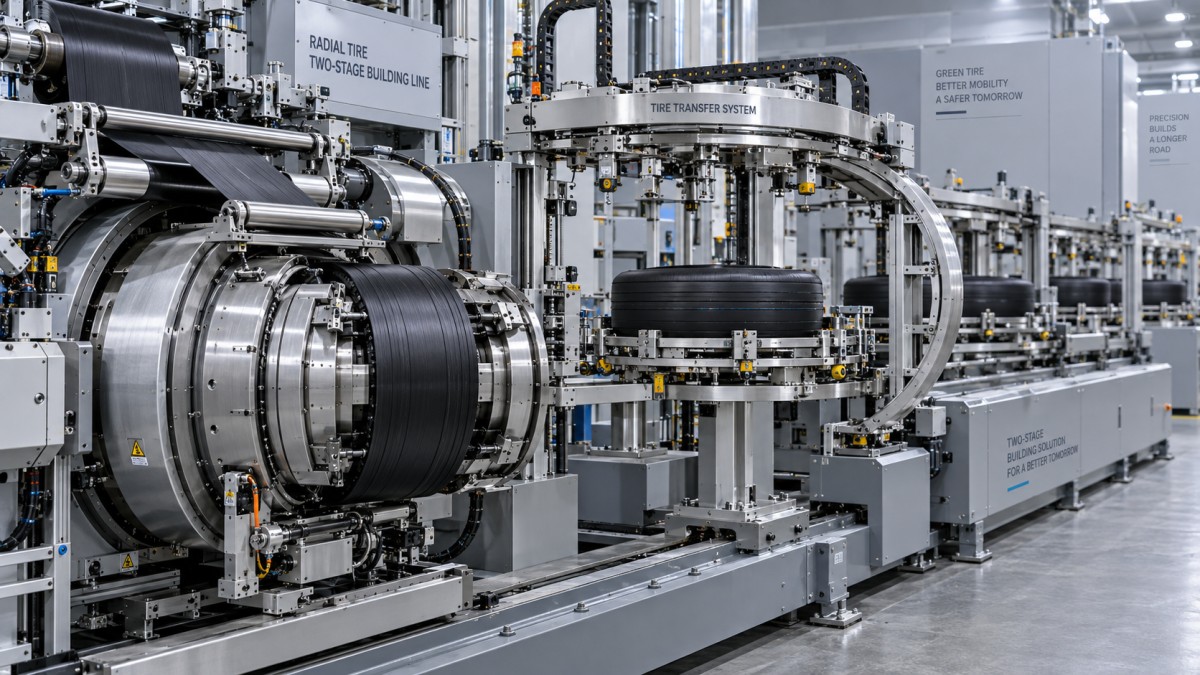
A two-stage configuration divides the work. The first stage forms the carcass, including the inner liner, body ply, sidewall and bead area. The second stage transfers or receives the carcass and combines it with the belt package and tread. This division creates more process independence, but it also introduces additional requirements for transfer accuracy, component identification, storage and synchronisation between the two stages.
The distinction is important because radial tyre quality is sensitive to the relationship between components, not only to their individual dimensions. Belt centring, splice quality, bead positioning, ply alignment and tread run-out can all be affected by the way the building stages are linked.
When a single-stage machine is the stronger choice
A single-stage tyre building machine is attractive when the plant values process integration and a compact material flow. Since more operations are completed in one coordinated system, there may be fewer intermediate handling points between carcass and final assembly. This can reduce the opportunity for handling damage or incorrect component matching, provided the machine’s control system and material feeding equipment are properly configured.
The main technical advantages are often found in:
- Integrated control of carcass shaping and belt/tread application;
- Reduced dependence on intermediate carcass storage;
- Compact layout compared with two independent building areas;
- Consistent recipe management when production is highly standardised;
- Better compatibility with automated component feeding and production tracking.
However, integration does not automatically mean higher productivity. The complete cycle is constrained by the slowest operation within the machine. If a belt package, bead application or shaping step requires more time, the entire line may wait. A fault in one integrated machine can also interrupt both carcass building and final assembly rather than affecting only one process area.
Single-stage equipment also requires careful evaluation of its product envelope. A machine configured for passenger car tyres may not readily accommodate a broad range of light truck, truck or specialty radial tyres without changes to drums, applicators, bead handling and software recipes. Product flexibility must be confirmed from actual component dimensions and process sequences, not inferred from a general machine description.
Where two-stage building provides an advantage
The two-stage approach separates the technical functions of carcass formation and belt/tread assembly. This can be valuable when the plant produces multiple tyre sizes or specifications with different production rhythms. Carcasses may be built in batches, buffered and supplied to the second stage according to downstream demand.
This separation can support:
- Independent balancing of carcass and final assembly capacity;
- More flexible scheduling for different tyre families;
- Inspection or controlled storage between the two stages;
- Phased investment, where capacity is expanded in one stage first;
- Maintenance work on one process without necessarily stopping the other.
The trade-off is additional material movement and coordination. Every transfer step creates a potential source of error. The carcass must be correctly identified, positioned and centred before belt and tread assembly. If the transfer unit, locating system or recipe control is not sufficiently accurate, the theoretical flexibility of a two-stage line can be offset by alignment defects and higher adjustment requirements.
Two-stage systems also need a more deliberate approach to work-in-process management. Buffer capacity, barcode or recipe tracking, carcass inspection criteria and production sequencing should be defined before equipment selection. Without these controls, the separation between stages can create waiting time rather than useful flexibility.
Quality evaluation should focus on repeatability
For radial tyre production, the key question is not whether a machine can apply each component. It is whether the machine can repeat the required position, tension and splice condition across the intended production range.
Technical evaluation should therefore examine:
- Component centring: How is the position of plies, belts, sidewalls and tread detected and corrected?
- Material tension: Can the feeding system maintain stable tension when material width, compound or gauge changes?
- Splice control: Are splice angle, overlap and cutting conditions controlled by recipe and verified during operation?
- Shaping accuracy: Does the machine maintain the required carcass geometry before belt and tread assembly?
- Bead positioning: Are bead placement and bead-to-bead dimensions controlled consistently for each specification?
- Inspection feedback: Can process data be linked to tyre identification and quality records?
In a single-stage system, these controls must work together within one continuous sequence. In a two-stage system, the evaluation must also include the interface between stages. A technically capable first-stage machine does not compensate for poor transfer repeatability, and an accurate second-stage machine cannot correct every dimensional error inherited from carcass building.
Automation and line integration
The building machine should be evaluated as part of the production system rather than as an isolated asset. Automatic material loading, splice preparation, bead setting, drum exchange, recipe selection, defect alarms and data collection can influence actual output more than the nominal machine cycle.
Single-stage equipment usually benefits from a unified control architecture, but this can make software integration and troubleshooting more specialised. Two-stage equipment offers more modular integration, although the plant must connect separate controls, material tracking systems and production schedules.
For either configuration, the supplier should clarify how recipe permissions, parameter changes, alarm history and production records are managed. A machine that depends heavily on manual adjustments may produce acceptable results during commissioning but become difficult to control across shifts and product changes.
Do not overlook upstream component consistency
Building accuracy depends on the quality and dimensional stability of the components supplied to the machine. Variations in calendered ply, inner liner or belt material can create feeding and centring problems that are incorrectly attributed to the building machine.
When reviewing a complete tyre manufacturing line, equipment such as a used_second hand Calender should therefore be assessed for output consistency, width control, gauge stability and compatibility with the building machine’s material specifications. A lower acquisition cost is meaningful only if the refurbished equipment can maintain the component tolerances required by the selected building process.
Total cost is more than machine price
A single-stage machine may reduce floor space and intermediate handling, but its integrated design can involve higher technical complexity and greater dependency on specialised service support. A two-stage line may require more equipment, operators or floor area, while offering more options for capacity balancing and product scheduling.
The cost comparison should include:
- Drums, applicators, transfer units and tooling required for the actual tyre range;
- Changeover time and the number of format-specific components;
- Operator skill requirements and training duration;
- Spare parts for mechanical, electrical and control systems;
- Energy use, compressed air and environmental requirements;
- Downtime impact when a major subsystem fails;
- Integration work for material handling, inspection and factory data systems;
- Availability of commissioning, calibration and long-term technical support.
Refurbished equipment can be considered when the mechanical platform is suitable and the control system, safety functions, tooling and documentation are brought into line with current production requirements. The evaluation should distinguish between a simple used-machine sale and a verified refurbishment involving inspection, replacement of wear parts, control upgrades and performance testing.
A practical selection decision
Choose a single-stage arrangement when the product range is controlled, the process benefits from continuous integration and the plant can support a complex unified control system. Choose a two-stage arrangement when product variety, scheduling independence, intermediate inspection or phased capacity planning has greater value than minimum floor space.
The final decision should be based on representative tyre specifications rather than a generic catalogue comparison. Request cycle-time calculations for the actual component set, confirm changeover procedures, review transfer accuracy where applicable, and define acceptance criteria for centring, splice quality, run-out and repeatability. A machine that appears faster on paper may not deliver better plant performance if it cannot maintain stable quality across the full production mix.