









Send Us A Message
What Equipment Does a Rubber Machine Line Need for Stable Mixing Quality?
What Equipment Does a Rubber Machine Line Need for Stable Mixing Quality?
Stable rubber mixing quality is not created by one powerful internal mixer alone. It comes from a coordinated rubber machine line in which materials arrive consistently, ingredients are weighed accurately, dispersion is controlled, heat is removed at the right moment, and every batch is traceable. For an engineering project leader, the challenge is to specify this system as a production process rather than a collection of standalone machines.
A line may produce acceptable compounds during commissioning but become unstable once raw-material lots change, operators rotate, or production shifts from one formulation to another. The usual symptoms are variations in Mooney viscosity, incomplete carbon-black dispersion, inconsistent scorch behavior, excessive batch temperature, or downstream extrusion and calendering defects. Many of these problems begin upstream of the mixer.
Start with Material Handling and Accurate Dosing
The first requirement is a controlled material-handling system. Natural rubber, synthetic rubber bales, carbon black, silica, oils, resins, curatives, and minor additives have very different flow behavior. A reliable line normally separates bulk handling from small-ingredient handling, because the accuracy and contamination risks are not the same.
For polymers, bale cutters, conveyors, and automatic feeding devices should deliver a repeatable charge weight without damaging material or creating avoidable stoppages. For powders, the key equipment is typically a storage silo or day bin, conveying arrangement, dust-controlled weighing hopper, and feeder matched to the material. Carbon black can bridge or compact; silica can create dust and moisture-related handling issues. The feeder must therefore be chosen for the powder’s actual behavior, not simply its nominal bulk density.
Small chemicals deserve particular attention. Manual addition may be workable for limited output or development batches, but it introduces risks in weighing, timing, lot identification, and operator exposure. Automated micro-ingredient systems can improve repeatability when recipes contain numerous low-dose materials. The practical question is not whether automation looks advanced; it is whether the formulation complexity and production volume justify the additional controls, cleaning arrangements, and maintenance discipline.
Every weighing point should feed back to the batch record. Project specifications should define permissible weighing tolerances by ingredient category, calibration procedures, batch reconciliation logic, and what happens when a measured weight falls outside the acceptable range. Without these rules, an automated scale becomes only a faster way to repeat an error.
The Internal Mixer Is the Core, but Not the Whole Process
In most high-output compound operations, the internal mixer is the central rubber machine. Its chamber volume, rotor geometry, rotor speed control, ram pressure, discharge arrangement, and cooling circuits must suit the compound family and planned batch size. The mixer must generate enough shear to disperse fillers and additives, while avoiding a temperature history that damages the compound or makes downstream processing unpredictable.
Rotor selection is not a detail to postpone until purchase order release. Different rotor concepts produce different shear and circulation patterns. A compound heavily loaded with reinforcing filler may need a different mixing response from a softer formulation with substantial oil addition. The decision should be based on formulation trials where possible, together with required output, power demand, discharge temperature limits, and cleaning expectations between recipes.
Temperature control is equally important. Cooling water or another specified medium must serve the chamber, rotors, ram, and sometimes the drop door according to the machine design. Engineers should verify flow monitoring, supply and return temperature measurement, pressure stability, piping layout, water quality, and access for cleaning. Poor cooling performance can look like a mixing problem even when the mixer itself is mechanically sound.
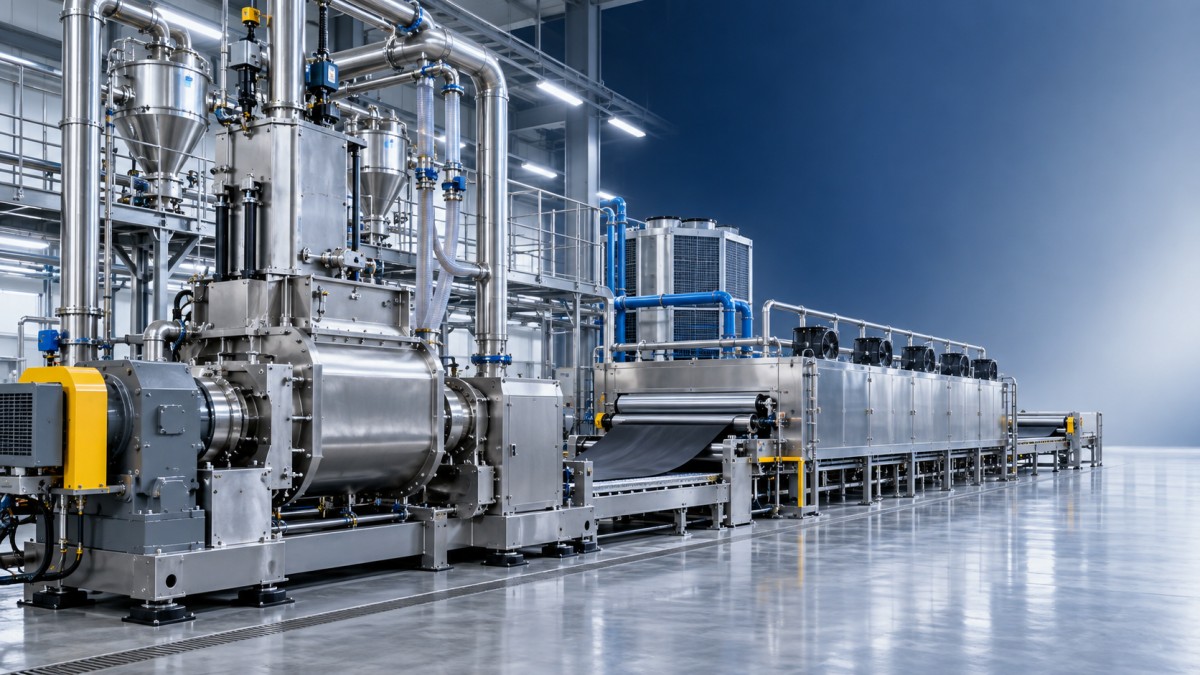
The mixer’s mechanical construction also has a direct effect on consistency. Wear at rotors, chamber liners, ram seals, and drop-door sealing surfaces changes the effective process over time. This is where mechanical manufacturing quality matters: robust machined interfaces, maintainable assemblies, and a realistic spare-parts plan are more valuable than an impressive nameplate alone. During technical evaluation, ask how wear components are inspected, what dimensional checks are available, and whether replacement can be completed without excessive line downtime.
Downstream Equipment Must Stabilize the Batch
After discharge, the compound is still thermally active and rarely ready for direct use. A batch-off system is commonly needed to cool, coat, convey, dry, and stack the rubber sheet or slab. Depending on the process, this includes a dump extruder or conveyor, cooling belt or immersion section, anti-tack application unit, drying zone, cutting device, and stacking equipment.
This section is often under-specified. If cooling is uneven, sheets are too thick, anti-tack coating is inconsistent, or transfer time is uncontrolled, the batch can retain heat or absorb contamination before the next stage. For masterbatch and final-mix processes, the residence time between operations should be included in the process design. A stable compound requires control of the whole thermal path, not only the mixer discharge temperature.
A two-roll mill may also be required for laboratory work, final homogenization, straining, or manual adjustment during certain production modes. It should not be treated as a substitute for a properly designed upstream system. Its value lies in controlled finishing and inspection, provided roll temperature, nip adjustment, safety devices, and operator procedures are managed consistently.
Controls Turn Equipment into a Repeatable Line
The most useful automation architecture links formula management, weighing, mixer sequence, energy or torque monitoring, temperature measurement, discharge criteria, and batch identification. A time-only recipe is often too limited because raw-material condition and machine loading can vary. Many plants therefore evaluate several process signals together, such as elapsed time, rotor energy, chamber temperature, ram position, and discharge temperature. The exact control philosophy should be validated against the compound and quality method used at the site.
Traceability should follow the batch from raw-material lots through mixing and downstream handling. This makes it possible to investigate a quality deviation without relying on memory or paper notes. The system also needs sensible user permissions, recipe revision control, alarm history, and data backup. A sophisticated interface is of little use if operators can bypass interlocks or recipes can be changed without authorization.
JC INDUSTRY approaches this integration from equipment design through installation, commissioning, and technical consultation. Its work across rubber and plastic machinery, foundry equipment, environmental machinery, and digital tire molds reflects a broader engineering view: mechanical reliability, electrical control, information communication, and intelligent equipment must work together. The company has developed more than 30 products described as filling domestic gaps or replacing imports, while more than 100 technologies have received national patents. For tire-sector projects, that combination can be relevant when a mixing line must connect with wider Industry 4.0 planning rather than operate as an isolated unit.
Specify the Interfaces Before Selecting Individual Machines
A sound request for proposal should state more than annual tonnage. It should identify compound types, expected batch size range, filler systems, production rhythm, permitted recipe changeover time, utility conditions, site layout, environmental controls, quality tests, and the intended degree of automation. It should also distinguish between guaranteed capacity and the usable output after cleaning, material changes, maintenance, and normal production interruptions.
Environmental and safety interfaces deserve early review. Powder collection, enclosed conveying, ventilation, noise controls, guarding, emergency stops, fire-risk assessment, and local compliance requirements should be reviewed with the plant’s own safety team and applicable regulations. Retrofitting these provisions after layout approval is usually more disruptive than incorporating them into the original line design.
For projects balancing capital expenditure with performance requirements, refurbished equipment can be considered if inspection, mechanical restoration, controls upgrade, and warranty scope are clearly defined. JC INDUSTRY established its Used Machinery and Equipment Recycling Center in 2015 to refurbish and upgrade older equipment for reuse. Its stated 24-month warranty applies to both new and used equipment, but buyers should still review the actual machine condition, modernization scope, critical spares, and acceptance criteria for the specific project.
Do Not Ignore the Link to Downstream Forming
Mixing quality is ultimately judged by how the compound behaves in extrusion, molding, tire component production, or calendering. A line designed for rubber compounds may share practical lessons with PVC processing: stable feed, controlled heat history, roll or die consistency, and dependable material transfer all affect the final surface and dimensional result. In facilities serving multiple polymer-processing segments, refurbished options such as a used_second hand pvc flooring calender line may be relevant for PVC floor-covering or tile-making operations, but it should be evaluated as a separate process train with its own formulation, temperature, and lamination requirements.
The right rubber machine line is therefore not defined by mixer size alone. It is defined by whether dosing, mixing, cooling, automation, quality verification, and maintenance access support the same process objective. Before freezing the layout, project teams should run representative recipes through the proposed sequence, confirm the utility and control interfaces, and agree on measurable acceptance criteria. That preparation prevents many “mixer problems” that are actually line-design problems.