









Send Us A Message
When is a conveyor-fed bale cutter worth the extra investment?
When is a conveyor-fed bale cutter worth the extra investment?
A conveyor-fed bale cutter is worth the extra investment when measurable operating savings outweigh its higher purchase and integration costs. For rubber-processing equipment, the decision hinges on labor requirements, sustained throughput, downtime, and total cost of ownership—not automation alone. Will conveyor feeding remove a genuine production bottleneck, or simply add capacity the line cannot use?
The distinction matters in capital equipment purchasing. A conveyor can reduce repeated bale handling and keep material moving toward the cutting position, but it does not automatically increase cutting force, shorten every cutting cycle, or eliminate operator intervention. The financial case must reflect the complete workflow rather than the machine’s advertised output.
Find out whether feeding is actually the constraint
Start by observing a representative production shift. Separate time spent loading and positioning bales from cutting, removing cut material, changing batches, and waiting for downstream equipment. If operators spend substantial time moving bales into position while the cutter stands ready, conveyor feeding addresses a plausible source of lost capacity.
The opposite situation is equally important. When the hydraulic cutting cycle sets the pace, or the mixer regularly stops accepting material, faster feeding may produce little additional saleable output. A conveyor might still reduce handling effort, but that is a different investment justification.
Map the route from bale storage through wrapper removal, loading, cutting, discharge, and downstream transfer. Identify who performs each task and where material accumulates. A feeding conveyor does not necessarily automate unloading or remove the need for batch identification.
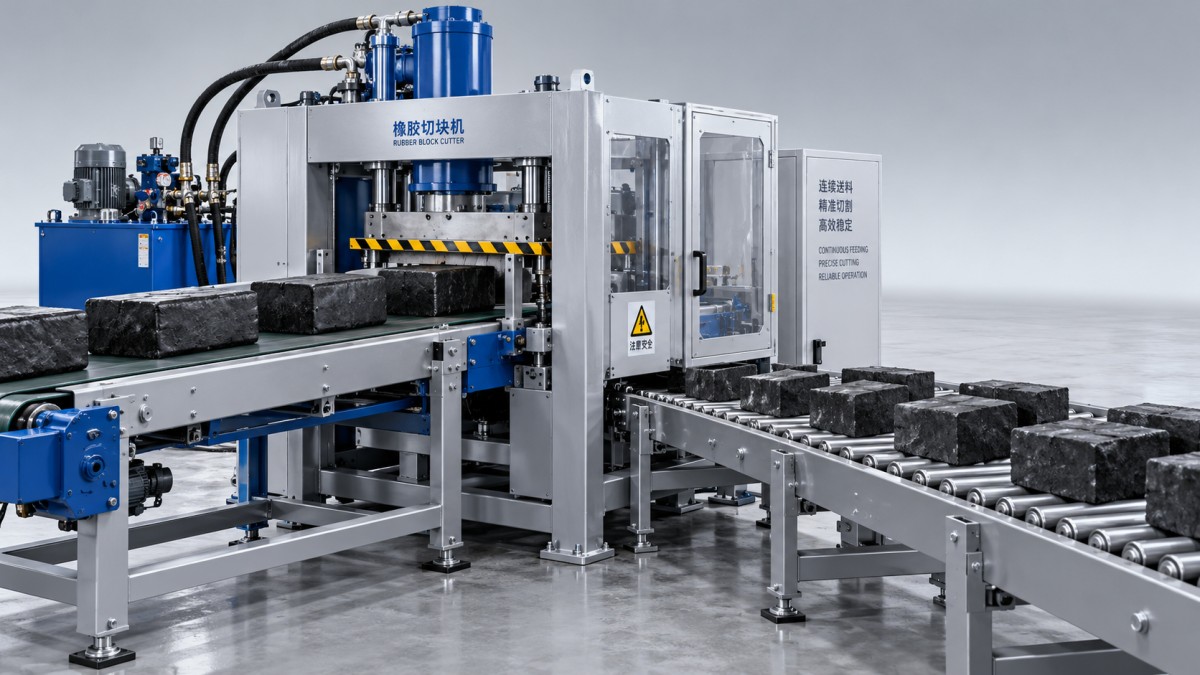
Scope also needs clarification: the bale cutter discussed here prepares rubber bales, not metal scrap. Buyers familiar with metal-processing machinery should avoid transferring assumptions about feedstock, cutting forces, or tool wear between these applications.
Compare the installed premium with realizable savings
Request comparable quotations for manual-feed and conveyor-fed configurations. Both should cover the same bale range, cutting requirements, guarding expectations, and acceptance conditions. Otherwise, the apparent automation premium may conceal differences in the base machine.
The incremental investment should include freight, installation, electrical work, guarding, control integration, commissioning, training, and production disruption. Floor-space changes and access for maintenance can also affect the installed cost.
Simple payback = incremental installed investment ÷ annual net operating benefit.
Annual net benefit should combine realizable labor savings, avoided overtime, and contribution from additional saleable production, then subtract added energy, maintenance, and other recurring costs. Keep the categories separate:
- Labor: Count paid hours genuinely removed or overtime avoided. Reassigned staff may create useful capacity elsewhere, but that is not automatically a payroll saving.
- Throughput: Value additional output only when downstream capacity and customer demand can absorb it. Use contribution margin rather than sales revenue.
- Downtime: Credit reduced feeding delays only where operating records support them. Include possible conveyor stoppages and recovery time.
- Maintenance: Allow for conveyor wear parts, drives, sensors, alignment work, and spare-parts holdings.
Avoid counting the same recovered production time twice as both labor savings and throughput benefit. For longer-lived projects, supplement simple payback with discounted cash flow using the company’s approved assumptions.
Ask for a production trial, not just a cycle-time demonstration
A short demonstration with uniform bales can conceal handling difficulties. Ask suppliers to test representative materials across the intended bale dimensions, weights, grades, and storage conditions. Confirm whether wrapping must be removed before loading and whether sticky or distorted bales need manual repositioning.
Measure accepted cut material over the full test period, including replenishment, interruptions, and discharge. Record operator involvement as well as output. “One operator” is not a useful comparison unless that person’s loading, monitoring, clearing, and transfer duties are defined.
The trial should also show how the system responds to a downstream stop, mispositioned bale, or interrupted feed. Review guarding, interlocks, emergency stops, restart behavior, and isolation procedures against applicable site and local requirements. Conveyor feeding can reduce some manual handling while introducing nip points and additional stored-energy hazards.
Do not confuse local automation with line capacity
For manufacturers of steel-reinforced conveyor belts, rubber preparation is only one part of a longer production chain. Equipment such as JC INDUSTRY’s Steel cord conveyor belt curing press line uses PLC control, hydraulic systems, and precision tensioning for belt manufacture. It is a separate process stage, not a bale-cutting alternative.
That distinction has financial consequences. If mixing, belt building, or curing limits output, a faster cutter may improve preparation scheduling without increasing finished-belt production. Any proposed control interface or coordinated operation needs a defined engineering scope; shared use of PLC technology does not establish compatibility.
A refurbished option changes the comparison
The choice need not be limited to a new manual-feed machine versus a new automated system. A suitably refurbished cutter may preserve capital, provided its condition, controls, safety provisions, and feed-system compatibility are verified.
JC INDUSTRY combines machinery research, design, manufacture, installation, commissioning, and consultation across foundry, rubber, plastics, and environmental equipment. Its Used Machinery and Equipment Recycling Center, established in 2015, refurbishes and upgrades equipment for resale. The company states that both new and used equipment carry a 24-month warranty.
For an approval package, convert those capabilities into contractual detail: inspection findings, replaced components, hydraulic condition, controls support, acceptance criteria, and warranty exclusions. Confirm when coverage starts, whether site labor and travel are included, and how replacement parts will be supplied. A warranty period alone does not establish equivalent condition or performance.
Approve the upgrade only if the conservative case works
Conveyor feeding is most persuasive where repetitive loading consumes recoverable paid time, demand supports sustained operation, and downstream equipment can use the improved feed rate. Manual feeding may remain financially sound for intermittent production, frequent material changes, or a line constrained elsewhere.
Before approval, test lower utilization, smaller labor savings, and longer maintenance interruptions. Require a written scope and acceptance test tied to actual material. If the investment meets the company’s return threshold under those conditions, the premium has a defensible basis. If it works only at maximum quoted throughput, resolve that uncertainty before committing capital.