









Send Us A Message
Can a used calender produce rubber sheet to your required thickness?
A used calender can produce rubber sheet at a required thickness, but its suitability depends on more than the nominal roll gap. Roll condition, gap adjustment accuracy, bearing wear, temperature control, compound properties and operating speed all affect thickness consistency. For technical evaluators, the decision should rest on an inspection of the machine and, wherever practical, a production trial using material and settings representative of the intended application.
The important question is not simply whether the rolls can be set to a particular opening. It is whether the machine can maintain acceptable sheet thickness across the width and throughout a production run, under the conditions in which it will actually operate.
Define the thickness requirement before assessing the machine
A target thickness alone is not enough to specify a calender. A sheet intended for a subsequent forming operation may tolerate different variation from one used directly in a finished product. Before comparing machines, document the nominal thickness and its permitted tolerance, finished sheet width, compound formulation, expected output and operating speed range.
Also define how the sheet will be measured. Specify the measuring instrument, measurement positions, sample frequency and the point at which readings will be taken. Rubber can recover or shrink after leaving the rolls, and its temperature can affect the measurement. A setting that looks correct at the nip may therefore produce a different result once the sheet has cooled or been handled downstream.
Separate two requirements that are often grouped together: thickness profile across the sheet and thickness variation along its length. The first can reveal roll deflection or alignment issues; the second may point to changing feed, temperature, speed or mechanical instability. Both need to be considered when setting acceptance criteria.
What determines the achievable thickness on a used calender?
Calendering forces deform the rolls and supporting structure during operation. The actual working gap is consequently influenced by the compound and load, not just the value shown on the adjustment mechanism. A machine with a suitable nominal gap range may still struggle to hold the required profile with a particular rubber compound or sheet width.
Roll geometry and surface condition
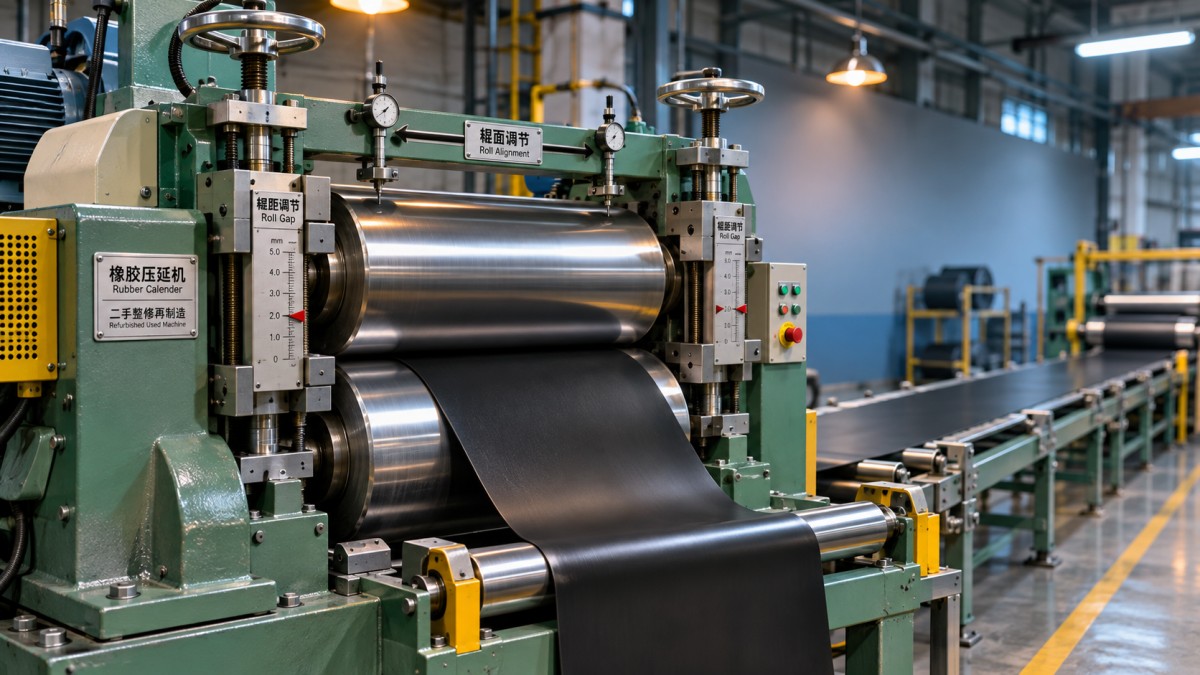
Inspect the roll surfaces for scoring, corrosion, local damage and signs of uneven wear. Ask for measurements of diameter, roundness, runout and profile, including the condition of any designed roll crown. A crown that was appropriate for the previous application is not automatically appropriate for a new one.
Grinding can restore a damaged surface, but it is not a universal cure. Material removal changes roll dimensions and may affect the profile or remaining service life. If regrinding is proposed, request the intended profile and confirmation that the finished dimensions remain within the manufacturer’s limits.
Bearings, alignment and gap adjustment
Worn bearings, excessive clearance or damaged bearing housings can allow roll movement under load. Check the condition of the bearing assemblies, lubrication arrangements and evidence of abnormal heat or vibration. Inspect frames and housings for cracks, distortion and previous repairs that could affect alignment.
Then examine the gap adjustment system: screws, gears, actuators, position feedback and any hydraulic components fitted to the machine. Look for backlash, uneven movement and difficulty returning to a previous setting. A display with fine increments is useful only if the mechanical system can respond consistently and the indicated position has been calibrated.
Temperature and compound behavior
Roll temperature affects rubber flow, sticking and sheet appearance. Check the condition of heating and cooling passages, rotary joints, controls and temperature sensors. Blocked passages or uneven thermal control can make a thickness profile difficult to correct, even when the mechanical gap appears sound.
Compound viscosity, temperature, feed preparation and bank stability also matter. A test with a soft, easy-running material does not establish performance with a more demanding production compound. Likewise, a satisfactory result at low speed may not represent behavior at the intended operating rate.
Use a production trial to reduce uncertainty
The strongest evidence is a witnessed trial with the intended compound, or an agreed representative material, at the target sheet width and a relevant speed. If the supplier cannot reproduce every production condition, record the differences and treat the outcome accordingly rather than assuming the results will transfer unchanged.
Agree on the procedure before the trial begins. The following checks turn a demonstration into useful purchasing evidence:
- Record compound identification, feed condition, roll temperatures, speed, gap settings and stabilization time.
- Measure thickness at agreed positions across the usable sheet width, including locations near both edges and the center.
- Repeat measurements along the sheet after the process has stabilized, using a calibrated instrument and a consistent method.
- Compare results with the agreed tolerance and note visible defects such as marks, waviness or edge irregularities.
- Observe whether the operator can reproduce the setting after an adjustment, stop or restart, if those checks are part of the acceptance plan.
Keep the raw readings as well as the average. An average close to the target can conceal thin edges, a heavy center or intermittent variation. If the sheet is to be cooled, wound or processed further, consider checking it after those stages too; downstream handling can influence the final measured thickness.
What refurbishment should cover
A freshly painted machine may look reassuring, but appearance does not establish its condition. Request an itemized scope identifying what will be inspected, repaired, replaced and tested. Depending on the findings, work may include roll grinding, bearing replacement, gap mechanism repair, temperature-control servicing or electrical upgrades.
Ask for pre- and post-refurbishment measurements where available, along with drawings, maintenance information and a list of replaced parts. Confirm the condition and availability of safety functions, guards, emergency stops and controls, and assess compliance with the requirements applicable at the installation site. Refurbishment can improve a machine substantially, but its performance must still be demonstrated against the buyer’s own acceptance criteria.
JC Industry’s used machinery and equipment recycling center refurbishes, upgrades and resells equipment. For an evaluator, the useful next step is to discuss the proposed machine’s inspection findings and trial conditions rather than relying on a general description of refurbishment. JC Industry offers a 24-month warranty for new and used equipment; buyers should review its written terms, coverage and service arrangements before purchase.
Keep the wider production line in view
A calender’s result is only one part of a sheet or coated-material process. Upstream mixing and feeding, as well as downstream cooling, tension and winding, can all affect the material delivered to the next operation. Equipment should therefore be selected as a line, with interfaces and operating ranges checked together.
For a different application, such as PU/PVC synthetic leather or fabric coating, process needs may extend beyond rubber-sheet calendering. The Wet type PU coating line STENTER is designed for wet coating processes, with configurable fabric preparation, coagulation and washing stages. Its role should not be confused with that of a rubber calender: suitability depends on the coating material, substrate and complete process requirements, including solvent handling.
Ultimately, a used calender is a sound candidate when its verified mechanical condition, controls and trial results support the specified thickness tolerance at the required width and operating conditions. If evidence is missing, make the outstanding inspection or trial a condition of the decision. That is a more dependable basis for purchase than the machine’s age, appearance or stated gap range alone.