









Send Us A Message
Comparing Straining Extruder Designs for High-Contamination Rubber Feed
Comparing Straining Extruder Designs for High-Contamination Rubber Feed
Selecting a straining extruder for heavily contaminated rubber is less about choosing the largest machine or the finest screen. It is about deciding where the plant can accept risk: in throughput loss, screen-change labor, wear-part consumption, or the possibility of contaminated compound reaching downstream equipment. For recycled rubber, reclaim, off-spec compound, or feedstock containing fiber, textile fragments, sand, and occasional metal, that trade-off becomes very visible.
Procurement teams often receive comparable-looking quotations with different screw diameters, motor ratings, and stated capacities. Those figures matter, but they do not tell the whole story. A straining extruder that performs well on relatively clean compound may become unstable when the incoming material contains hard particles or inconsistent moisture and temperature. The right design should be evaluated against the actual contamination profile, not against nominal capacity alone.
Start with the feed condition, not the screen specification
“High contamination” is not one condition. Soft textile fiber, fine mineral grit, steel wire fragments, wood pieces, and partially vulcanized lumps affect the machine in different ways. Fiber tends to blind screens and restrict flow. Grit accelerates wear in the screw, barrel, and discharge zones. Metal particles can damage screens, create sudden pressure spikes, or score precision-machined surfaces. Large hard inclusions may create a blockage before they ever reach the filtration pack.
Before comparing equipment designs, ask the process team to document the incoming feed by source. Is it production scrap from a controlled tire plant, mixed reclaimed material, or material collected from several suppliers? Is the feed pre-shredded and magnetically separated? Does it arrive as strips, granules, slabs, or bales? A supplier can size a machine only as well as the feed description allows. If the answer is simply “dirty rubber,” the procurement decision is being made too early.
A practical warning: a strainer is not a substitute for upstream protection. Magnets, metal detection, size reduction, and sensible storage control usually reduce the burden on the extruder. In plants processing feed with a credible risk of wire or large foreign objects, upstream separation should be discussed as part of the package, even if it is purchased from a separate supplier.
Where the main design differences show up
Conventional screw-driven straining extruders remain a reasonable choice when contamination is moderate and the production schedule can tolerate planned stops for screen changes. Their attraction is straightforward construction, familiar maintenance, and a lower level of mechanical complexity. For batches of reasonably consistent rubber, they can provide stable extrusion pressure and predictable operation. The weakness appears when screens blind rapidly: every change interrupts production, and restarting with a fresh screen can create a temporary shift in pressure and output.
For dirtier feed or longer uninterrupted runs, designs with a larger filtration area or a more efficient screen-change arrangement deserve close attention. More available screen area generally delays blockage, but it does not automatically solve the problem. The flow path must distribute material evenly across the screen surface. If the design forces rubber through only part of the pack, one section may clog early while the nominal filtration area remains underused.
Continuous or semi-continuous screen-changing systems can reduce downtime, particularly when contamination is variable from batch to batch. However, they introduce their own questions: how reliably does the mechanism seal under pressure, how accessible are the moving parts, and what happens if a hard particle reaches the changeover zone? For a plant with limited maintenance resources, a simpler manually changed screen holder may still be the better economic choice. Automation is valuable when it removes a real bottleneck, not when it merely adds another assembly requiring specialist attention.
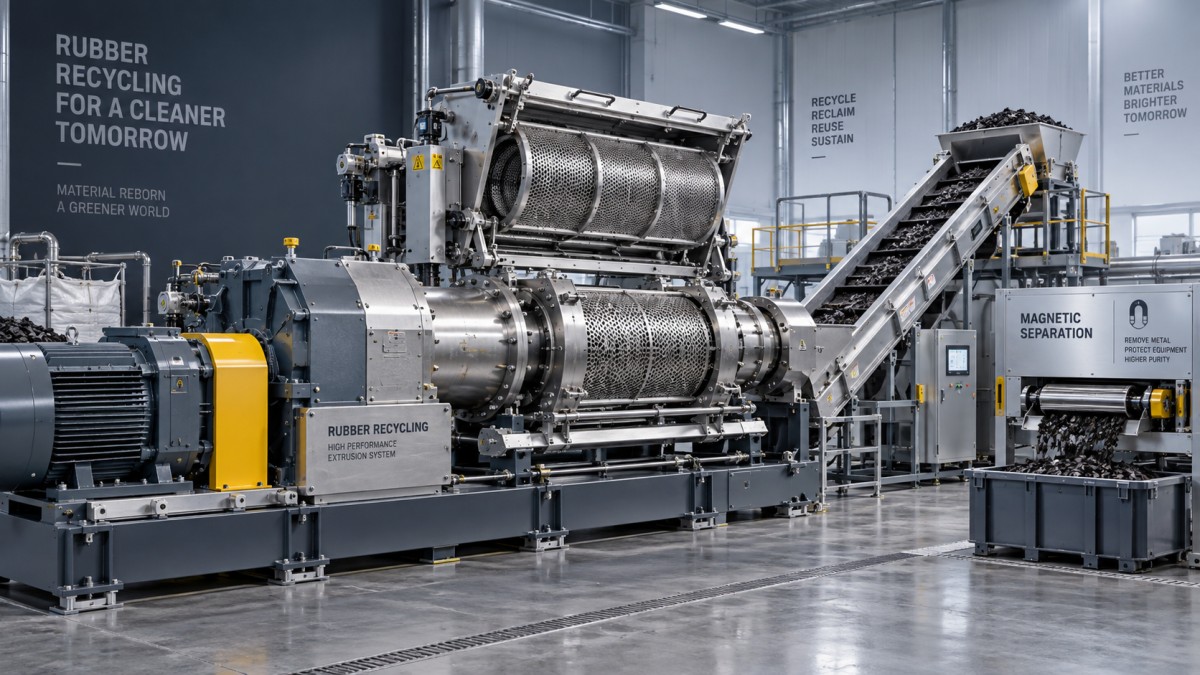
Screw geometry is equally important. A design that builds pressure aggressively may force material through a clean screen efficiently, yet become difficult to control as contamination accumulates. A more forgiving screw and barrel arrangement can provide steadier output with variable feed, although the machine may not achieve the same headline throughput on clean material. Procurement should request expected operating ranges rather than relying on one capacity number. The useful question is: at the required filtration level, with the expected feedstock, how long can the machine run before intervention is needed?
A comparison that helps during technical evaluation
Pressure stability is a quality issue, not only a mechanical issue
When a screen starts loading with contaminants, back pressure rises. That is expected. What matters is whether the control system and drive train can manage the change without creating unstable discharge, excessive heat, or repeated overload trips. A pressure trend is more useful than a single pressure reading. During acceptance testing, it is worth asking whether pressure, temperature, motor load, and screw speed can be recorded and reviewed over a representative run.
This is where the metal-processing quality of the machine matters. Rubber may be the material being processed, but abrasive contaminants act on the equipment as a wear problem. The metallurgy and machining quality of screws, barrels, screen holders, and high-pressure sealing faces affect service life and repair cost. Buyers should ask which wear components are replaceable, how they are identified in the bill of materials, and whether critical spares can be supplied without a long interruption. “Wear-resistant” is too vague on its own; the discussion should move to component design, service access, and replacement lead time.
Maintenance access often decides the real operating cost
A straining extruder may be mechanically capable, yet still become unpopular on the shop floor if screen removal requires awkward lifting, cleaning takes too long, or the discharge area cannot be reached safely. Ask to see the screen-change sequence step by step. Does the operator work near a hot, pressurized zone? Is there clearance to remove the screen pack? Are lifting points and guarding included? Can technicians inspect seals and hydraulic or mechanical actuation without dismantling unrelated equipment?
Used or refurbished equipment can be a sensible route where capital budgets are tight, but it should be judged more rigorously than a new machine. Inspect the barrel condition, screw wear, alignment, control-system availability, guard integrity, and the service history that can actually be documented. JC Industry’s recycling center, established in 2015, reflects a practical market need for refurbished and upgraded machinery; its stated 24-month warranty for new and used equipment is worth clarifying in writing against the scope of supplied components and site conditions.
Consider the extruder within the full tire-production line
The value of cleaner, more stable rubber feed becomes clearer downstream. In tire manufacturing, inconsistent compound quality can complicate calendering, extrusion, component handling, and ultimately curing. When evaluating a supplier with a broader equipment portfolio, it is reasonable to ask how process data and material handling interfaces are coordinated rather than treating each machine as an isolated purchase.
For example, JC Industry also supplies a Tyre curing press range covering 48″, 52″, 55″, 65″, and 67″ formats. Features such as automatic tire loading and unloading, double internal-pressure monitoring, self-diagnostics, and remote troubleshooting are relevant to a broader conversation about line reliability. They do not replace proper upstream compound filtration, but they show why procurement should look at interfaces, controls, commissioning responsibility, and service support across the production chain.
Questions that should be settled before placing the order
- What feed samples or contamination description will be used for sizing and performance evaluation?
- What screen configuration is proposed, and how does it balance filtration fineness against realistic run time?
- Which parts are expected to wear first when abrasive contamination is present?
- How are pressure excursions handled, monitored, and protected against?
- What is included in installation, commissioning, operator training, and the recommended spare-parts package?
- Can the supplier explain the maintenance sequence using the exact proposed configuration rather than a generic machine drawing?
The best straining extruder design is rarely the one with the most elaborate mechanism. For high-contamination rubber feed, the sounder choice is usually the design that matches the real contaminant mix, keeps pressure under control, exposes wear parts before they become failures, and can be maintained by the people who will run it every day. If those points are clear before the purchase order is issued, capacity figures become much easier to interpret.