









Send Us A Message
How Belt Building Machines Control Ply Alignment During Conveyor Belt Making
How Belt Building Machines Control Ply Alignment During Conveyor Belt Making
Ply alignment is not a cosmetic detail in conveyor belt manufacturing. When a fabric or steel-cord layer enters the building stage off-center, at an angle, or under uneven tension, the effect can remain hidden until the belt is cured, slit, or placed into service. The result may be poor belt tracking, irregular edge geometry, non-uniform load distribution, and premature fatigue around splices or transition zones.
A belt buidling machine is therefore judged less by its headline speed than by how consistently it positions each ply under real production conditions. Material rolls vary. Cord packages do not unwind identically from one batch to another. Operators change shifts. Adhesive-coated layers can respond differently to temperature and storage time. A capable machine must absorb these normal variations before they become a dimensional defect in the finished belt.
Alignment Begins Before the Ply Reaches the Building Drum
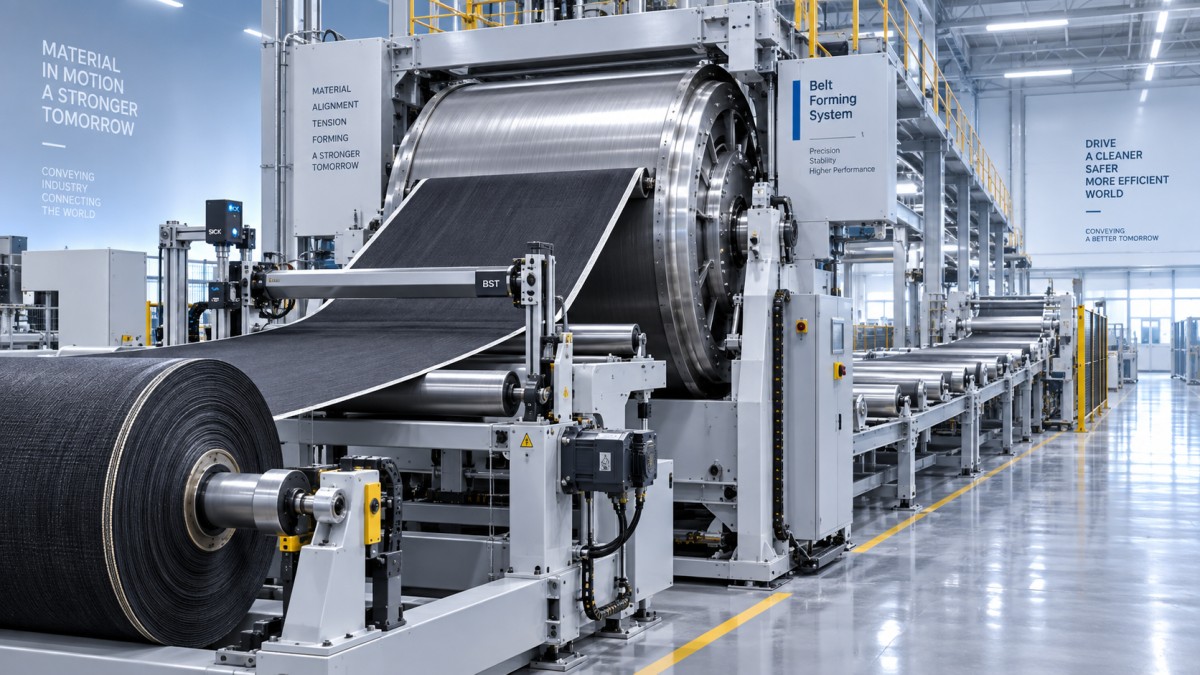
The most reliable alignment strategy starts at the unwind. A ply cannot be corrected properly at the drum if it has already wandered across multiple guide rollers or developed uneven edge tension. For this reason, modern conveyor belt building lines typically combine a stable unwinding frame, controlled braking or driven payoff, edge sensing, and a web-guiding actuator.
The sensor may detect the physical edge of the fabric, a printed reference line, or another defined feature in the material. Its function is simple: identify lateral drift early. The difficult part is tuning the response. An over-sensitive guiding loop can create constant small corrections, making the ply “hunt” from side to side. A slow loop may allow the material to move too far before correction. During technical evaluation, it is worth asking how the machine supplier sets response limits for different fabrics, cord constructions, and roll widths.
For steel-cord conveyor belts, alignment is especially demanding because lateral movement can affect cord spacing and edge cover symmetry. Fabric plies are more forgiving in some respects, but they can stretch or skew if the line pulls harder on one side. The control system must distinguish between simple lateral offset and material distortion. Those are not the same fault, and they should not receive the same correction.
Tension Control Prevents the “Straight but Wrong” Ply
A ply can look centered while still being improperly aligned. This happens when one side is under more tension than the other. The layer may arrive at the drum with a slight diagonal pull, creating skew as it is laid down. On a long conveyor belt, even a modest angular error can become significant across the full width.
A properly designed building machine controls tension through a combination of load measurement, dancer-roll movement, servo synchronization, and closed-loop drive regulation. The exact arrangement depends on the belt design and production architecture, but the objective remains constant: keep the ply stable without stretching it beyond its intended condition.
Technical teams should not treat tension as one universal setpoint. Different reinforcement materials require different handling windows. A light textile carcass can be affected by excessive tension or aggressive acceleration. A heavier steel-cord layer may demand greater control authority during starts, stops, and direction changes. A useful acceptance test is to observe alignment during transient conditions rather than only at steady speed. Many machines look accurate when running continuously; the more revealing moment is when the line decelerates, indexes, or resumes after a stoppage.
Building Drum Positioning and Reference Logic
Once the ply reaches the building station, drum geometry and reference logic take over. The machine needs a repeatable centerline from which it can position every reinforcement layer, rubber component, and edge strip. Depending on the process, this may involve a fixed drum, expandable drum, moving carriage, or automated lay-up table. What matters is that the control system knows where the material is relative to the product datum—not merely where it is relative to a nearby roller.
Servo-driven carriage systems are commonly used to place plies at programmed positions. Their value is not only speed. They reduce dependence on manual measuring and allow the machine to apply different offsets for different belt constructions. For example, a production recipe may define specific positions for a carcass layer, breaker layer, edge reinforcement, and cover stock. If an operator must manually compensate for each variation, repeatability will eventually suffer.
However, automation does not eliminate the need for mechanical discipline. Drum runout, worn bearings, roller contamination, and loose guide assemblies can undermine even an advanced servo system. Evaluators should inspect how easily critical alignment points can be checked and recalibrated. A machine that is accurate only immediately after installation is not necessarily a stable production asset.
Vision, Sensors, and Operator Verification Work Best Together
Intelligent monitoring has improved the ability to detect ply offset before the belt moves into the next process. Camera systems, laser references, edge sensors, encoder feedback, and PLC-based alarms can all contribute. Still, the practical question is whether the system provides actionable information. An alarm that simply states “alignment fault” is less useful than one that identifies the layer, measured deviation, correction status, and likely mechanical source.
A sensible system keeps a record of position and tension trends by recipe or production batch. This helps maintenance teams identify recurring drift caused by a particular unwind stand, guide roller, or material format. It also prevents operators from repeatedly correcting a symptom without addressing the cause. In conveyor belt making, operators remain important because they can notice wrinkles, trapped air, skewed cord appearance, or adhesive behavior that a basic edge sensor may not recognize.
The broader principle applies across rubber and plastic sheet handling. On equipment such as a Pvc flooring calender line, stable roll alignment, controlled tension, and responsive electrical control are similarly necessary to form uniform sheet products. The materials and end uses differ, but the engineering lesson is familiar: accurate downstream forming depends on disciplined upstream web handling.
What to Check When Evaluating a Belt Building System
When comparing a belt buidling machine, technical reviewers should look beyond a supplier’s stated positioning accuracy. That figure may describe a single axis under ideal conditions rather than the complete material-handling process. The more useful review focuses on how the machine maintains alignment across a production shift.
- How are ply edges detected, and can the sensing method be changed for different materials?
- Is tension measured directly, inferred from drive load, or controlled only through preset settings?
- What occurs during acceleration, emergency stops, roll changes, and manual intervention?
- Can the recipe define independent offsets and tension parameters for each ply?
- Are alignment trends, alarms, and operator adjustments recorded for traceability?
- How accessible are rollers, sensors, bearings, and calibration points during maintenance?
These questions matter because alignment faults are often cumulative. A small lateral error in one layer can force an operator to compensate on the next. By the time the belt is complete, the nominal centerline may be preserved while internal symmetry has been compromised.
Equipment Stability Is a Lifecycle Issue
For manufacturers evaluating new, upgraded, or refurbished equipment, the controls architecture should be reviewed alongside the machine frame and mechanical condition. JC INDUSTRY works across foundry, rubber and plastic, environmental machinery, and digital tire mold equipment, with capabilities spanning design, manufacture, installation, commissioning, and technical consultation. Its focus on electronic control and intelligent equipment reflects a practical reality: mechanical strength alone cannot guarantee consistent material placement.
Refurbished machinery can be a reasonable option when the frame, drums, drives, and safety systems are properly assessed and when obsolete control components can be upgraded. Yet a lower initial price should not distract from sensor availability, PLC support, spare-part compatibility, and the condition of moving alignment assemblies. JC INDUSTRY’s used machinery and equipment recycling service includes refurbishment and upgrading, with a stated 24-month warranty for both new and used equipment. For an evaluator, the relevant next step is still a technical review of the specific machine scope, inspection records, control retrofit content, and acceptance criteria.
Good ply alignment is rarely the result of one sensor or one servo axis. It comes from a coordinated system: stable unwinding, balanced tension, reliable references, controlled lay-up motion, and maintenance practices that preserve calibration. If one of these elements is weak, operators will spend their shifts compensating. If they work together, the building process becomes far more predictable—and that is what protects conveyor belt quality before curing ever begins.