









Send Us A Message
How to Select a Reclaimed Rubber Machine for Different Scrap Feedstocks
Choosing a reclaimed rubber machine is not a matter of simply matching a machine to a target tonnage. The same production line can perform very differently when fed tire buffings instead of whole truck tires, or clean uncured compound instead of mixed industrial rubber waste. For a technical evaluator, the central question is practical: can the selected process handle the actual variability of the incoming material while still delivering reclaimed rubber with stable properties?
That question affects everything downstream—pre-treatment, grinding, devulcanization, filtration, odor control, energy use, wear parts, and the consistency expected by mixing or molding operations. A line that looks economical on paper may become difficult to operate if the feedstock contains steel, textile, moisture, incompatible polymers, or large swings in particle size.
The best selection process therefore begins with the scrap itself, not with the machine brochure.
Start with a feedstock audit, not a capacity target
Before comparing reclaimed rubber machine configurations, document what enters the facility over a representative period. “Waste tire rubber” is too broad a description for equipment selection. Technical teams should identify rubber type, source, contamination, dimensions, and seasonal variation. A feedstock audit should answer the following:
- Is the material whole tire, tread buffing, tire bead, molded scrap, conveyor belt, hose, gasket waste, or uncured compound?
- What proportion of steel wire, textile fiber, dust, sand, packaging, wood, or other non-rubber contaminants is present?
- Are NR, SBR, BR, NBR, EPDM, butyl, silicone, or mixed compounds involved?
- How consistent are the incoming lots in terms of moisture, particle size, and source?
- What final use is planned for the reclaimed rubber: tire compounds, mats, footwear, molded goods, asphalt modification, or lower-grade rubber products?
Capacity should be calculated only after this review. A nominal throughput rating based on clean, pre-shredded crumb cannot be directly applied to bulky, wire-containing tires or heavily contaminated industrial residues.
Whole tires require a robust front end
Whole passenger, truck, and agricultural tires demand the most complete preparation stage. Their rubber is compounded for durability, but the physical structure includes bead wire, reinforcing steel, textile cord, and thick sections that do not feed evenly into fine-processing equipment.
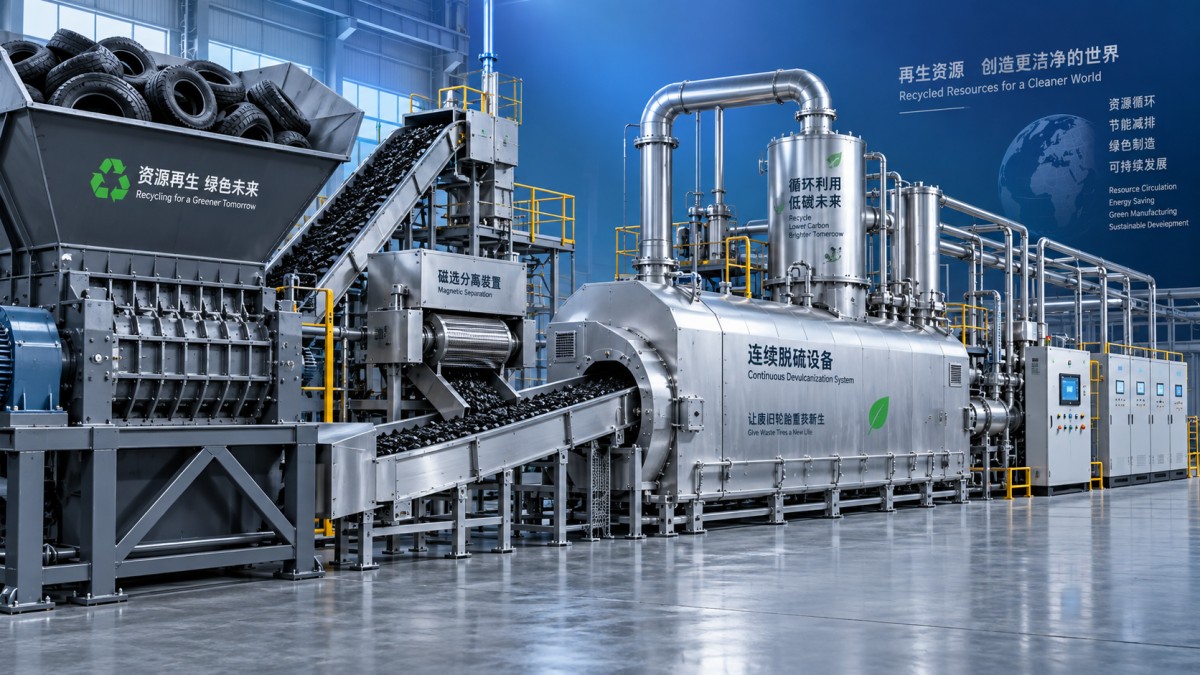
For this material, the reclaimed rubber machine should usually be part of an integrated line: primary shredding, bead or steel separation, secondary granulation, magnetic separation, fiber removal, screening, and controlled feeding into the reclaiming section. The size reduction system must be selected for the tire geometry and construction, not merely the nameplate motor power.
Agricultural tires deserve separate attention. Their larger section thickness, strong carcass construction, and field contamination can increase cutter loading and accelerate wear. When evaluating recycling potential from heavy-duty tractor and machinery tire streams, materials such as AGRICULTRIAL tire tyre illustrate why feedstock origin matters: durable tire construction is valuable in service, yet it also calls for deliberate shredding, separation, and cleaning decisions at end of life.
For whole-tire feedstock, assess the following equipment details:
- Rotor and knife design for thick and reinforced rubber sections
- Magnetic separation stages and the accessibility of magnets for cleaning
- Fiber separation efficiency before fine grinding or reclaiming
- Buffer storage to keep downstream processing stable
- Metal detection or protection systems before sensitive equipment
Skipping effective front-end separation often leads to a familiar problem: high maintenance frequency, unstable reclaim quality, and residual steel or fiber that later appears as defects in finished goods.
Tire buffings: cleaner feed, different quality expectations
Tire buffings from retreading operations are often one of the more attractive feedstocks for reclaimed rubber production. They are generally lower in steel and textile content than whole tires, more uniform in size, and easier to convey. However, “cleaner” does not mean “simple.” Buffings may contain tread rubber, casing rubber, dust, and occasional foreign objects depending on collection practices.
A dedicated buffing-based line can often reduce the need for aggressive primary shredding. Instead, the selection focus shifts toward dust management, particle classification, accurate dosing, and temperature control during devulcanization. Fine dust can create housekeeping concerns and inconsistent feeding if it bridges in hoppers, while overly broad particle-size distribution may produce uneven heat transfer in the reclaiming stage.
If the goal is reclaimed rubber for higher-value molded products or tire-related compounds, look closely at process repeatability. Stable feed particle size, controlled residence time, and reliable cooling after reclaiming can matter more than maximum hourly output. The machine should support quality control rather than force operators to compensate for process instability.
Uncured rubber scrap may need less reclaiming—and more discipline
Uncured factory scrap, such as off-spec compound, calender edge trim, extruder start-up waste, or green tire components, is fundamentally different from vulcanized tire rubber. Depending on its formulation, age, and contamination level, it may be suitable for direct reprocessing, controlled blending, or low-temperature size reduction rather than intensive devulcanization.
This is where technical evaluators can avoid an expensive mismatch. A reclaimed rubber machine designed primarily for highly crosslinked, cured rubber may apply unnecessary thermal and mechanical energy to uncured scrap. That can alter compound behavior, increase stickiness, and make handling harder.
For uncured waste, prioritize enclosed conveying, anti-bridging feeding arrangements, cooling where needed, and careful segregation by compound family. NBR and EPDM scraps should not be casually mixed with NR/SBR tire-based material if the final application requires predictable physical properties. Traceability by production area, recipe family, and collection date may create more value than simply combining all available scrap to fill the line.
Mixed industrial rubber residues demand a sorting strategy
Mixed industrial residues are usually the highest-risk feedstock category. They can include seals, hoses, belts, flooring, coated fabric, molded parts, and rubber-metal assemblies. The issue is not only contamination; polymer incompatibility is often the larger concern. A reclaiming process can reduce crosslink density, but it cannot turn a poorly sorted mixture into a uniform elastomer.
When this stream is unavoidable, choose a modular process with sorting and removal stages ahead of fine processing. Visual sorting, metal separation, density-based separation, screening, and laboratory verification of incoming lots should be considered according to the material mix. A flexible line may have a lower apparent utilization rate than a simple continuous system, but it can prevent off-spec batches and costly downstream claims.
For mixed scrap, the technical specification should define acceptable contamination limits and incoming material categories. Without that agreement, the machine supplier is being asked to solve a raw-material control problem that machinery alone cannot solve.
Match reclaiming technology to the desired output
After pre-treatment, the core reclaiming method must align with the final product requirement. Mechanical-thermal processes, chemical-assisted systems, and other devulcanization approaches each involve trade-offs in energy demand, odor, process control, and retained rubber properties. The correct choice depends less on which technology sounds more advanced and more on whether the output meets the compounder’s real requirements.
Ask for a clear definition of the target reclaimed rubber: Mooney viscosity range, ash level, residual fiber and metal limits, particle dispersion, odor tolerance, and expected use ratio in downstream formulations. If reclaimed rubber will be used in demanding technical products, process control and batch consistency should take priority. If it is intended for less sensitive applications, a simpler and more economical configuration may be appropriate.
Evaluate the machine as an operating system
A reclaimed rubber line will be judged over years of operation, not during a short acceptance test. Technical evaluators should inspect how easily operators can change screens, access knives, clean separators, monitor bearing conditions, and isolate a problem without shutting down the entire process. Wear-resistant surfaces, spare-parts availability, safety interlocks, and practical maintenance space are not secondary details.
Automation should also fit the plant’s operating reality. Sensors for temperature, torque, material level, and metal detection can protect product quality and equipment condition, but only if the control system provides understandable alarms and usable records. A highly automated line without clear process visibility can make troubleshooting more difficult, not less.
JC INDUSTRY approaches equipment selection with this full process view, combining mechanical manufacturing experience with intelligent equipment and Industry 4.0-oriented control concepts. For projects where capital planning is tight, its machinery recycling center also supports refurbishment and upgrading of used equipment. Whether new or used equipment is considered, a 24-month warranty provides an additional point for technical teams assessing operational risk.
A practical decision rule
Select the reclaimed rubber machine that is most tolerant of your confirmed feedstock, not the one with the most impressive standalone specification. Whole tires need powerful separation and size reduction; buffings reward consistency and dust control; uncured scrap requires segregation and gentle handling; mixed residues need disciplined sorting before reclaiming begins.
A successful installation is built around a realistic material balance, defined output criteria, and maintainable process steps. When those three elements are aligned, reclaimed rubber production becomes a controlled manufacturing operation rather than a constant effort to correct unpredictable scrap.