









Send Us A Message
How to isolate stored energy before clearing a shredder jam
How to isolate stored energy before clearing a shredder jam
A stopped shredder is not necessarily a safe shredder. Jammed material can hold mechanical tension, while hydraulic accumulators, rotating components, and electrical systems may retain hazardous energy after shutdown. Clearing a blockage starts with a machine-specific lockout/tagout procedure—not an emergency stop alone. Authorized personnel must identify energy sources, isolate and secure them, release or restrain stored energy, and verify a safe state before work begins.
The critical question is not simply, “Can the motor start?” It is also, “What could move when this piece of scrap comes free?” A twisted strip bridging two cutter shafts can unwind. A hydraulic pusher can advance. Material suspended in the hopper can fall into the working area.
Define the work boundary before touching the blockage
Use the manufacturer’s instructions and the site’s approved energy-control procedure. This guide supports planning; it does not replace either document. If the procedure does not cover the actual configuration or the jam requires an unfamiliar restraint method, stop and involve qualified maintenance or engineering personnel.
Identify everything capable of introducing energy or material into the work area: the shredder drive, hydraulic power unit, feed conveyor, pusher, discharge equipment, and any remotely controlled auxiliary equipment. Shared hydraulic supplies and separate electrical feeds are easy to overlook. Notify affected employees and prevent upstream loading.
An emergency stop, open interlocked guard, PLC stop command, or disabled touchscreen is not an energy-isolating device. Automatic reverse is an operating function, not protection for someone clearing a jam. Any manufacturer-approved powered jam-clearing cycle must occur with guards effective and everyone outside the danger zone—not while someone pulls material.
Look for energy that survives shutdown
The energy survey should connect each source to a specific hazard and its approved control. For a metal-processing shredder, check these points:
- Electrical: Main drives, auxiliary motors, separate control supplies, and variable-frequency-drive capacitors. Follow specified discharge times; elapsed time alone does not prove electrical safety.
- Hydraulic and pneumatic: Accumulators, cylinders, trapped pressure between valves, and circuits that can be replenished from another supply.
- Rotational: Coasting shafts, flywheels where fitted, and loaded drive components that may move when resistance disappears.
- Gravity: Raised covers, feed equipment, pushers, and scrap hanging above the cutting chamber.
- Elastic tension: Bent sheet, wire, strapping, compressed scrap, and material wound around cutters.
A rotor that appears stationary may still be restrained by the blockage itself. Removing that blockage can release torque or allow attached components to settle. Treat the jam as part of the energy problem, not merely an obstruction.
Isolate supplies, then control what remains
After an orderly shutdown, operate the identified energy-isolating devices and apply locks and tags under the site procedure. Each authorized worker needs personal protection through individual lockout or an approved group-lockout arrangement. Include a controlled handover if the work crosses shifts.
Electrical isolation should cover every supply relevant to the task. Where electrical exposure is involved, a qualified electrical person must verify absence of voltage using the required test method and suitable equipment. Do not open an electrical enclosure simply to look for a drive’s indicator light.
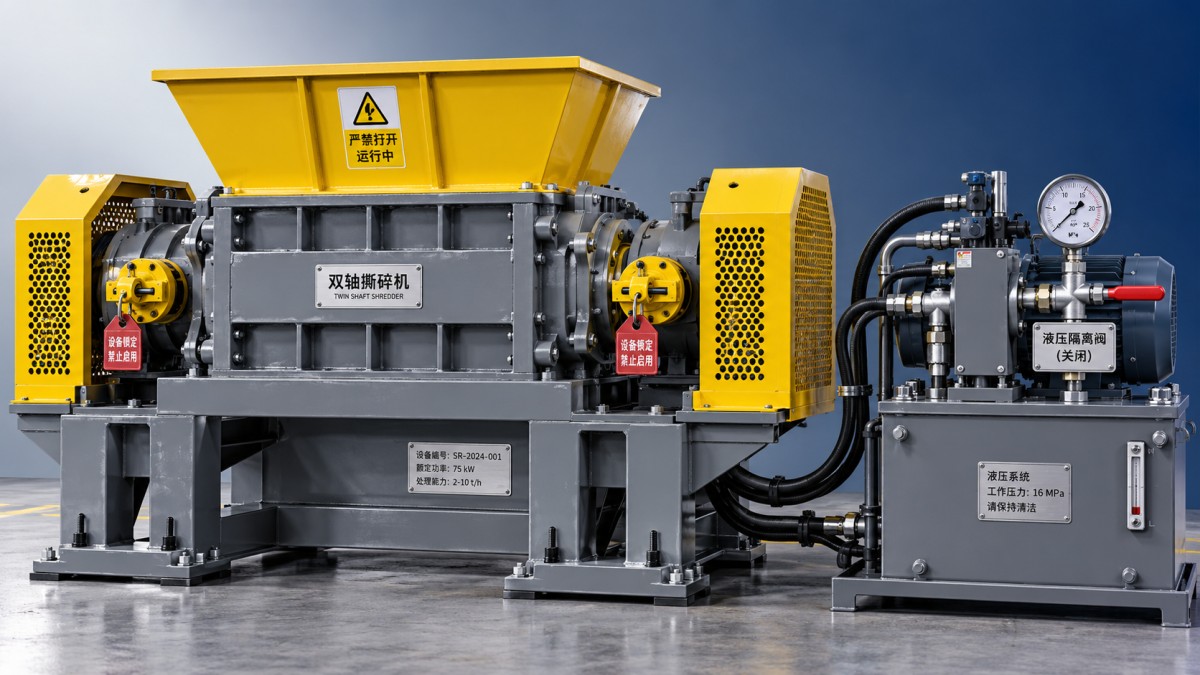
Hydraulic isolation requires more than stopping the pump. Use the designed isolation and pressure-release provisions, following the manufacturer’s sequence. Never loosen a hose or fitting to “check” for pressure. A zero reading at one gauge may not establish that every trapped section is depressurized.
Before releasing pressure, address components that could drop or shift as pressure disappears. Lower them to an approved safe position or secure them with manufacturer-specified mechanical supports. Where accumulators or load-holding circuits are fitted, their isolation and discharge requirements need explicit treatment.
Wait for rotating parts to stop, then apply any prescribed shaft restraint or blocking arrangement. Do not improvise with timber, scrap bars, or a tool wedged between cutters. Restraints must suit the expected forces and have approved installation and removal methods. Installing the restraint must not itself require uncontrolled exposure.
Verify the safe state before access
Verification is a separate task, not an assumption made after fitting padlocks. From a safe position, confirm isolation-device status, complete the prescribed checks for residual energy, and verify that supports and restraints are correctly engaged. Never use a hand or tool inside the chamber to test whether a shaft can move.
Where required by the procedure, attempt a normal start after ensuring everyone is clear. Check the relevant operating modes and remote-start paths identified in the procedure, then return controls to off or neutral. A failed start confirms only part of the picture; it does not prove that hydraulic pressure, gravity, or material tension has been controlled.
If energy can reaccumulate, verification must continue at the intervals or continuously as specified for the work. Pressure returning, a restraint shifting, or unexplained movement means stop and reassess. Entry into a hopper or chamber also requires a separate assessment of access, rescue, and any applicable confined-space requirements.
Once access is authorized, keep people out of the projected release path of bent or wound scrap. Use the approved removal method and handling equipment. Cutting tensioned metal can release stored energy suddenly; it needs its own planned controls, not an improvised decision inside the chamber.
Keep the procedure tied to the actual machine
Refurbishment makes configuration checks especially important. JC INDUSTRY’s Used Machinery and Equipment Recycling Center refurbishes and upgrades equipment. For any rebuilt shredder, confirm that isolation drawings, labels, accumulator details, and restraint instructions match the delivered machine. An older manual may no longer describe a replaced drive or modified hydraulic circuit.
The same discipline applies across equipment types, but the procedures are not interchangeable. A Sport flooring laminating line with a tension-detecting dancing roll and motor-driven trimming presents different movement and tension hazards. A common maintenance policy can set responsibilities; each machine still needs its own energy map.
Before restart, inspect cutters and screens, account for tools and removed material, restore guards, and clear personnel. Remove locks through the approved process, notify affected employees, and restart from a protected position. Record where the jam occurred and any damage or recurring feed condition. If clearing the same blockage has become routine, review the cause rather than accepting repeated exposure as normal maintenance.