









Send Us A Message
Steam or electric heating for a rubber vulcanizing press?
Steam or Electric Heating for a Rubber Vulcanizing Press?
Choosing the heating system for a vulcanizing press affects curing quality, energy consumption, maintenance, installation, and long-term production reliability.
For most procurement teams, the correct choice depends on existing utilities, production volume, temperature-control requirements, factory layout, and total cost of ownership.
Steam heating often suits plants with reliable boilers and high production demand, while electric heating can simplify installation where steam infrastructure is unavailable.
What Is the Core Purchasing Decision?
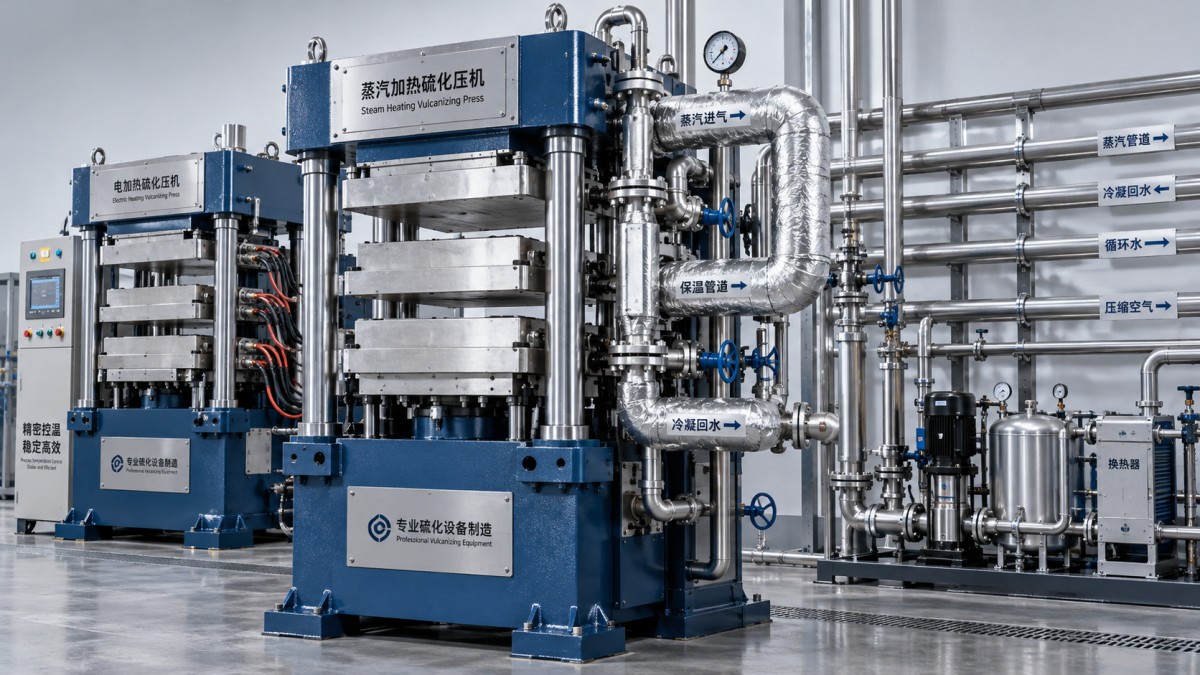
The central question is not whether steam or electricity is universally better, but which system matches the factory’s operating conditions.
Procurement teams should compare heating performance, utility availability, energy pricing, maintenance resources, safety requirements, and expected production changes before selecting a vulcanizing press.
A suitable system must deliver stable mold temperature throughout every curing cycle. Inconsistent heating can produce uneven vulcanization, dimensional variation, and unnecessary scrap.
The purchase price represents only one part of the investment. Installation work, utility upgrades, energy consumption, downtime, spare parts, and service support can significantly change the final cost.
Buyers should therefore request a complete technical proposal rather than comparing equipment prices alone. The proposal should identify heating capacity, control accuracy, utility consumption, and warranty terms.
When Does Steam Heating Make More Sense?
Steam heating is often practical for factories that already operate boilers, steam pipelines, water-treatment systems, and trained maintenance teams.
In high-volume rubber production, centralized steam generation can supply several presses efficiently. Existing infrastructure may reduce the additional installation cost for each new machine.
Steam transfers heat quickly and can support large platen areas. This characteristic is valuable when presses operate continuously and production schedules demand short, repeatable curing cycles.
A properly designed steam circuit can provide uniform heating across the mold. However, performance depends heavily on pressure stability, condensate removal, insulation, and valve quality.
Steam systems also require regular inspection and maintenance. Leaking valves, blocked traps, corrosion, poor insulation, or unstable boiler pressure can reduce efficiency and affect curing consistency.
Procurement teams should confirm whether the supplier includes steam traps, pressure regulators, safety valves, condensate drainage, and connection drawings within the equipment package.
Steam may be less attractive for a small factory without a boiler. Installing a complete steam system can create additional capital expense, construction work, and regulatory obligations.
When Is Electric Heating the Better Option?
Electric heating can be advantageous where the factory lacks steam infrastructure or requires a relatively simple installation process.
Electric heaters connect directly with the press control system and can provide precise temperature adjustment for different rubber compounds and mold designs.
Independent heating zones allow operators to correct temperature differences across the platen. This supports more consistent curing when products require tight dimensional or performance tolerances.
Electric systems also avoid boiler operation, condensate management, steam leakage, and some water-treatment requirements. These benefits may reduce routine maintenance for smaller operations.
However, electric heating can produce high operating costs when electricity prices are high or press utilization remains heavy throughout the day.
Buyers must verify the factory’s electrical capacity before ordering. Transformers, distribution cabinets, cables, and protection devices may require upgrades for large presses.
Electrical safety also deserves close attention. The supplier should provide appropriate insulation, grounding, overload protection, emergency stopping, and clear maintenance procedures.
Electric heating is often suitable for flexible production, laboratory work, lower-volume orders, and facilities that need independent control over individual presses.
How Should Procurement Teams Compare Energy Costs?
Energy comparison should use actual operating data rather than general claims about steam or electric efficiency.
Request the rated heating power, average consumption, operating hours, curing-cycle duration, local electricity price, and steam cost from each supplier.
For steam equipment, include boiler fuel, water treatment, pumping, distribution losses, maintenance, labor, and emissions-related expenses in the calculation.
For electric equipment, include demand charges, transformer losses, cable upgrades, control cabinet costs, and possible peak-period electricity pricing.
A simple annual-cost model can compare expected energy use with production volume. The model should calculate cost per curing cycle, cost per operating hour, and cost per finished product.
Procurement teams should also test several production scenarios. A system that is economical at full capacity may become expensive when orders decline or operating schedules change.
Payback calculations should include service life and replacement requirements. Heating elements, valves, sensors, controllers, and insulation materials may have different replacement intervals.
Ask suppliers to provide performance data from comparable rubber products. Reference information is more useful when it reflects similar platen dimensions, curing temperatures, and production cycles.
Which System Provides Better Temperature Control?
Temperature stability directly influences rubber hardness, elasticity, adhesion, compression set, and final product durability.
The heating method matters, but the control architecture often matters just as much. Sensors, controllers, zone design, insulation, and software determine practical results.
A modern vulcanizing press should monitor platen temperature continuously and identify abnormal temperature changes before defective products accumulate.
Procurement teams should ask about sensor accuracy, response time, control tolerance, alarm functions, data recording, and calibration procedures.
Electric heating usually provides straightforward zone control because each heating circuit can be adjusted independently.
Steam heating can also achieve excellent control when pressure regulation, steam distribution, condensate drainage, and temperature feedback are correctly engineered.
Suppliers should explain how the machine compensates for heat loss around the platen edges and during mold loading.
Buyers should request acceptance-test criteria before signing a contract. These criteria may include warm-up time, temperature uniformity, cycle repeatability, and alarm response.
What Are the Installation and Maintenance Requirements?
Installation requirements can affect project timing and total investment more than the initial equipment quotation suggests.
Steam presses may require boiler connections, pipelines, condensate return, drainage, pressure testing, insulation, and compliance inspections.
Electric presses may require high-capacity cables, transformers, distribution panels, ventilation, grounding, and protection against electrical overload.
Before purchase, suppliers should receive accurate information about factory voltage, available power, floor space, ceiling height, access routes, and utility connection points.
Maintenance planning should cover daily checks, weekly inspections, periodic calibration, spare parts, emergency service, and operator training.
For steam systems, maintenance teams should inspect traps, valves, gauges, seals, pipelines, and condensate equipment regularly.
For electric systems, teams should inspect heating elements, thermocouples, terminal connections, insulation resistance, relays, and control cabinets.
Remote diagnostics and digital production records can reduce troubleshooting time. These functions are especially valuable for factories operating multiple presses across several shifts.
Ask whether the manufacturer provides installation supervision, commissioning, maintenance manuals, operator training, and local technical support after delivery.
How Can Buyers Evaluate Supplier Capability?
A reliable supplier should demonstrate experience with rubber processing, press design, heating control, commissioning, and after-sales service.
Review the manufacturer’s engineering resources, production facilities, quality-control procedures, patents, customer references, and ability to customize equipment.
Supplier evaluation should include the complete project lifecycle. Design support, installation, commissioning, operator training, spare parts, and troubleshooting all affect production results.
JC INDUSTRY combines research, design, manufacturing, installation, commissioning, and consultation for rubber and plastic machinery applications.
Its broader manufacturing capability includes foundry equipment, environmental machinery, digital tire molds, and intelligent equipment solutions for tire enterprises.
For buyers managing different industrial assets, the company also supplies the Luxury business yacht UF25 for leisure and business outings.
The fiberglass vessel measures 7.64 meters long, 2.64 meters wide, and 1.19 meters deep, with 150HP to 250HP power and capacity for thirteen passengers.
Although this product serves a different application, the example illustrates why procurement teams should examine a supplier’s engineering breadth, manufacturing discipline, and service commitments.
Warranty terms should be reviewed carefully. Confirm coverage for heaters, valves, controllers, sensors, pressure components, labor, travel, and replacement parts.
JC INDUSTRY states that it provides a 24-month warranty for both new and refurbished machinery, supporting buyers seeking controlled investment risk.
Should You Buy New or Refurbished Equipment?
Refurbished vulcanizing presses may reduce capital expenditure when the machine has a documented history and receives professional upgrading.
Buyers should inspect the frame, hydraulic system, platens, heating components, control cabinet, safety systems, and available maintenance records.
A refurbishment program should clearly identify replaced parts, upgraded controls, tested functions, remaining service life, and commissioning procedures.
Used equipment can be suitable for expanding capacity, testing a new product, supporting seasonal demand, or replacing an urgently unavailable press.
However, the purchase decision should consider compatibility with existing molds, voltage, utility connections, product specifications, and factory automation systems.
Ask for performance-test records before shipment. The supplier should demonstrate pressure stability, platen temperature uniformity, safety interlocks, and automatic cycle operation.
A credible warranty and accessible technical support can make refurbished equipment a practical alternative for cost-sensitive procurement teams.
What Should the Final Specification Include?
The final purchase specification should state platen dimensions, maximum pressure, curing temperature, temperature tolerance, heating capacity, cycle time, and control functions.
It should also define utility requirements, installation conditions, safety devices, communication interfaces, data-recording functions, spare parts, and acceptance-test procedures.
Specify the expected rubber products and mold types. A press designed for tire components may require different heating performance from one used for rubber sheets or seals.
Include production targets and operating schedules. These details help suppliers recommend suitable heating capacity rather than offering an underpowered or unnecessarily expensive configuration.
Require a total-cost-of-ownership quotation covering equipment, installation, commissioning, training, utilities, maintenance, consumables, and warranty support.
For international purchases, confirm packaging, shipping dimensions, import documentation, electrical standards, spare-parts delivery, remote assistance, and local service arrangements.
Final Recommendation for Procurement Teams
Choose steam heating when the factory already has dependable boiler infrastructure, high press utilization, and a maintenance team familiar with steam systems.
Choose electric heating when installation simplicity, independent temperature control, flexible production, or the absence of steam infrastructure is more important.
Neither option should be selected from the purchase price alone. Energy, maintenance, downtime, infrastructure, safety, and product quality determine the real business value.
The strongest procurement process compares both systems using the same production assumptions and requires measurable performance commitments from suppliers.
Before placing an order, verify temperature uniformity, utility consumption, control accuracy, installation scope, service response, spare-parts availability, and warranty coverage.
A well-matched vulcanizing press can improve curing consistency, reduce waste, and protect production capacity for many years.