










Send Us A Message
When does a vacuum vulcanizing press justify its higher price?
A vacuum vulcanizing press earns its higher price when removing trapped air produces enough additional saleable parts, lower rejection costs, or usable production capacity to cover the extra investment and operating expense. The strongest case is a recurring air-related quality problem in a product with meaningful material, processing, or failure costs.
The purchase becomes harder to justify when a conventional press already meets quality requirements, production runs are infrequent, or defects originate elsewhere. Before comparing quotations, establish what vacuum will change on your actual parts—and what that change is worth.
Start with the defect you are paying to eliminate
During rubber molding, air can become trapped as the compound flows through the mold. Depending on the geometry and process, this can contribute to voids, incomplete filling, or surface blemishes. A vacuum system evacuates air from an enclosure or mold arrangement during a controlled stage of the molding cycle, helping air escape before the compound closes off its path.
This can be valuable for intricate cavities, thin sections, parts with demanding surface requirements, and some rubber-to-metal components where trapped air interferes with complete contact. However, the mold must provide a path for air to leave. A vacuum chamber cannot reliably evacuate an isolated pocket after rubber has sealed it.
Vacuum is an air-management tool, not a general cure for molding defects. Contamination, unsuitable compound viscosity, incorrect charge placement, inadequate venting, uneven platen temperature, and an unsuitable cure schedule can produce problems that evacuation alone will not resolve. Bonding failures also require attention to metal preparation, adhesive application, and cure conditions.
Classify current rejects by cause before assigning savings to a new machine. Counting every rejected part as recoverable through vacuum will overstate the return.
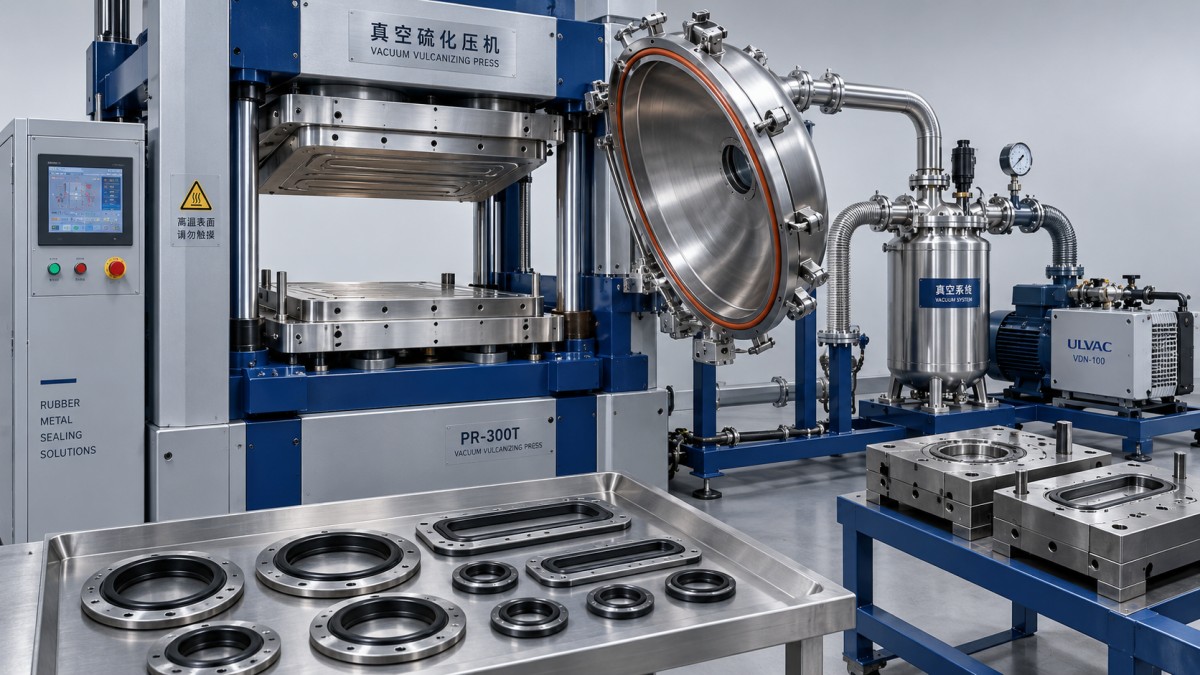
Where the price premium has the strongest business case
Production volume matters, but volume alone does not decide the purchase. A smaller run of costly components can justify vacuum more readily than a large run of simple, inexpensive parts that already mold consistently.
The cost of failure also matters. A defect discovered after trimming, assembly, or functional testing carries more accumulated cost than one caught immediately after molding. Include those downstream costs where they are documented, while keeping speculative warranty savings out of the base calculation.
Calculate the return against a comparable conventional press
Compare machines with equivalent useful platen area, clamping force, heating capability, mold access, and automation. Otherwise, improvements caused by a larger mold, better temperature control, or automatic handling may be incorrectly credited to vacuum.
The investment premium should include more than the difference between machine prices. Account for freight, installation, utilities, commissioning, training, mold modifications, and initial spare parts. A vacuum-compatible enclosure or tooling change can materially affect the installed cost.
A practical starting calculation is:
Annual net benefit = avoided scrap and rework costs + realizable labor savings + contribution from additional saleable output − additional operating and maintenance costs.
Simple payback = additional installed investment ÷ annual net benefit.
Use recoverable manufacturing cost for avoided scrap. When valuing extra output, use contribution after the variable costs needed to produce and sell it. Applying the full selling price to every additional part exaggerates the return.
Keep the benefits separate enough to avoid double counting. If improved yield already produces more good parts from the same production hours, do not also claim those same parts as an independent capacity gain. Labor savings should reflect time that can actually be reassigned or removed from the production requirement.
Calculate a conservative case using established demand and modest improvements. Then examine what happens if utilization falls, evacuation takes longer than expected, or maintenance costs rise. A purchase that depends on uninterrupted full-capacity operation deserves closer scrutiny.
Measure good parts per hour, including evacuation time
A vacuum vulcanizing press does not automatically shorten the cure. Cure requirements still depend on the compound, part thickness, temperature, and required properties. Evacuation adds a process step, although it may replace repeated venting movements or reduce rejects.
The useful comparison is acceptable output per production hour. Include loading, evacuation, mold closing, curing, opening, unloading, and routine interruptions. A faster molding cycle with more rejects may deliver less value than a slightly longer, more consistent one.
Vacuum performance also needs to be assessed under production conditions. Pump capacity alone does not show how quickly the required pressure will be reached. Chamber volume, piping, leakage, seal condition, and the loaded mold all influence evacuation. Specify whether quoted vacuum values are absolute pressure or readings relative to atmospheric pressure so competing offers can be compared consistently.
Request trials using your compound, representative tooling, normal loading practices, and agreed acceptance criteria. Record evacuation time, complete cycle time, defect types, and functional results across repeated cycles after the machine reaches operating temperature. One visually acceptable sample provides little evidence of repeatable production economics.
Check whether the constraint is outside the press
Vacuum adds limited value if the press regularly waits for prepared material or if downstream finishing cannot handle additional output. Inconsistent compound preparation and storage can also undermine an otherwise capable molding process.
For facilities preparing rubber sheet in-house, upstream equipment such as the Batch off line supports cooling, conveying, cutting, and folding through PLC-controlled operation. Its relevance is material preparation and handling. Any benefit from that equipment should be evaluated separately from the air-removal performance of the press.
Review the whole production route before assigning a capacity benefit. Additional molding capacity has financial value when sufficient material, labor, finishing capacity, and customer demand are available to use it.
Allow for maintenance—and consider refurbished equipment
The vacuum package introduces pumps, seals, valves, sensors, and associated controls. Maintenance requirements depend on the design and process, but the cost comparison should address pump servicing, seal replacement, filtration where fitted, leak diagnosis, and spare-parts availability.
Ask how the machine responds when it cannot reach the specified vacuum: does it alarm, stop, or continue molding? A system that continues without clear indication can produce suspect parts until the problem is noticed. Useful process records should make departures from the validated cycle visible.
A refurbished vacuum press may make the economics more attractive by reducing initial investment. Its suitability depends on the condition of the complete machine, including the frame, platens, hydraulics, heating system, vacuum enclosure, controls, and safety functions.
JC INDUSTRY offers refurbished machinery alongside new equipment and states a 24-month warranty for both. Include warranty scope, service arrangements, refurbishment details, and production acceptance testing in the comparison. A warranty provides a contractual remedy; demonstrated process capability supports the production forecast.
Before approving the purchase, define the result the premium must buy: an acceptable defect rate, repeatable functional quality, required good parts per hour, and sustainable operating costs. Put those requirements into the acceptance agreement. When representative trials meet them and the conservative financial case clears your investment threshold, the higher price has a defensible basis.