









Send Us A Message
Automatic vs Manual Vacuum Forming Machines: Which Fits Your Output Plan?
The choice between an automatic and manual vacuum forming machine should begin with the output plan, not the purchase price. A manual unit can be the better production tool when product mixes change often and daily demand is uneven. An automatic system becomes more compelling when repeatability, labor availability, and predictable throughput matter more than frequent hands-on adjustment.
For formed metal-adjacent components, protective covers, trays, housings, transport packaging, and other thermoplastic parts used around fabrication operations, the machine affects more than cycle speed. It shapes how reliably parts meet trim requirements, how much operator time each batch consumes, how easily a new tool can be introduced, and how much disruption a missed shift can cause.
A useful first decision is simple: choose manual forming for variable, lower-volume work that needs frequent setup changes; choose automatic forming for stable, repeatable programs where the line can stay busy. The details below determine whether that initial answer holds up.
What Actually Changes Between Manual and Automatic Forming?
Both types heat a plastic sheet, draw it over or into a mold using vacuum, cool the formed part, and release it for trimming or further processing. The difference is how much of the cycle depends on an operator.
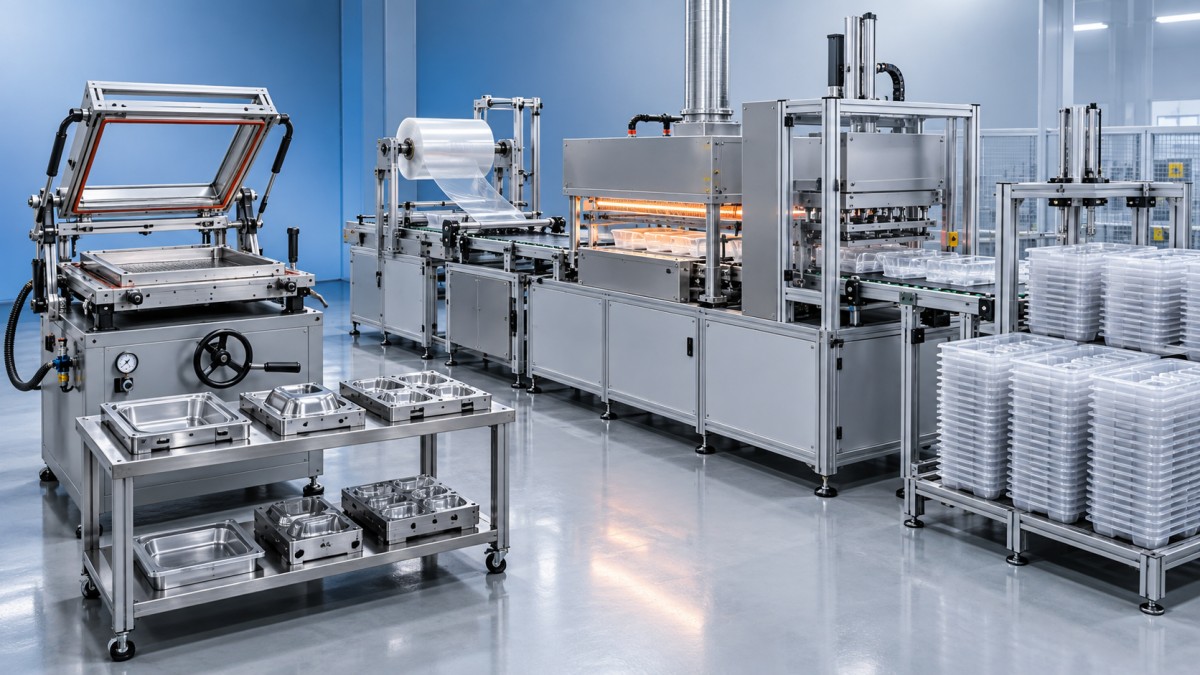
With a manual vacuum forming machine, the operator commonly loads the sheet, positions the frame, controls or initiates the forming sequence, and removes the finished part. Heating and vacuum controls may still be regulated, but material handling and timing rely heavily on the person running the machine. This gives the operator direct control when sheets, molds, or process conditions change.
An automatic vacuum forming machine uses powered sheet feeding, programmable heating and forming stages, and often automated part handling or stacking. Some systems are built as inline cells with trimming, conveying, or robotics. Automation reduces repeated handling, but it also makes the process more dependent on stable sheet supply, confirmed tooling dimensions, well-defined recipes, and reliable downstream flow.
Do Not Size the Machine From Peak Demand Alone
A common mistake is to select automation based on the busiest forecast month. That can leave a production line carrying high capital cost and floor-space demand while running well below its useful capacity for most of the year. Instead, map the expected work in three layers: normal weekly volume, the duration of busy periods, and the number of part changes during those periods.
Automation is usually justified when the same parts repeat often enough to keep the machine supplied, staffed for support, and connected to a dependable trimming or packing step. The savings do not come from the forming station alone. They come from reducing repeated loading and unloading, controlling heating time consistently, and avoiding the variation that appears when different operators use slightly different methods.
Manual equipment can outperform an underused automatic line in a mixed program. If the work includes development samples, low-volume service parts, irregular orders, or several tools per shift, the ability to adjust heat exposure, vacuum timing, and setup directly may be more valuable than a theoretical cycle-time advantage.
Part Design Can Push the Decision Either Way
Part complexity does not automatically mean “automatic.” Deep draws, sharp radii, textured surfaces, tight cosmetic requirements, and demanding material behavior all need a controlled process. At the development stage, manual operation can help technicians observe sheet sag, heating balance, webbing, thinning, and release behavior before a recipe is locked.
Once the material, mold venting, plug-assist requirements, and heating profile are proven, automation can preserve those conditions from batch to batch. This is especially useful for parts whose appearance or fit is sensitive to small changes in forming temperature or dwell time.
Tooling is equally important. A machine cannot compensate for poor vacuum venting, insufficient draft, unsuitable cooling, or a mold that makes release inconsistent. Before approving either machine type, review the largest part footprint, maximum draw depth, mold height, required clamp area, sheet thickness range, and where trimming will occur. These points set the practical machine envelope.
Labor Is Not Just an Operator Count
It is tempting to compare one manual operator with an automated loading system and treat the difference as a direct labor saving. In practice, a manual cell may require additional attention for sheet preparation, part inspection, trimming, and material movement. An automatic line reduces repetitive handling, but it needs operators or technicians who can manage recipes, sheet-feed alignment, alarms, preventive maintenance, and recovery after a stoppage.
The more useful question is: where does labor create the production constraint? If skilled operators are spending too much time loading sheets and taking parts off the mold, automation may remove a clear bottleneck. If trimming, inspection, or tool changes are the actual constraints, automating the forming station alone may only move the queue downstream.
Run a simple process walk before committing. Record every touchpoint from incoming sheet to finished, trimmed part. Include warm-up time, material changes, mold swaps, first-off inspection, rejected parts, and cleanup. The slowest recurring step should shape the investment plan.
Installation Requirements Often Decide the Real Cost
Automatic equipment generally needs a more complete project definition. Beyond electrical power and compressed air, consider material loading access, sheet storage, scrap handling, guarding, control-panel access, extraction where required by the material and process, and space for maintenance. The machine footprint is not the operating footprint.
There also needs to be a plan for what happens when the downstream station stops. If a trimming press, CNC router, or packing area cannot accept parts, the forming machine needs a safe buffer or a controlled stop sequence. Without this, a high-speed former can create excess work-in-progress, part deformation risk, or unnecessary reheating and scrap.
Manual systems usually demand less integration, which can shorten implementation. That does not remove the need for safe operating procedures, consistent material conditioning, and tooling checks. It simply makes phased expansion easier: start with a forming station, validate demand, then add trim automation or material handling when the volume supports it.
Use a Trial Plan Before Specifying Automation
For a new part family, specify the process around evidence from representative material and tooling rather than a brochure cycle time. Request trials that reflect the actual sheet grade, thickness, surface finish, mold geometry, and expected trim method. Review the first acceptable part as well as repeated parts after the machine has run continuously.
During the review, look for issues that affect production rather than just appearance: uneven wall thickness, bridging around details, incomplete definition, inconsistent flange shape, poor release, excessive scrap skeleton, and variation between cavities or shifts. These are the problems that determine whether an automatic recipe will remain reliable.
The same selection logic appears in other precision manufacturing cells. For example, a Tyre building macine with servo-controlled operations, automatic material application, and remote diagnostics is suited to a defined, repeatable tire-building sequence. It illustrates the broader rule: automation creates the greatest value after the product range, material flow, and process sequence are sufficiently stable.
A Practical Selection Rule
Select a manual vacuum forming machine when your project needs flexible tooling trials, short or irregular batches, frequent material changes, or a modest first-stage investment. It is also a sensible choice when the team needs to learn the behavior of a new part before committing to a fixed process.
Select an automatic system when demand is sustained, product specifications are stable, the line has a realistic plan for sheet supply and finished-part handling, and the business can support process maintenance. The goal is not simply fewer button presses. It is predictable output with less variation and less dependence on continuous manual handling.
Before issuing a purchase specification, define the required parts per shift, product mix, changeover frequency, approved material range, trim route, floor layout, utility capacity, and acceptable recovery time after a fault. Those answers will reveal whether manual flexibility or automated consistency better supports the output plan.