









Send Us A Message
Emission Controls to Review Before Installing a Reclaimed Rubber Machine
Emission controls should be defined before the reclaimed rubber machine is placed on the floor, not added after odor complaints, failed inspections, or unstable production appear. The practical question is not simply whether the line has an exhaust fan. Quality and safety teams need to identify every point where dust, fumes, vapors, or odor can be released, then confirm that the collection, treatment, discharge, and monitoring arrangements match the actual process.
A reclaimed rubber operation may include size reduction, conveying, mixing, reclaiming, cooling, and discharge. Each stage can create a different emission profile. A system that controls powder at the grinding area may do little for heated-process vapors, while a strong exhaust flow can create material losses or interfere with temperature control if the hoods are poorly designed.
Start with an emission map of the whole process
Before approving equipment layout, map the material path from incoming feedstock to finished reclaimed rubber. Mark enclosed equipment, transfer points, heating zones, inspection stations, and maintenance access points. This is more useful than reviewing the main machine in isolation because emissions often escape at interfaces: a conveyor drop point, an open hopper, a poorly sealed cover, or a discharge bin that is opened too early.
For each location, identify the likely contaminant and the condition that creates it. Fine particulate is usually linked to dry handling and mechanical agitation. Vapor, smoke, and odor are more likely where rubber is heated or where reclaiming agents are introduced. Maintenance tasks also matter: opening a chamber, changing filters, cleaning ductwork, and clearing a blockage can produce short but significant exposure events.
Do not treat dust collection and fume treatment as the same system
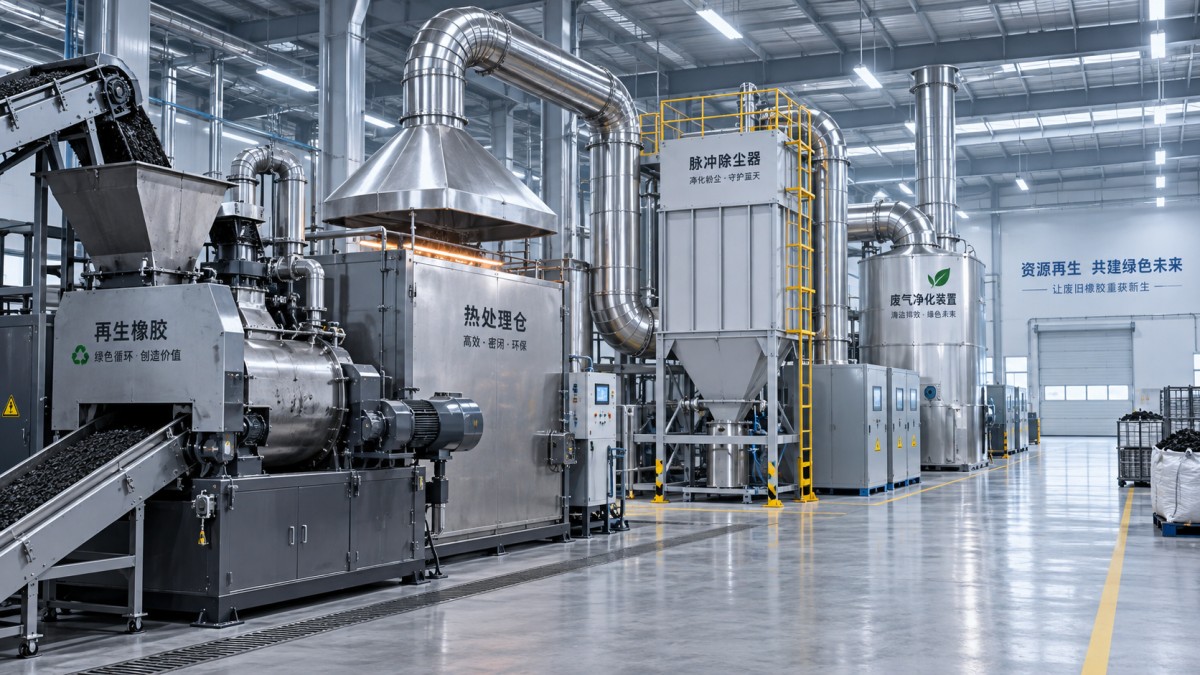
A dust collector is designed to capture airborne solids. It is often essential around feeding, conveying, cutting, and other dry material-handling activities. Its effectiveness depends on hood placement, air velocity in the duct, duct routing, filter selection, pressure control, and the method used to empty collected dust. Installing a collector with insufficient capture at the source simply moves the problem from the machine to the work area.
Fumes and volatile compounds from heated rubber require a separate assessment. Depending on the process and the substances used, treatment may involve condensation, adsorption, thermal or catalytic oxidation, scrubbing, or another suitable method. The treatment choice should follow the expected contaminant stream, temperature, moisture, concentration variability, and operating schedule. A treatment device selected only by nominal airflow can be ineffective if it is not compatible with the gas stream.
Odor deserves its own review. Odor can trigger complaints even where visible smoke is limited, and it can be difficult to solve once exhaust ducts and discharge points have been fixed in place. Evaluate the full path: capture hood, duct sealing, treatment equipment, stack location, and the potential for exhaust to re-enter doors, air intakes, or neighboring work areas.
Capture at the source before increasing fan capacity
A common installation mistake is to respond to emissions by specifying a larger fan. More airflow does not automatically mean better control. If a hood is too far from the release point, if cross-drafts pull contaminants away, or if the machine opening is unnecessarily large, increased fan capacity may waste energy while still leaving workers exposed.
Review whether each enclosure allows normal operation without creating a permanent opening. Covers, inspection ports, flexible connections, and feed interfaces should be designed so they can be used in real production, not only during acceptance testing. Where hot material must be accessed, local extraction should be arranged around the opening and balanced so that it captures emissions without disturbing process stability.
Material handling equipment is part of this control strategy. When reclaimed material, scrap, or additives move between elevations, open transfer points can become dust sources. A durable Sidewall conveyor belt can support heavy material handling where a steep or contained conveying route is needed, but it should be evaluated together with skirt sealing, loading height, belt cleaning, and local extraction. The belt alone does not provide emission control.
Review the ductwork, not just the treatment unit
Emission systems fail frequently at the connections between components. Long duct runs, sharp bends, undersized branches, poorly placed dampers, and unsealed access doors can reduce capture performance. Dust-bearing ducts also need a layout that avoids excessive accumulation, because deposits can restrict airflow and increase cleaning exposure.
Where several machines share one collector, confirm how the system behaves when only one machine is operating, when all machines operate together, and during start-up or shutdown. The airflow balance must remain acceptable across these conditions. It is also important to prevent incompatible streams from being combined without review. Dust, hot vapors, moisture, and chemical-laden exhaust can create maintenance, corrosion, or treatment problems when mixed indiscriminately.
Build monitoring and maintenance into commissioning
Emission control should have measurable operating conditions. At a minimum, the installation should make it practical to check differential pressure across filters, fan condition, airflow or static pressure at key points, and the operating status of treatment equipment. Alarm logic should identify conditions that reduce control performance rather than merely report that a motor is energized.
Quality personnel should also connect environmental checks to production records. A change in feedstock, reclaiming agent, batch temperature, residence time, or throughput can alter the emission load. If odor or visible emissions increase after a process change, the cause may be the process condition rather than a failed control device. Recording both sets of information makes investigation faster and prevents repeated adjustments to the wrong component.
Maintenance access needs the same level of planning. Filters, dust bins, inspection ports, and cleaning points should be reachable without forcing personnel to work directly in a contaminated plume. A sound design includes isolation points, safe shutdown steps, and enough room to remove service parts without damaging ducts or seals.
Check the installation package before release
Before the reclaimed rubber machine is commissioned, request a documented emission-control scope that covers the machine boundary, hoods, ducting, fans, collectors, treatment equipment, discharge arrangement, controls, and maintenance points. The document should state the intended process conditions and identify the assumptions used for material type, operating temperature, and production pattern.
This is particularly important for refurbished or upgraded equipment. A machine may be mechanically sound while its original ventilation arrangement is unsuitable for a new layout, a different feedstock, or changed environmental requirements. Equipment suppliers that combine process machinery with environmental equipment can help coordinate these interfaces, but the final acceptance review should still examine the complete installed system rather than treating each item as an independent purchase.
The most useful pre-installation decision is therefore to approve an emission-control design based on the actual material flow and operating conditions. Once the reclaimed rubber line is running, correcting enclosure gaps, relocating hoods, or rebuilding ductwork is usually more disruptive than resolving those details during layout and commissioning.