










Send Us A Message
How Drum Accuracy Affects Tire Uniformity on a Tyre Building Macine
What drum accuracy really changes in a Tyre Building Macine
In a Tyre Building Macine, “drum accuracy” is often discussed as if it were only a machining issue. In practice, it is a tire quality issue that shows up later as radial force variation, lateral runout, ply misalignment, bead positioning drift, or an unexpected balance correction at the finished tire stage. The drum is the reference surface on which multiple components are assembled. If that reference is unstable, eccentric, out of round, or inconsistent in expansion behavior, uniformity problems are built into the green tire before curing even begins.
That is why maintenance teams should not treat drum precision as a narrow dimensional tolerance problem. The more useful question is this: does the drum still create a repeatable building geometry under real operating conditions, including load, temperature, speed, sleeve wear, and repeated expansion cycles? A drum can pass a basic static check and still create non-uniform tires once production starts.
The most common misunderstanding is to link tire uniformity only to rubber compound variation or curing performance. Those factors matter, but a surprising number of complaints that appear downstream begin upstream at the building stage. When the drum centerline shifts slightly, when segment expansion is uneven, or when the contact surface no longer holds the carcass evenly, component placement errors accumulate. One small deviation may not be visible on a single layer. Across inner liner, carcass ply, bead, sidewall, and belt package positioning, it becomes measurable.
Where accuracy matters more than people expect
For after-sales service work, it helps to separate drum accuracy into several practical conditions rather than one vague specification:
- Geometric accuracy: roundness, concentricity, straightness, and axial runout of the drum body.
- Dynamic accuracy: whether the drum remains stable during rotation, indexing, and expansion at production speed.
- Functional accuracy: whether segments, bladder systems, sleeves, or clamping parts move symmetrically and return to the same position every cycle.
- Surface accuracy: whether the drum face still provides uniform support and friction without local high spots, wear grooves, contamination, or repaired patches.
These conditions affect different defects. Radial non-uniformity is often associated with eccentricity, out-of-round conditions, or inconsistent expansion diameter. Lateral uniformity issues may be connected to axial drift, segment synchronization error, or side-to-side loading differences. If splice quality starts varying while materials remain unchanged, the drum surface condition and diameter stability deserve attention before process settings are adjusted.
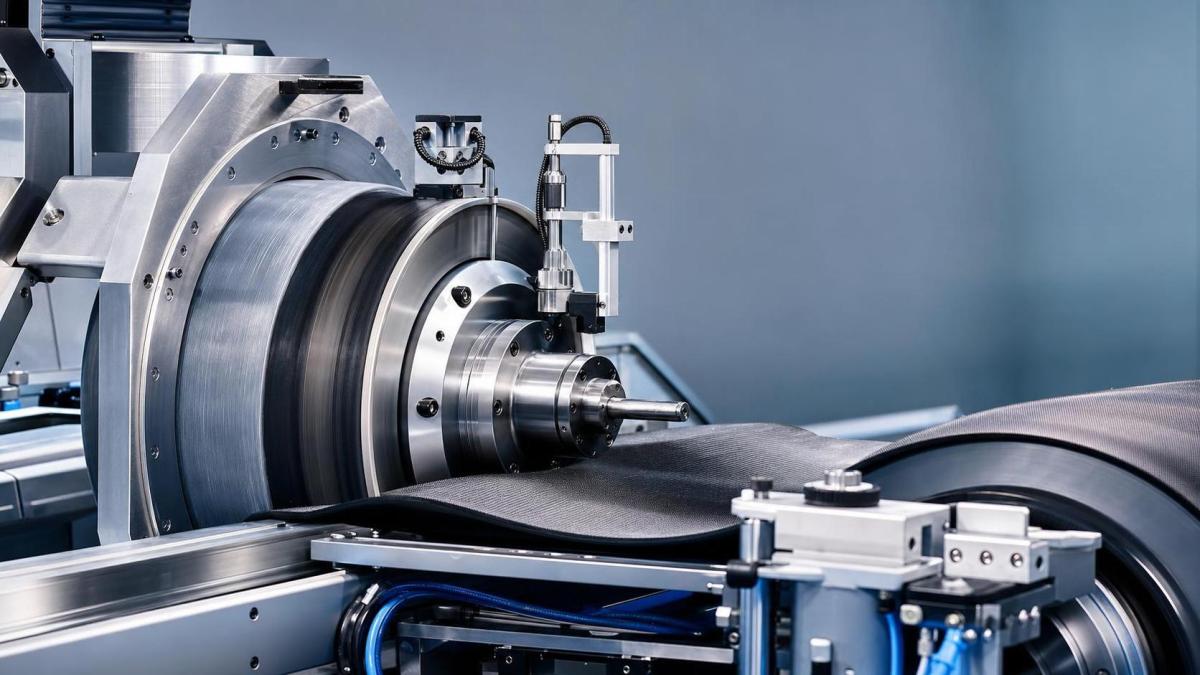
A good field diagnosis usually starts with the symptom pattern. If the defect repeats at a fixed angular position, maintenance should suspect mechanical periodic error: bearing wear, shaft eccentricity, segment damage, or encoder-related indexing deviation. If the variation grows after warm-up, thermal behavior may be part of the cause. This is one reason experienced machinery manufacturers pay close attention not only to nominal dimensions but also to structural stiffness, material selection, and heat-related deformation control. In other rubber processing systems, the same logic appears. For example, the Fabric cord conveyor belt curing press line relies on controlled pressure, stable heating, and tight platen tolerance because dimensional repeatability under load is what protects final product consistency. Tire building drums are different equipment, but the engineering principle is similar: precision only matters if it is maintained under operating stress.
Why static measurement is not enough
A newly installed or refurbished drum may look acceptable when checked with simple dial indicators at rest. That does not automatically mean it will build uniform tires. The actual working state includes rotation, inflation or expansion movement, vacuum or holding action, material tension, and repeated stop-start cycles. Any looseness in the transmission chain, wear in guide parts, or mismatch between control feedback and mechanical response can turn a nominally accurate drum into an unstable process reference.
This is where maintenance experience matters. If a machine produces acceptable geometry at low speed but quality drifts during standard production rate, the problem may not be “process” in the narrow sense. It may be dynamic response: servo tuning interacting with backlash, drum mass imbalance, or delayed segment return. In that situation, replacing consumables without checking mechanical synchronization usually wastes time.
Signs that the drum is becoming the hidden source of uniformity loss
Not every plant has the same inspection routine, but several warning signs are worth treating seriously:
- A gradual increase in balance correction demand without a corresponding material change.
- Repeated shoulder or belt edge positioning variation on one machine only.
- Splice inconsistency that cannot be explained by operator method alone.
- Frequent need to compensate through process parameter changes just to hold the same result.
- Differences between cold-start production and stable-temperature production.
These signs do not prove a drum problem by themselves, but they justify inspection of bearings, sleeves, segment wear, locking mechanisms, expansion repeatability, and centerline alignment relative to the rest of the building station.
What maintenance teams should actually monitor
The most effective maintenance approach is not to chase one number. It is to build a repeatability record. That means comparing current drum behavior against its own known-good condition: runout trend, expansion diameter consistency, return position stability, vibration change, and wear progression of contact parts. In many factories, quality issues are investigated only after finished tire test data worsens. By then, the mechanical drift has usually been developing for some time.
For companies with long experience in rubber machinery, this preventive view is standard practice. JC INDUSTRY, with design, manufacturing, refurbishment, and service capability across tire-related equipment, has the practical advantage of seeing how accuracy degrades over the equipment life cycle, not just at delivery. That perspective is especially relevant for used or upgraded machines. A rebuilt system can perform reliably, but only if the drum assembly, drive chain, and control response are restored as a working system rather than treated as isolated parts.
It also helps to keep inspection language precise. “The drum is okay” is not a useful conclusion. Better records describe what was checked and under what condition: static radial runout, axial movement during rotation, expansion diameter deviation over repeated cycles, segment synchronization, surface wear pattern, and bearing temperature trend. That kind of detail lets a later quality complaint be traced to a mechanism rather than a guess.
The practical standard
There is no single universal field number that explains all uniformity outcomes across every tire design and every Tyre Building Macine configuration. Tire size, drum structure, building method, and downstream quality criteria all matter. The practical standard is repeatable geometry under production conditions. If the drum cannot hold that, uniformity will drift even when operators are experienced and materials are within normal range.
For maintenance personnel, the right mindset is straightforward: when tire uniformity changes, inspect the drum as a process reference, not just as a rotating part. Once that shift is made, troubleshooting becomes faster, adjustment becomes more disciplined, and the real source of variation is easier to isolate before it turns into scrap, downtime, or recurring customer complaints.