









Send Us A Message
Tyre Retreading Machine Costs: Comparing Capacity, Labor, and Cure Energy
The purchase price of a tyre retreading machine is only the visible part of the investment. The more consequential comparison is cost per acceptable retreaded casing: how many tyres the line can process at the required quality level, how many operators it needs at each production stage, and how much energy the curing system consumes per cycle.
A lower-priced machine can be the more expensive choice when it creates bottlenecks, requires repeated manual handling, or operates with poorly controlled cure cycles. Conversely, a larger or more automated system is not automatically economical if casing supply, order mix, workshop power capacity, or downstream inspection capacity cannot support its output. Equipment selection should begin with the production constraint, not the nameplate capacity.
Capacity is a line-balance question, not a machine rating
Suppliers may state capacity as tyres per day, tyres per shift, or chamber positions. Those figures are useful only when the underlying assumptions are clear: tyre sizes, casing condition, buffing and repair requirements, cure time, loading method, shift length, and reject rate. A curing unit with more positions does not raise finished output if inspection, skiving, repair, envelope fitting, or unloading remains slow.
For precure retreading, the curing stage is often the clearest capacity constraint because each tyre occupies a chamber or autoclave position for a defined period. The relevant calculation is not simply the number of positions. It is:
usable cure positions × completed cycles per shift × average tyres per position × first-pass acceptance rate.
“Usable” matters. A chamber that is technically installed but unavailable because of maintenance, pressure instability, poor loading access, or frequent changeover should not be treated as productive capacity. The same principle applies to a larger autoclave: its theoretical batch output may look attractive, but its economics depend on whether batches can be loaded close to full without delaying orders.
A small plant with a varied mix of truck, bus, agricultural, or off-road casings may value flexible, shorter production batches more than maximum batch volume. A high-volume operation processing a narrow tyre-size range can generally benefit more from standardized handling and larger cure loads. Neither configuration is inherently cheaper; the cost advantage comes from matching machine architecture to the actual production pattern.
Before requesting quotations, the buyer should provide a realistic monthly casing profile rather than a single annual volume. Include tyre dimensions, expected repair intensity, preferred tread application method, production shifts, and target turnaround time. This makes it possible to compare proposals against the same operating basis.
Labor cost is shaped by material flow
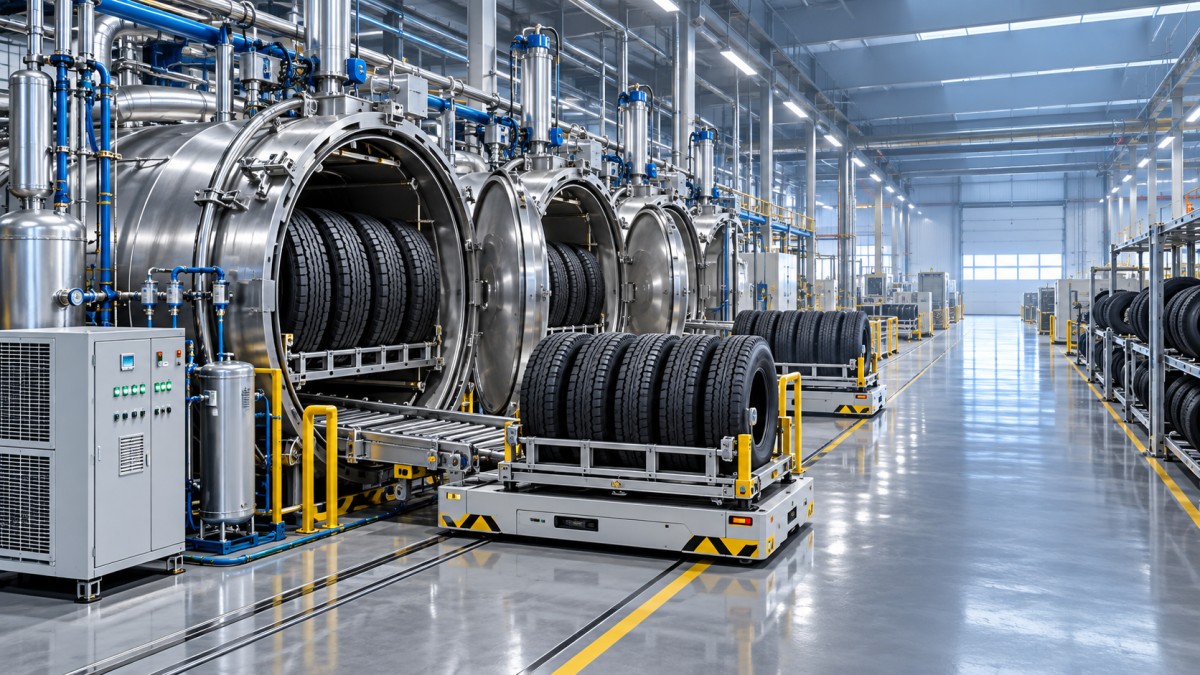
Labor requirements are frequently underestimated because quotations tend to list the main tyre retreading machine rather than every manual activity around it. Casing loading, buffer positioning, tread preparation, envelope installation, rim handling, trolley movement, cooling, and final inspection can consume more labor than the core machine cycle suggests.
The important distinction is between labor that adds technical value and labor that only moves material or compensates for poor equipment integration. Skilled inspection and repair work cannot simply be eliminated; these steps protect quality and casing value. Repeated lifting, manual turning, searching for tools, and waiting for the next station are different. They raise labor cost, increase ergonomic exposure, and make output sensitive to absenteeism and operator variation.
When comparing automation levels, ask suppliers to state the operator count required for a complete operating cell, not only for a single machine. A buffing machine may need one operator, but the practical cell may also require assistance for loading and staging. A cure system may have automatic controls while still requiring manual envelope handling and trolley transfer. The result should be expressed as labor hours per finished tyre under the intended shift arrangement.
Automation also has limits. Adding powered handling or automatic loading may be difficult to justify where volume is low, casing sizes vary substantially, or the process changes frequently. In such cases, a robust manual workflow with short travel distances and clear workstations can outperform an expensive automated layout that is poorly utilized. The purchasing decision is therefore not “manual versus automatic”; it is whether the reduction in labor hours, handling risk, and production variability exceeds the additional capital cost and service burden.
Upstream rubber preparation deserves separate consideration where reclaimed rubber is processed in-house. An Open refining mill is used for regenerated-rubber refining and sheeting rather than as a curing machine, but it can affect labor planning in an integrated rubber-processing operation. Features such as hydraulic roll adjustment and a stock blender designed to replace manual turning can reduce handling intensity. This should be assessed as part of the material-preparation workflow, not counted as a direct substitute for retreading-line automation.
Cure energy must be measured per productive tyre
Curing energy is often discussed as motor power or autoclave heating capacity. Neither figure alone indicates energy cost. The more useful measure is energy consumed per accepted tyre, calculated across warm-up, pressure generation, heat retention, air circulation, idle time, and losses associated with partially loaded batches.
For electrically heated systems, the local electricity tariff, demand charges where applicable, and peak-load profile may materially affect operating cost. For steam-heated systems, the analysis should include the boiler, water treatment, condensate return, distribution losses, and the cost of keeping steam infrastructure available. A steam system may be economical in a plant that already has stable boiler capacity, while a standalone installation may face a very different cost structure.
Cure energy is also tied to scheduling discipline. Running an autoclave with unused space can increase energy per tyre even when the cycle itself meets specification. Waiting too long to build a full batch, however, may increase work-in-progress, extend lead time, and create congestion upstream. The best operating point depends on order flow and tyre mix, not on a universal “fullest possible batch” rule.
Suppliers should be asked for documented utility requirements at normal operating conditions: connected electrical load, heating method, compressed-air demand, operating pressure range, expected cycle parameters, and any cooling requirements. These should then be converted into the site’s own energy prices. If the supplier offers only installed power, the utility estimate remains incomplete.
The purchase comparison should include the costs outside the machine frame
Freight, installation, commissioning, foundations, ventilation, electrical distribution, compressed-air upgrades, steam connections, drainage, and lifting equipment can materially change the project cost. For imported equipment, procurement timing should also account for spare-parts availability, documentation quality, remote troubleshooting capability, customs classification, and the scope of supplier responsibility during commissioning.
Maintenance cost is not limited to replacement parts. Downtime from seals, valves, sensors, vacuum components, heating controls, reducers, or control-system faults can be more expensive than the part itself when curing capacity is constrained. A useful quotation review separates consumables, recommended critical spares, scheduled maintenance tasks, and items requiring specialist service. It should also identify whether replacement components are standard industrial parts or proprietary items with a single supply route.
Control systems deserve particular scrutiny. Temperature, pressure, and time records are central to cure consistency and traceability. The buyer should establish what data are recorded, how operators see alarms, whether records can be exported, and how calibration is handled. A machine that reaches nominal output but provides weak process visibility can create costly quality investigations later.
New versus professionally refurbished equipment
Professionally refurbished equipment can reduce initial capital exposure, especially where the intended volume does not justify a fully new line. The decision should not be based on age alone. The relevant question is what has been rebuilt, tested, documented, and warranted.
A credible refurbishment scope should identify the condition of the pressure vessel or cure chamber, heating and insulation system, piping, valves, electrical cabinet, instrumentation, safety devices, drive components, and control software. It should also specify what is replaced versus repaired, whether the machine is tested under operating conditions, and whether installation support and warranty coverage are included. Cosmetic repainting is not evidence of process reliability.
New equipment may offer clearer control integration, current component availability, and simpler commissioning where layout requirements are known. Refurbished equipment can be sensible where the mechanical platform remains suitable and the rebuild includes critical upgrades. In either case, expected uptime, spare-parts lead time, cure uniformity, and service response should carry more weight than headline acquisition price.
A sound comparison converts each proposal into an estimated cost per accepted tyre over a defined planning period. Include capital recovery, labor hours, energy, maintenance, consumables, expected downtime, and an allowance for rejects or rework. The estimate will remain sensitive to assumptions, but it exposes whether a lower-cost tyre retreading machine is genuinely economical or merely cheaper to purchase. The strongest choice is the one that fits the casing mix, produces stable cure quality, and maintains predictable operating cost at the utilization level the plant can realistically sustain.