









Send Us A Message
When does an all-electric injection moulding press pay back?
An all-electric injection moulding press pays back when its accumulated operating cash savings recover the additional installed investment within an acceptable ownership period. The strongest cases combine sustained production hours, a measurable reduction in electricity consumption and a process that benefits from repeatable motion control. Low utilisation, efficient existing hydraulics or cooling-limited cycles can leave too little annual saving to justify the premium.
The calculation starts with a specific comparison: replacing an existing press, choosing between two new machines, or selecting a refurbished alternative. Each produces a different investment figure. Mixing the purchase premium from one comparison with operating savings from another creates a misleading payback period.
Define the investment that must be recovered
When two machines are credible options for the same production requirement, use the difference between their total installed costs. Include freight, rigging, electrical work, compatible tooling interfaces, commissioning, training and production qualification. Deduct disposal proceeds or trade-in value only where they differ between the options and are supported by an offer.
Keeping an existing, serviceable machine is a different baseline. Its historical purchase price is already spent. The replacement decision therefore compares the new installed outlay, less disposal proceeds, against the cash costs of continuing operation. Document any imminent overhaul separately; an unavoidable repair changes the economics, while a speculative repair allowance should remain outside the committed baseline.
Simple payback in years = incremental installed investment ÷ annual net operating cash savings.
Annual savings must be positive for this formula to produce a meaningful result. Depreciation is not an operating cash saving. For a longer ownership period, use discounted cash flow to account for the timing of savings, major component replacements, taxes where applicable and residual value. Keep financing assumptions consistent: an unlevered investment appraisal and a loan-payment cash budget answer different questions.
Measure energy against saleable production
Installed motor power does not establish electricity consumption. A hydraulic pump’s rated capacity says little about its actual load through injection, holding, cooling and mould movement. Likewise, an all-electric machine still consumes energy through barrel heating, drives, controls and associated equipment.
Measure both candidates using the same mould, resin grade, drying condition, part weight and acceptance criteria. Record stable production alongside start-up, idle periods and restarts. A short demonstration using an easy-running mould is weak evidence for a production programme containing long holding stages or frequent changes.
Use two connected measures: average electrical demand during representative operation and electricity consumed per accepted part. The first supports utility budgeting; the second exposes differences in cycle time and scrap. Comparing energy per shot alone hides rejected parts and changes in cavity utilisation.
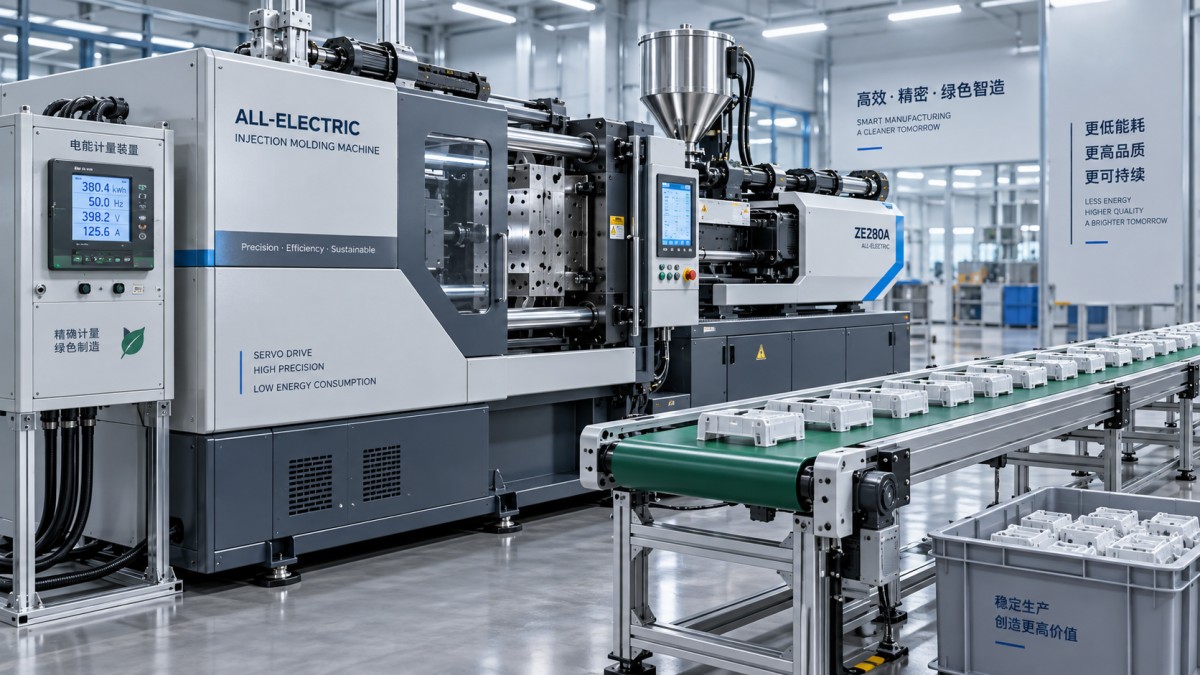
Set the metering boundary explicitly. A press-only measurement excludes dryers, mould-temperature controllers, chillers, robots and compressed air. Those loads can dilute the percentage saving visible at the complete production cell. Include a change in auxiliary consumption only when the proposed installation actually changes that demand.
For equivalent production hours and output, annual electricity savings equal the measured average power reduction multiplied by annual operating hours and the applicable energy tariff. If throughput differs, calculate each option’s energy requirement for the same annual quantity of accepted parts instead. Apply time-of-use rates where production scheduling matters; demand-charge savings require evidence that the site’s billed peak will fall.
Separate recoverable savings from technical improvements
Reduced hydraulic heat does not translate directly into an equal reduction in the electricity bill. The result depends on whether heat is removed through a chiller, cooling tower or another circuit, and how that equipment responds to reduced load. Fixed-speed equipment that continues running unchanged can limit the cash benefit.
Maintenance savings also need a net calculation. All-electric construction removes certain hydraulic service requirements, but lubrication, drive electronics, transmission components and specialist repairs remain relevant. Compare planned service and realistic failure exposure across the intended ownership period.
Keep unrelated plant expenditure outside the press comparison. A Steel cord rubber conveyor belt used for heavy-duty material handling belongs to its own equipment budget unless the press project directly changes that installation. Shared project timing does not make its cost or savings attributable to the moulding machine.
Establish whether the process can use the machine’s advantages
A faster clamp movement will not remove a cooling bottleneck. When cooling determines most of the cycle, higher motion speeds affect only the remaining movements. Similarly, overlapping machine actions creates value only where the mould, ejection arrangement and safety sequence permit it.
Validate injection pressure, injection speed, shot capacity, plasticising output and holding requirements together. A press that meets nominal clamping force can still be unsuitable for the screw recovery rate or sustained injection duty required by the part. An undersized injection unit can erase an apparent purchase saving through longer cycles or unstable processing.
Precision has financial value when it changes an observed loss. Reduced variation in cushion position or filling behaviour supports a scrap-saving assumption only if those variables contribute to current rejects. Defects caused by inconsistent resin moisture, blocked mould vents or uneven cooling need their own corrective work.
Additional capacity deserves similar discipline. If demand is fixed, a shorter cycle creates cash savings through fewer operating hours only where electricity, labour scheduling or other expenditure actually falls. Where extra output can be sold, use contribution after incremental material, packaging and downstream costs. Do not credit both avoided production hours and extra production from those same hours.
Find the utilisation threshold before approving the premium
A useful sensitivity calculation reverses the payback formula. Let the incremental installed investment be I, the target payback period be T, net savings per operating hour be S, and annual savings independent of operating hours be F. The required annual operating hours are:
Required annual hours = (I ÷ T − F) ÷ S
This simplified relationship assumes savings scale reasonably with hours and that production remains comparable. Use a production schedule model where changeovers, warm-up losses or multiple materials make that assumption unreliable. A threshold above available staffed capacity rules out the target payback under the stated assumptions.
Build a downside case around confirmed orders, measured energy differences and essential maintenance savings. Keep unproven scrap reductions and additional sales in a separate upside case. This reveals whether repayment relies on dependable cost reductions or on commercial outcomes that have yet to occur.
Let refurbishment compete on the same basis
A refurbished press can reduce the investment to recover, but its condition and process suitability determine whether that advantage survives operation. Establish the work completed, remaining wear, control-system support, spare-part availability and acceptance-test conditions. Warranty scope matters alongside duration: exclusions, labour coverage and responsibility for travel affect repair exposure.
Compare the refurbished option using the same mould trial, installed-cost boundary and annual production requirement as the new machine. Allow for controls integration and qualification time. A lower purchase price loses value if unavailable components or unstable processing interrupt the production schedule.
The approval threshold becomes concrete when the quotation, metered trial and production schedule agree. If the required annual hours fit committed demand and the downside cash flow recovers the premium within the ownership horizon, the all-electric investment has a defensible repayment case. If recovery requires every anticipated improvement to succeed, the price premium remains dependent on assumptions that still need evidence.