









Send Us A Message
How Straining Extruders Support Contamination Control in Rubber Compounds
A black speck found during a sheet inspection, an unexpected screen residue after a production run, or a recurring surface defect in a molded part can turn a routine quality review into a containment issue. In rubber processing, contamination is rarely limited to appearance. Foreign particles, scorched compound, hard gel, fiber, metal fragments, or poorly dispersed ingredients can affect extrusion stability, downstream tooling, finished-product uniformity, and, in safety-sensitive applications, the acceptability of the material.
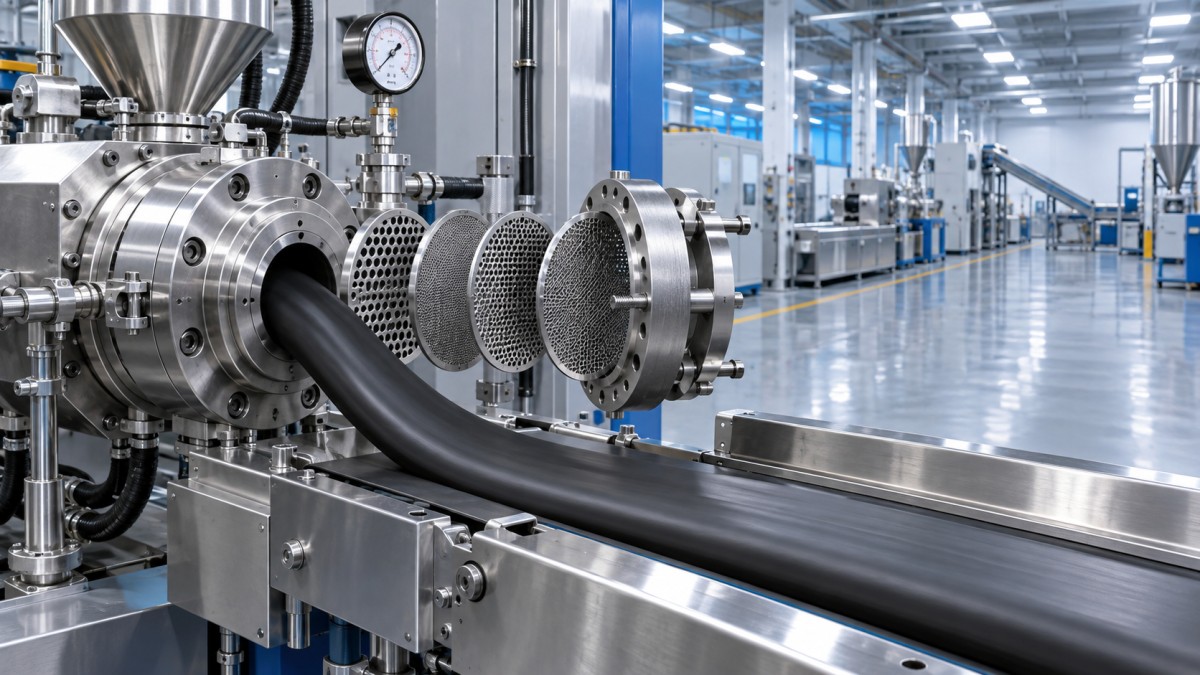
A straining extruder supports contamination control by forcing compounded rubber through a screen pack before the material enters later processing stages. It is not a substitute for good raw-material handling, mixing discipline, cleaning, or inspection. Its value is as a controlled filtering point: it can retain particles and agglomerates above the selected screen opening, generate evidence of abnormal contamination, and prevent suspect material from moving unnoticed into calendering, extrusion, molding, or sheet finishing.
Why contamination control needs a defined barrier
Rubber compounds can pick up contamination at more than one point. Packaging debris may enter during charging; accumulated material can break loose from a mixer or transfer line; carbon black or other ingredients may be incompletely incorporated; degraded rubber can form hard particles during a temperature excursion. Maintenance work introduces another exposure point, particularly where covers, guards, tools, fasteners, or cleaning materials are handled around open equipment.
Without a defined barrier, the first indication may appear far downstream. A die may show unstable flow, a calendered sheet may contain visible defects, or a molded component may fail visual inspection only after value has already been added. The later the discovery, the wider the potential lot review. A straining stage moves detection upstream and provides a practical separation point between “mixed compound” and “compound released for the next process.”
For quality and safety teams, the key point is not that every particle will be removed. Screen selection always has limits, and contaminants smaller than the opening may pass through. The control objective is to establish a validated, monitored process that addresses credible contamination risks for a defined compound and application.
What the screen pack can—and cannot—control
The screen pack creates resistance as rubber passes through it. This resistance helps capture oversize foreign matter and some unmixed or degraded material. The screen arrangement, mesh size, compound viscosity, throughput, temperature, and pressure behavior determine how the system performs. A finer screen can improve retention of smaller particles, but it also increases pressure demand and may raise the risk of excessive heat generation or unstable output.
A screen pack also cannot correct a fundamentally poor mix. When screen residue contains a high level of the compound itself rather than isolated foreign material, the process may be revealing dispersion, scorch, temperature, or cleaning problems upstream. Treating the extruder merely as a “clean-up machine” can hide a developing process failure until pressure rises, output becomes inconsistent, or the frequency of rejected material increases.
Build contamination control around observable process conditions
Effective control begins before the extruder is started. The screen specification should be documented by compound family and intended application, including the sequence of screens where multiple layers are used. Operators need an unambiguous method for confirming that the correct screen pack is installed. A screen that looks similar but has a different opening, material condition, or support arrangement can change both filtration performance and pressure response.
Before production release, verify that the feed area, screw zone, head, breaker plate, tools, and collection surfaces are clean and free of loose residues. Cleaning materials should themselves be controlled; cloth fibers, damaged brushes, and fragments of wiping media are avoidable contamination sources. After maintenance, a documented line-clearance check is especially important because loose hardware and displaced material may not become visible until flow begins.
Watch the pressure trend, not only the final reading
Pressure is one of the most useful indicators, but a single number does not explain the condition of the screen. A gradual rise at stable operating conditions often indicates normal screen loading. A rapid increase can indicate unusually high contamination, excessive screen fineness, colder-than-expected compound, early crosslinking, or a blockage in the flow path. A sudden pressure drop may suggest a damaged screen, an incorrect assembly, a leak path, or a significant change in feed consistency.
Set operating limits using the equipment design, compound behavior, and established internal process requirements. The response to an excursion should be defined in advance: reduce or stop feed where necessary, isolate material produced since the last acceptable verification point, inspect the screen pack, and investigate the cause before restarting. Continuing to run simply because output is still moving can expand the amount of material requiring review.
Screen residue is a quality signal
Screen changes are not just maintenance events. They are inspection opportunities. The removed material should be examined under a consistent routine appropriate to the product risk. Record the screen identification, time or batch reference, operating observations, and any unusual residue. Clear evidence of metal, fibers, packaging fragments, hard cured particles, or repeated ingredient clusters should trigger traceability and root-cause action rather than disposal without review.
The review should distinguish between isolated findings and recurring patterns. A single fragment associated with a known maintenance activity calls for a different response from repeated hard particles found across several batches. Repetition may point to dead spots in equipment, insufficient cleaning between compounds, material aging, unstable mixing conditions, or wear in transfer components. Where metal contamination is credible, upstream magnets, metal detection, and maintenance controls should be assessed alongside straining; no single device should carry the entire control burden.
Keep release decisions connected to downstream handling
Filtered compound can be recontaminated after the extruder. Open conveyors, exposed cooling surfaces, manual handling, floor-level storage, and poorly controlled collection trays all create opportunities for foreign matter to re-enter. This is why contamination control should follow the material through cooling, conveying, sampling, cutting, and stacking rather than stopping at the screen head.
For sheeted rubber, an automated cooling and conveying arrangement can reduce unnecessary handling after the filtration step. A Batch off line is designed for industrial rubber sheet cooling and includes PLC-controlled cooling, pressing, conveying, sampling, cutting, and sheet handling functions. Its separate water-bath arrangement and automated pick-up, conveying, swing, and folding functions can support a cleaner post-straining workflow when they are incorporated into a documented hygiene and inspection routine. The equipment itself still requires cleaning verification, controlled access, and inspection of contact surfaces between production runs.
Common control failures that weaken straining performance
- Using one screen specification for every compound: a setting appropriate for one formulation may overload another or fail to address a more sensitive downstream requirement.
- Changing screens only when pressure becomes excessive: this misses the inspection value of planned changes and can allow variable quality between events.
- Recording pressure without recording operating context: pressure trends are difficult to interpret without temperature, rate, compound identity, and screen details.
- Ignoring residue as “normal waste”: unusual residue can be the earliest visible signal of an upstream contamination source.
- Releasing material after a deviation without defining the hold point: traceability becomes weak when the last verified acceptable material cannot be identified.
A practical procedure should state who can approve screen changes, how installed screens are verified, which operating signals require action, how suspect compound is identified, and what inspection record accompanies the residue. These controls are often more important to consistent results than simply selecting the smallest possible mesh.
Using the straining stage in audit-ready quality assurance
Where a plant operates under an internal quality system or a customer-specific requirement, the straining extruder can provide useful objective evidence when its controls are documented. Useful records may include approved screen specifications, installation verification, cleaning and maintenance status, operating trends, screen-change logs, residue observations, deviation reports, and disposition of held material. The purpose is not paperwork for its own sake; it is to show that contamination risks were identified, monitored, and addressed before the compound reached a critical operation.
The strongest approach connects the filter to upstream prevention and downstream protection. Good receiving controls reduce what enters the process. Mixing and housekeeping reduce what develops or falls in. The straining extruder captures and reveals what remains. Controlled cooling, conveying, and storage help preserve the condition achieved at the filter. When these stages are managed as one chain, quality teams can investigate deviations earlier, limit the scope of material review, and make release decisions on evidence rather than assumptions.