









Send Us A Message
Why does a tire shredder keep reversing during normal feeding?
Why does a tire shredder keep reversing during normal feeding?
When your tire shredder keeps reversing during seemingly normal feeding, throughput drops and a frustrating question follows: is the machine protecting itself, or is something wrong? Automatic reversal often responds to excessive load, but repeated cycles can point to uneven feeding, worn cutters, trapped steel wire, or drive and control issues. The useful distinction is whether reversal clears an occasional difficult bite or has become the machine’s normal operating pattern.
Do not start by increasing the overload threshold. Establish what triggers the reverse command, then work back through the material, cutting chamber, drive, and controls.
Confirm whether it is overload protection or a programmed cycle
Many low-speed tire shredders monitor motor current, hydraulic pressure, shaft speed, or a combination of signals. When the configured overload condition is reached, the controller may stop forward rotation, reverse briefly, and retry. Other machines include timed reversing sequences. The operating manual and controller event history should identify which behavior applies.
An occasional reversal that releases a difficult tire and restores stable cutting may be expected. Repeated reversals on the same material, without meaningful discharge, suggest an unresolved restriction. Reversal under a lighter-than-usual load—or during an authorized empty-running check—deserves investigation beyond feeding technique.
Record the exact alarm or event message before resetting it. A drive fault followed by a restart is not necessarily the same as a deliberate anti-jam cycle, even if the shaft movement looks similar.
“Normal feeding” can still create an abnormal cutting load
A steady conveyor does not guarantee a steady load at the cutters. Tires can bridge above the chamber, then collapse together. Nested tires and overlapping sidewalls can present several layers at once. A change from passenger tires to heavier commercial tires may also increase cutting resistance without an obvious change in conveyor speed.
Watch from a designated safe position: does reversal follow a bundle entering, a bead section reaching the cutters, or material collecting faster than it leaves? Strong bead bundles can be difficult to process, particularly when the feed differs from the machine’s approved specification. Whether debeading or pre-cutting is necessary depends on the shredder design and tire type.
Where operating procedures permit, reduce the feed rate and separate incoming tires using the installed feeding equipment. If cutting stabilizes, investigate feed presentation and material suitability before suspecting the controls. Never push, pull, or reposition tires by hand near the hopper.
Check what prevents material from clearing
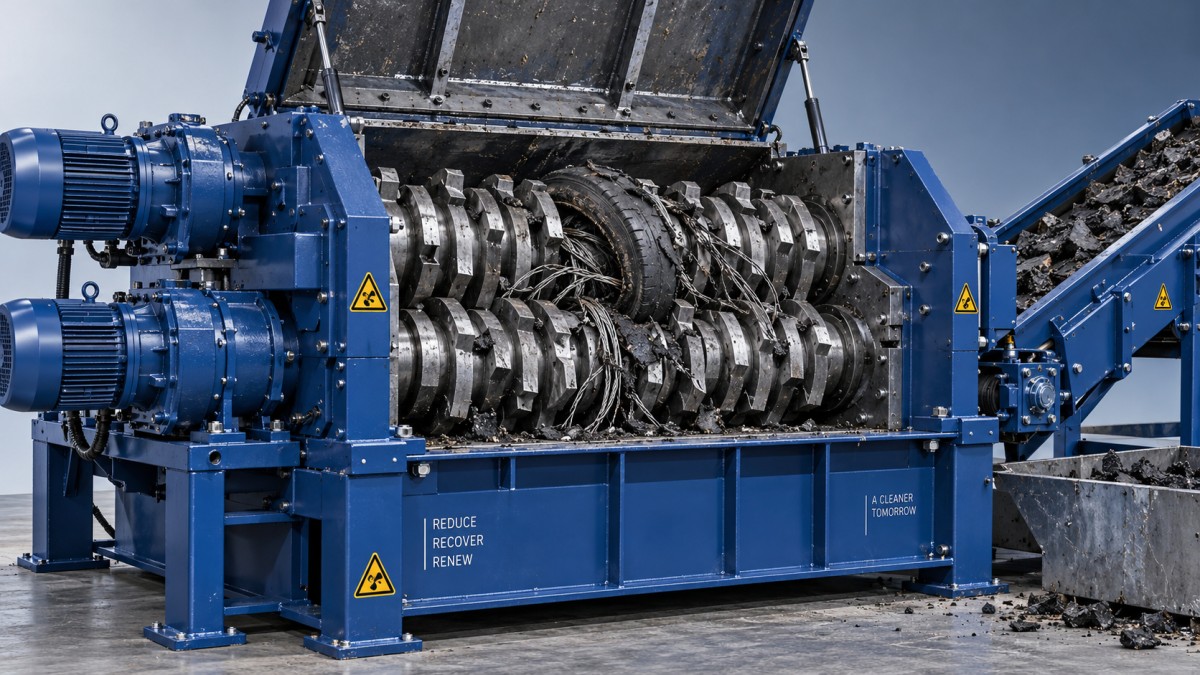
A chamber can look busy while doing little useful cutting. Rounded cutter edges may grip and stretch rubber rather than shear it cleanly. Damaged cutter teeth, unsuitable clearances, or worn cleaning components can leave material circulating instead of moving through. These conditions need inspection against the manufacturer’s wear limits—not a generic clearance taken from another machine.
Steel reinforcement adds another complication. Released wire can wrap around shafts or collect near spacers and cleaning fingers. Reversing may briefly loosen the accumulation without removing it, so the same overload returns on the next forward cycle.
Also check the discharge system. A stopped takeaway conveyor, obstructed chute, or overloaded downstream separator can prevent processed material from leaving. On machines with a sizing screen, screen blockage may contribute. Do not assume every tire shredder has this arrangement.
Stop for inspection if there is persistent non-clearing material, unusual metallic impact, smoke, leakage, or abnormal vibration. Isolate and lock out all energy sources, control stored energy according to the machine procedure, and verify isolation before access. Wire and rubber can retain tension; removal requires suitable tools and trained personnel.
Use operating signals to narrow the fault
The sequence immediately before reversal is more useful than a single peak reading. Compare observations with the machine’s documented settings and its own stable operating history.
- Load rises as the shaft slows: excessive bite size, trapped material, cutter wear, or mechanical resistance are plausible causes.
- Reversal occurs without a corresponding load increase: review timed cycles, speed feedback, signal scaling, and the recorded command source.
- The problem develops as the machine warms: check temperature trends, cooling performance, and drive alarms. On hydraulic machines, oil condition and hydraulic performance also need assessment.
- One shaft behaves differently on a twin-shaft machine: inspect that shaft’s cutting assembly, drive, and feedback rather than treating the issue only as excess feed.
Electrical testing, pressure testing, and controller diagnostics belong with qualified technicians. Operators can provide timestamps, displayed readings, tire descriptions, and safely captured video without opening panels or approaching moving parts.
Do not tune away the warning
Increasing current limits, hydraulic relief pressure, or overload delay may reduce visible reversals while increasing stress on cutters, shafts, gearboxes, and motors. Shortening the reverse interval can also leave insufficient time to release a jam. Any adjustment must remain within approved limits and follow identification of the cause.
After corrective work, restart under the manufacturer’s procedure with controlled feeding. Compare forward-running stability, discharge consistency, load trends, and reversal events under comparable material conditions. Fewer reversals are not an improvement if the machine is simply carrying a higher sustained overload.
For refurbished equipment, verify the operating baseline
A used shredder may have replacement cutters, a changed drive, or control settings inherited from another application. Confirm the approved feed specification, installed components, protection settings, and commissioning records. Refurbishment alone does not establish suitability for every tire stream.
JC INDUSTRY combines machinery design, manufacture, installation, commissioning, and consultation across rubber, environmental, and foundry equipment. Its Used Machinery and Equipment Recycling Center, established in 2015, provides a relevant context for reviewing machine condition and configuration. The company states a 24-month warranty for both new and used equipment; coverage and service arrangements should be confirmed in the purchase documents.
Its used tire-manufacturing equipment also includes used_second hand Calender machinery. That is a separate manufacturing application, not a remedy for shredder reversal; equipment assessments should remain specific to each machine’s duty.
For recurring reversals, prepare the machine model, feed description, alarm history, load readings, maintenance record, and details of recent changes before requesting technical support. That evidence helps distinguish a feeding problem from wear, restricted discharge, or a control fault—without weakening the protection keeping the machine safe.