









Send Us A Message
How Retreading Machines Help Prevent Tread Separation in Truck Tyres
Tread separation rarely begins with one dramatic mistake. It usually develops when several controls drift at the same time: a casing with hidden damage enters production, buffing leaves an uneven surface, the bonding layer is contaminated or poorly applied, or curing conditions vary from tyre to tyre. A properly configured tyre retreading machine helps prevent these failures by making each critical stage repeatable, measurable, and easier to trace.
For quality-control and safety managers, the goal is not simply to produce a retread that looks uniform. The objective is to establish a process in which only suitable casings are accepted, bonding surfaces are prepared consistently, and every tyre receives the intended building and curing conditions. Equipment matters because manual work can introduce variation; however, equipment alone cannot compensate for weak inspection rules or poorly maintained process controls.
Separation prevention starts before the new tread is applied
A separated tread may appear to be a bonding failure, but the cause can be embedded in the original casing. Damage around the belt package, fatigue from prior overload, moisture intrusion, exposed steel, or an unsuitable repair can all reduce the casing's ability to support a new tread under highway heat and cyclic loading.
The inspection section of a retreading line should therefore act as a release gate, not a formality. A good process combines visual inspection with internal casing assessment appropriate to the plant's work. The operator should be able to identify whether the casing is structurally suitable for retreading, not merely whether it can be made to look acceptable after buffing.
Quality teams should also record why casings are rejected. Repeated rejection patterns can reveal upstream fleet problems, such as persistent underinflation, axle misalignment, excessive heat exposure, or unsuitable service routes. Retreading equipment improves consistency, but casing quality remains the first condition for reliable adhesion.
Why controlled buffing has a direct effect on bond reliability
Buffing removes the worn tread and creates the prepared surface that will receive the cushion gum and replacement tread. If the contour is inaccurate, the new tread may not sit evenly on the casing. If the surface is too smooth, the bond may be weaker; if it is excessively rough or damaged, it can create stress concentrations and waste casing material.
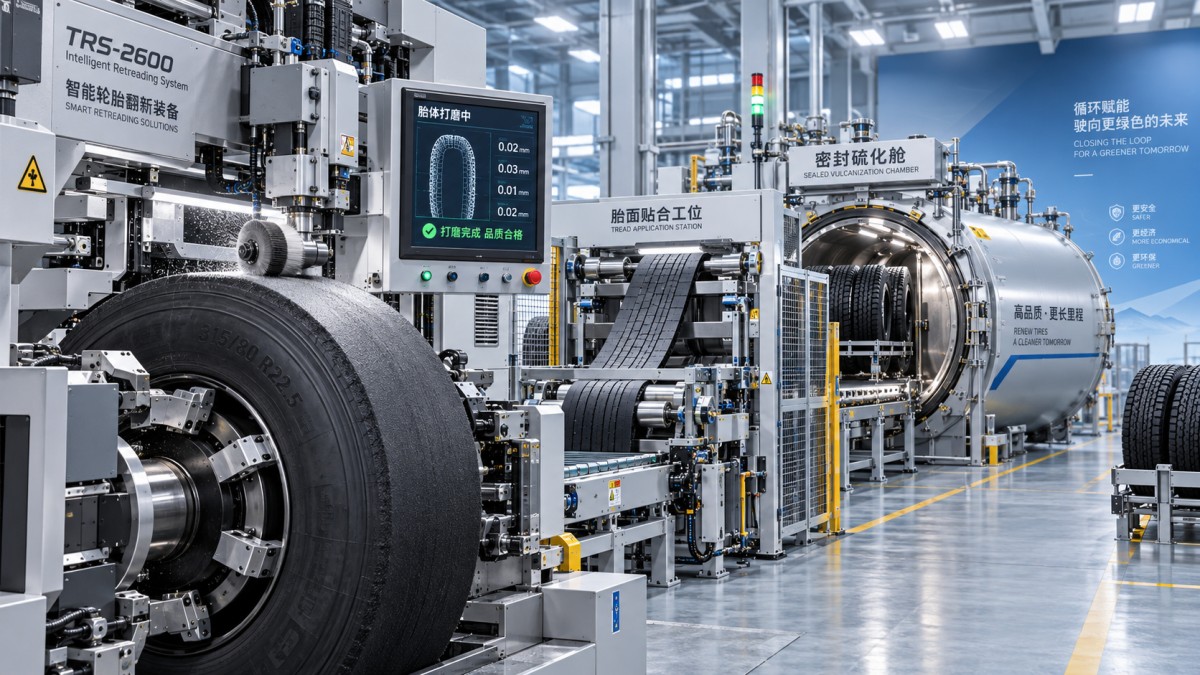
A tyre retreading machine with controlled buffing parameters helps operators maintain the required profile across different truck tyre sizes and casing conditions. Consistent buff radius, crown shape, shoulder geometry, and residual tread depth give the building stage a more stable foundation. This is especially important at the shoulder area, where heat and flexing are often more demanding in service.
Buffing dust should also be controlled. Fine rubber debris, loose wire fragments, oil, moisture, and handling contamination can interfere with the bonding system. A common mistake is to focus on the machine setting while treating cleaning as secondary. A correctly buffed casing still needs to be clean, dry, and protected from contamination before the next stage.
Building equipment reduces variation in the adhesive interface
The bond between casing and tread depends on intimate, even contact throughout the tyre circumference. During building, the cushion gum and tread must be positioned without trapped air, folds, stretched sections, or poorly joined ends. These defects may not be visible after curing, yet they can become initiation points for separation during service.
Machine-assisted building helps standardize tread centering, tension, stitch-down pressure, and overlap control. The benefit is practical: operators can follow a repeatable sequence instead of relying only on visual judgement and individual technique. For safety managers, this also makes training and audit work more meaningful because the key settings and actions can be defined in a work instruction.
Automation is most useful when it supports process discipline. It should not encourage teams to skip verification. Operators still need to check tread alignment, shoulder seating, splice quality, and the condition of consumable materials before the tyre enters the curing stage.
Curing control is where a sound assembly becomes a durable retread
During curing, heat and pressure activate the bonding system and consolidate the tread, cushion gum, and casing into one assembly. Poor pressure distribution, unsuitable temperature control, an incomplete cycle, or damaged envelope equipment can leave areas of inadequate consolidation. The result may be a tyre that passes a visual check but has a reduced margin against heat, load, and repeated flexing on the road.
Reliable curing equipment supports consistent cycle execution, but quality control should verify the condition of the whole curing system: envelopes, rims, seals, valves, pressure lines, temperature sensors, and the records that show the cycle was completed. A process record is valuable only when the readings are linked to the tyre or batch and reviewed when defects or customer returns occur.
Choose equipment around control points, not only output capacity
When evaluating retreading equipment, production capacity matters, but it is not the strongest indicator of separation prevention. Quality and safety teams should first confirm whether the equipment can hold the settings that affect casing preparation, tread application, and curing consistently across the tyre range being processed.
- Check whether settings can be repeated by shift, operator, and tyre size rather than recreated from memory.
- Confirm that inspection, buffing, building, and curing stages can be linked through clear tyre identification and production records.
- Review access for cleaning, calibration, and maintenance. A difficult-to-maintain machine tends to lose process stability over time.
- Match automation to the plant's actual operating discipline. More automation is useful only when procedures, training, and verification keep pace with it.
- Assess service support, commissioning, and operator training alongside the machine specification.
JC INDUSTRY develops rubber and plastic machinery alongside digital tyre mould and other industrial equipment, with a focus on integrating information communication, electronic control, and intelligent equipment. For retreading operations, that combination is relevant when a plant needs stronger process visibility rather than isolated machines that cannot support consistent production records.
Do not confuse retreading controls with end-of-life tyre handling
Rejected casings and production scrap need a separate disposal or recycling route. This activity does not prevent tread separation in tyres that remain in service, but it can improve housekeeping and material segregation in a retreading facility. For industrial scrap processing, a used_second hand Tyre shredder can process whole waste steel-wire radial tyres into rubber chips below 50 x 50 mm. The ZPS-900 and ZPS-1200 configurations are intended for different tyre sizes and processing volumes, with automated control functions that include overload reversal.
That equipment should be evaluated as part of a waste-tyre handling system, not as a substitute for casing inspection or retread process control. Mixing these decisions is a common procurement error because both deal with tyres, but they solve entirely different safety and production problems.
The checks that matter after curing
Final inspection should look beyond surface appearance. Inspectors need to assess tread placement, shoulder condition, splice area, curing-related defects, and any sign that the casing or tread assembly has been compromised. Where a plant uses non-destructive inspection methods, they should be integrated into a documented release decision rather than used inconsistently after a problem has already occurred.
The most useful response to a separation incident is to trace it backward through the process: casing acceptance, buffing parameters, materials used, building checks, curing record, final release, and the tyre's service conditions. This separates a one-off operating error from a recurring system weakness. When the same defect appears across multiple tyres, changing the final inspection standard alone is rarely enough; the earlier process stage that introduced the variation must be corrected.
A dependable retreading operation is built on controlled preparation, clean bonding conditions, accurate assembly, verified curing, and traceability. The machine provides the repeatability. The quality system ensures that repeatability is applied to the right casing, with the right materials, every time.