









Send Us A Message
What does ISO 20430 cover for injection moulding press safety?
What does ISO 20430 cover for injection moulding press safety?
Assessing an injection moulding press means looking beyond cycle time, shot consistency and clamping force. ISO 20430 addresses the safety of injection moulding machines processing plastics or rubber, including hazards from closing platens, moving mechanisms, hot materials and pressurised systems. It provides a basis for evaluating protective measures, safety-related controls and the information needed for safe operation.
For equipment acceptance, the useful question is not simply whether a supplier mentions the standard. It is whether the machine’s actual configuration, operating modes and supporting evidence demonstrate that its hazards have been addressed.
Start with the machine’s process, not its name
ISO 20430:2020, Plastics and rubber machines — Injection moulding machines — Safety requirements, is a machine-specific, or Type-C, safety standard. It addresses significant hazards associated with these machines and specifies protective measures and verification requirements. Use the applicable edition and national adoption when defining a project’s acceptance criteria.
This distinction matters in metalworking plants, where different machines may all be called “presses.” A plastics injection moulding machine producing components for metal assemblies is not the same equipment category as a metal stamping press or a metal die-casting machine. Shared features—platens, hydraulic circuits and guarding—do not make their safety standards interchangeable.
Nor does ISO 20430 automatically cover every hazard introduced by a complete production cell. Robots, conveyors, material-handling equipment and other attachments need their own assessment and appropriate standards. Their interfaces with the moulding machine must also be evaluated.
The hazards extend beyond the mould-closing area
The mould area deserves close attention because a closing platen can cause fatal crushing injuries. However, an inspection limited to the front safety gate leaves substantial gaps. Depending on the machine design, the assessment must also consider access from the rear, above, below and through openings used for parts discharge or auxiliary equipment.
- Clamping and mould mechanisms: crushing and shearing at platens, toggle mechanisms, ejectors and powered cores.
- Injection unit: hazardous movement of the injection carriage, accessible drive components and danger around the nozzle area.
- Thermal and material hazards: contact with heated surfaces and exposure to hot material during injection, leakage or purging.
- Energy systems: electrical hazards, pressurised hydraulic or pneumatic circuits and stored energy that can remain after a stop.
- Other operating risks: noise, access for maintenance and hazards associated with foreseeable intervention tasks.
Machine geometry changes the assessment. A vertical clamping arrangement, for example, requires attention to unintended downward movement. A large machine that permits whole-body entry raises different access and restart concerns from one where only a hand can reach the danger zone.
Guarding, interlocks and emergency stops must work together
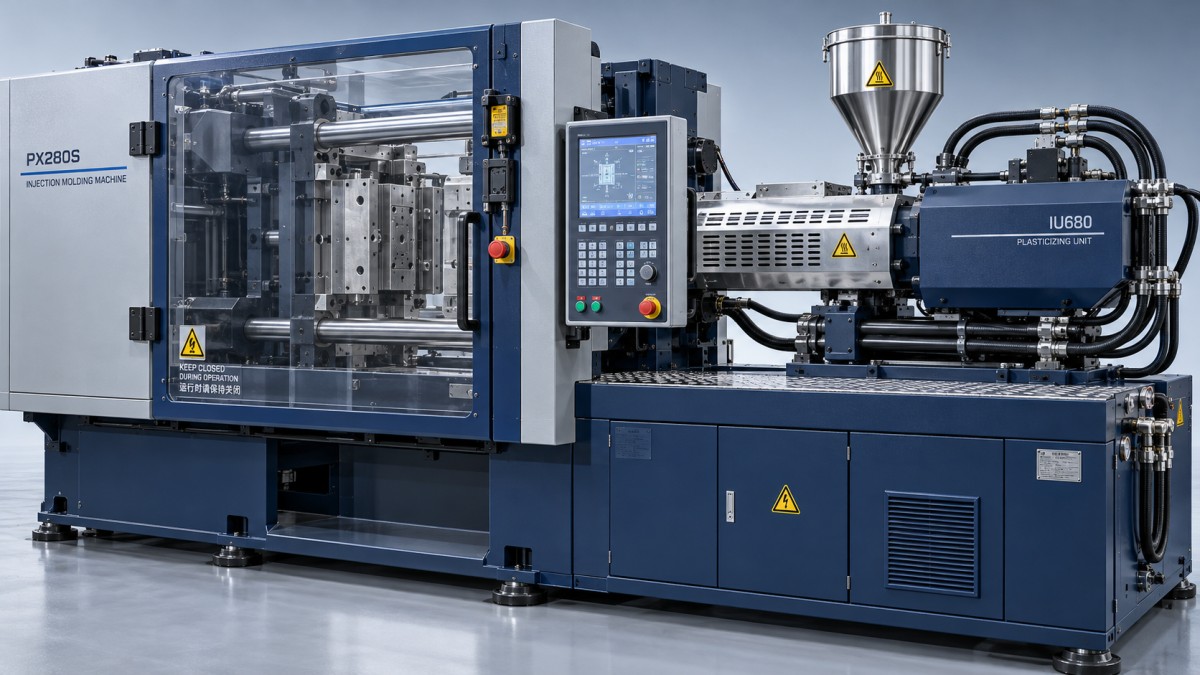
A guard is not adequate merely because it separates an operator from moving parts during normal production. Its openings, position and construction must prevent relevant access. Where access is needed, interlocking must control the associated hazardous functions. Where stopping time leaves a danger accessible, guard locking may be necessary; the actual design must follow the applicable requirements.
Safety-related controls need documented performance and validation. Ask which safety functions are implemented, which movements they affect and how faults are detected. ISO 13849-1 and ISO 13849-2 are relevant references for control-system design and validation, but a single performance-level claim should not be applied indiscriminately to every function.
An emergency stop is a complementary protective measure, not a replacement for guarding. It is also not an energy-isolation device. A stopped press may still contain hydraulic pressure, charged accumulators, hot polymer or components capable of moving under gravity.
Pay particular attention to reset and restart behaviour. Closing a guard or resetting a protective device should not, by itself, create an unexpected hazardous restart. Where someone can enter completely, the protective arrangement must address the possibility of that person remaining inside.
Review intervention tasks—not just automatic production
Mould changes, setting, purging, cleaning and fault recovery expose weaknesses that a normal production demonstration can miss. Identify which tasks require access, whether movement is necessary and what protective measures apply in each selected mode. A mode selector alone does not establish that an intervention is safe.
Cleaning equipment illustrates why process boundaries matter. JC INDUSTRY’s Platen cleaning device is intended for heating platens on conveyor-belt curing presses, not automatically for an injection moulding press. Its stated operating conditions include platen daylight of 230–350 mm, temperature below 60°C and a 380 V AC, three-phase, four-wire supply; it includes a brush roller, remote control and spare parts.
Those parameters help establish compatibility, but they do not establish ISO 20430 conformity. Any cleaning attachment requires assessment of access, entanglement, electrical connection and isolation arrangements. Remote operation does not remove the need to prevent hazardous press movement.
Turn the standard into an acceptance evidence trail
A supplier statement is a starting point, not the complete acceptance record. Request evidence tied to the delivered serial number and configuration. Useful records include the applicable standards list, safety-function descriptions, validation results, electrical and fluid-power diagrams, operating instructions and documented residual risks. The precise documentation supplied depends on contractual and legal requirements.
During factory and site acceptance, agree safe, documented checks such as:
- Verifying which hazardous functions each interlocked guard inhibits.
- Checking protective-device reset behaviour and prevention of unexpected restart.
- Confirming that robot interfaces and parts-discharge openings do not create unprotected access.
- Reviewing isolation points, stored-energy release and mechanical restraint instructions.
- Checking that installed software, safety components and drawings match the validated configuration.
Fault-response testing should be planned and performed by competent personnel using controlled procedures. Improvised switch bypassing is not an acceptable acceptance method.
Refurbished machinery needs configuration-specific scrutiny
A refurbished injection moulding press may have replacement controls, altered hydraulic circuits or a different guarding layout. Original documentation cannot automatically validate those changes. Establish what was modified, who assessed it and which tests support the finished machine.
JC INDUSTRY combines machinery manufacture with installation, commissioning and consultation, and established its Used Machinery and Equipment Recycling Center in 2015. Its stated 24-month warranty covers both new and used equipment. That support is relevant to maintenance planning, but warranty duration is separate from proof of safety conformity.
ISO 20430 is not, by itself, a certificate or permission to operate in every market. Local legislation, the machine’s history and the extent of modifications also matter. Before acceptance, resolve any gap between the supplied documentation, the installed protective measures and the tasks people will actually perform. A repeatable cycle proves production capability; it does not prove safe access, safe intervention or safe restart.