










Send Us A Message
How rubber temperature affects the load on a bale cutter
Cold rubber generally increases the force needed to cut a bale because it resists deformation and blade penetration more strongly. Warming the same material often reduces that resistance, but excessive warmth introduces tack, blade drag, and distortion. The lowest cutting pressure therefore does not necessarily produce the most reliable cycle. A useful operating condition combines manageable cutting force, clean separation, and stable handling within the bale cutter’s approved limits.
Temperature alone cannot define the expected load. Rubber grade, bale dimensions, blade condition, cutting speed, and temperature differences inside the bale all influence the result. Pressure readings become meaningful when these conditions are recorded together.
Where temperature changes the cutting load
Uncured rubber is viscoelastic: its response combines elastic deformation with time-dependent flow. At a lower temperature, molecular movement is more restricted, so the material generally offers greater resistance as the blade enters and pushes through it. Faster blade movement also leaves less time for deformation. A cold bale cut quickly can therefore demand substantially more force than the same grade cut under warmer, otherwise comparable conditions.
The load develops through several overlapping mechanisms. The cutting edge initiates separation, the blade faces displace the surrounding rubber, and friction resists movement along those faces. Temperature affects each mechanism differently. Softer rubber can require less force at the edge while maintaining substantial contact and adhesion against the blade.
This explains an apparently contradictory result: warming a bale reduces the initial pressure peak, yet the blade still travels slowly or pulls material upward during retraction. The resistance has shifted toward sustained drag and adhesion. Raising hydraulic pressure does not address that change.
Rubber grades also respond differently. Polymer type, filler content, oils, and storage history affect stiffness and tack. A temperature that produces clean cuts in one material is not automatically suitable for another. Comparisons between grades should use separate operating records.
A warm surface can hide a cold center
A bale brought from cold storage into a warmer production area develops a temperature gradient. Its exposed surface warms first, while the interior responds more slowly. A surface reading can therefore suggest readiness even when the blade will encounter a much stiffer core.
One possible symptom is relatively easy entry followed by a pronounced pressure rise deeper into the cut. That pattern supports a temperature-gradient explanation only after allowing for bale geometry: the blade may also be engaging a larger cross-section at that point. A repeatable rise at a particular machine position, regardless of material, requires investigation of the cutter itself.
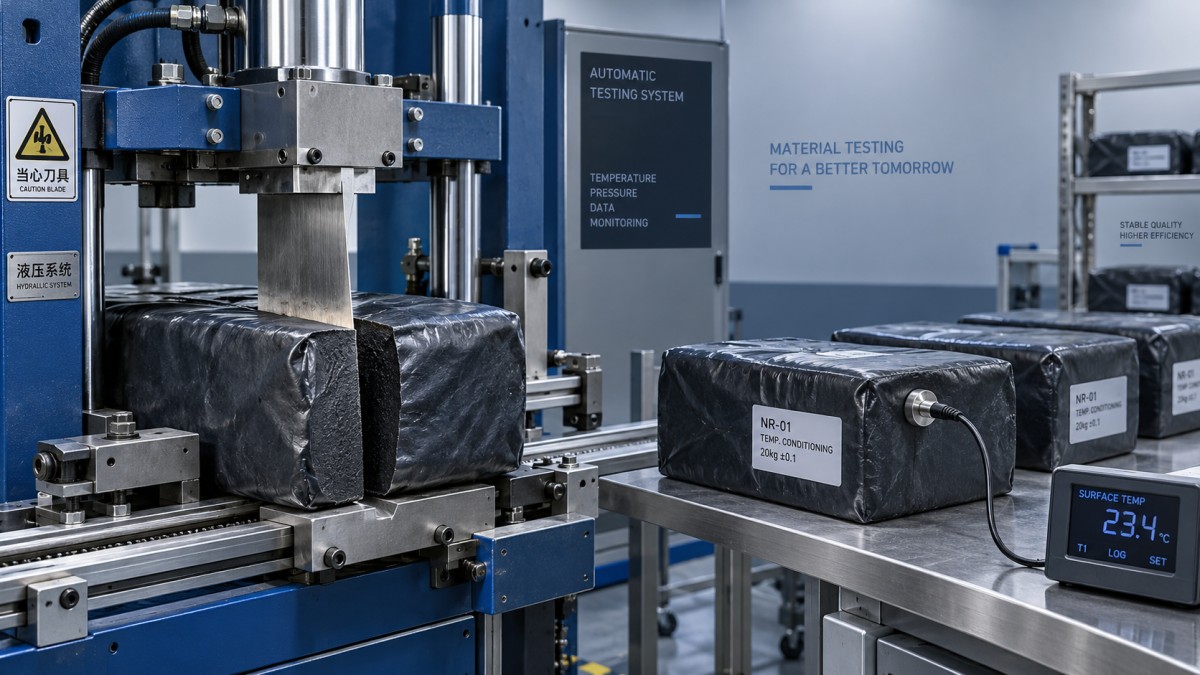
Infrared instruments measure surface temperature, and packaging film, reflections, or inconsistent measurement locations can distort comparisons. Use the same exposed-rubber location and measurement method for each trial. Where core temperature is needed, use an approved sampling or contact-measurement procedure outside the guarded cutting area. Do not reach into the machine to obtain a reading.
Conditioning time should be established for the actual bale size, storage arrangement, and material. Closely stacked bales exchange heat differently from separated bales. Localized heating can soften the outside excessively while leaving the center cold, making a single temperature reading even less representative.
Read hydraulic pressure alongside blade movement
Hydraulic pressure provides an indication of cylinder demand, but it is not a direct measurement of rubber cutting resistance. Cylinder area, return-side pressure, seal friction, guide resistance, and mechanical arrangement influence the force reaching the blade. For a directly driven cylinder, pressure multiplied by effective piston area gives a simplified force estimate; opposing pressure and friction must still be considered.
A gauge approaching the relief setting shows that the hydraulic circuit is nearing its configured pressure limit. It does not establish whether the cause is cold rubber, a damaged edge, excessive bale thickness, or mechanical binding. Increasing the relief setting to overcome a difficult bale risks exceeding the machine’s approved loading.
Cold oil and cold rubber frequently occur together at startup. Oil viscosity affects hydraulic flow and pressure losses, while rubber temperature affects material resistance. Following the specified hydraulic warm-up procedure before comparing cuts helps separate these effects.
Peak pressure also says little about total cycle demand by itself. A short pressure peak and a prolonged high-pressure dwell impose different demands. Record penetration time, any stall, and retraction behavior alongside the maximum reading. Repeated relief operation adds heat without delivering useful blade travel.
Establish a working temperature range through controlled comparisons
There is no universal rubber temperature or pressure threshold suitable for every bale cutter. Start with the machine manual and the material supplier’s handling limits. Within those boundaries, a controlled comparison can identify a practical conditioning range:
- Select bales of the same grade with comparable dimensions and storage history. Keep blade condition, orientation, and machine settings consistent.
- Record the rubber measurement location, temperature, hydraulic warm-up status, peak cutting pressure, and penetration time. Include whether separation and retraction are clean.
- Repeat after approved conditioning, changing only the material-temperature condition as far as practical. One unusually easy cut is insufficient evidence of a stable process.
- Stop the trial if travel stalls, the relief valve operates repeatedly, the bale shifts abnormally, or vibration appears. Follow the machine’s recovery procedure before further investigation.
Choose a range that remains workable despite normal variation between bales. Seeking the lowest possible pressure can push the material into a condition where sticking and handling delays dominate. Reduced cutting resistance is useful only when the complete cycle remains controlled.
Upstream conditioning records should also remain separate from downstream tire inspection results. A Balance testing machine measures finished-tire dynamic balance and ovality; those measurements do not establish whether a bale’s cutting temperature was suitable. Cutting conditions require evidence from the cutting process itself.
When conditioning does not resolve the resistance
If comparable, conditioned bales still require excessive force, inspect the cutting system under the prescribed isolation procedure. A rounded edge increases deformation before separation begins. Rubber buildup increases contact drag, while damaged guides or incorrect alignment can create resistance throughout the stroke. Blade geometry and cutting clearances must remain within the equipment specification.
Uneven support deserves attention as well. A bale that tilts or shifts changes the load distribution and can introduce side loading. Embedded foreign material can produce a sudden local obstruction that warming will not resolve.
Speed changes require similar care. Slower travel can reduce rate-related resistance in some rubbers, but tacky material may remain in contact with the blade longer. Use only approved settings and compare the full cycle. If acceptable cutting requires operation beyond the specified pressure, bale size, or temperature limits, stop processing that condition until the material preparation or equipment issue is resolved.