









Send Us A Message
Understanding Pressure, Temperature, and Filtration in Straining Extrusion
Understanding Pressure, Temperature, and Filtration in Straining Extrusion
In straining extrusion, pressure, temperature, and filtration work as one operating system rather than three independent settings. A change in screen pack can alter pressure demand; higher pressure can increase shear heating; a small temperature shift can change compound viscosity enough to affect both throughput and contaminant removal. For technical evaluation, this is why nameplate output alone says very little about the real capability of a straining extruder.
The practical purpose of straining is straightforward: remove foreign particles, undispersed ingredients, scorch particles, or degraded material before the compound reaches a more sensitive downstream process. In tire, hose, seal, belt, and industrial rubber production, the consequences may not be visible at the extruder itself. They often appear later as surface defects, die lines, weak spots, processing interruptions, or rejected cured products. Plastic compounds face a similar issue where contamination can affect film appearance, extrusion consistency, or molded-part integrity.
The difficult part is that cleaner output normally requires more resistance to flow. A sound evaluation therefore looks at how the equipment manages that resistance without overheating the compound, creating unstable output, or forcing screen changes so frequently that the line becomes uneconomical.
Pressure is useful information, not simply a load to overcome
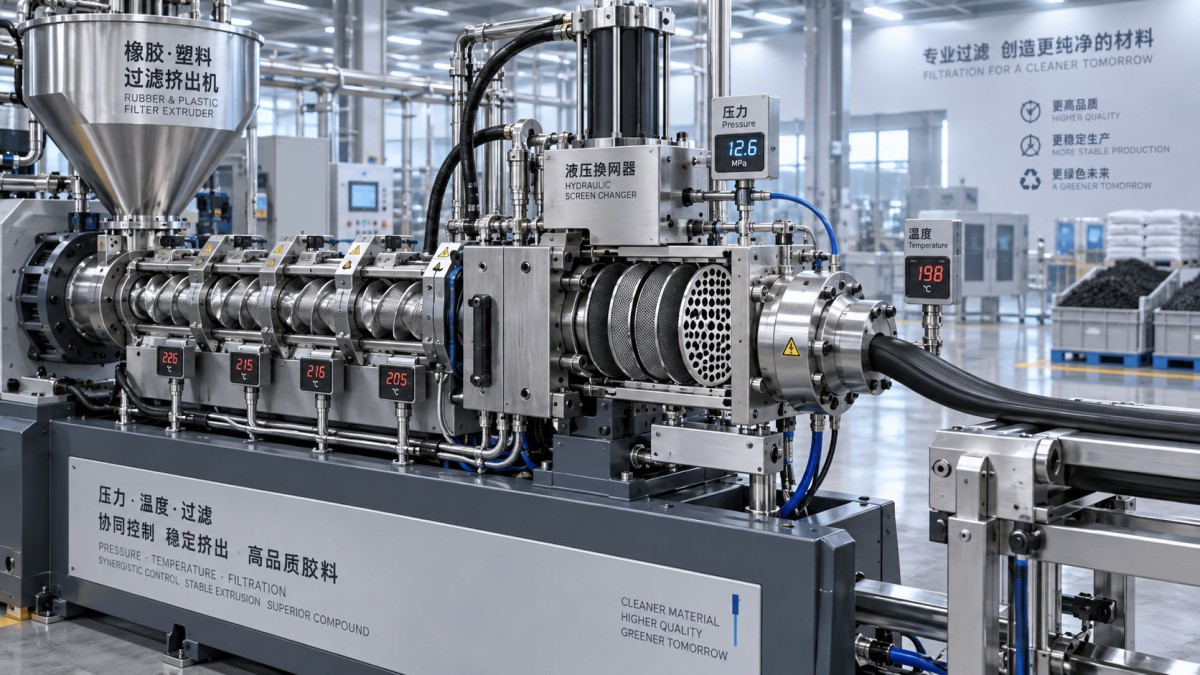
Pressure develops as material is pushed through the breaker plate and screen pack. It is affected by compound viscosity, feed consistency, screw design, screen area, screen mesh arrangement, die geometry, and the amount of contamination retained by the filter. A pressure reading is therefore meaningful only when it is considered together with temperature, screw speed, output rate, and the screen configuration in use.
A common mistake is to interpret high pressure as proof of good filtration. It may indicate effective screening, but it can also mean that the system is approaching an unstable operating point. If pressure climbs rapidly during a run, the first question should be whether the screens are loading with contaminants or whether the incoming compound has changed. A colder batch, a variation in filler dispersion, or partially pre-cured material can all increase resistance before the screen pack is genuinely blocked.
Pressure stability matters as much as the absolute number. A machine that repeatedly surges may produce an inconsistent strand or sheet even when its average pressure appears acceptable. For this reason, evaluators should request trend data where available, not only a single pressure value taken during commissioning. The pressure curve during startup, steady production, and screen-change intervals reveals much more about process control than a brochure capacity figure.
The mechanical side deserves equal attention. The barrel, head, screen changer, seals, and drive train must be rated for the intended duty cycle and maximum operating pressure. Safety relief arrangements, interlocks, guarding, and maintenance access are not peripheral details on a high-pressure line. They affect whether a plant can service the equipment safely and return it to production without introducing avoidable contamination.
Temperature control begins before the material reaches the screen
Rubber and many polymer compounds are highly sensitive to thermal history. In a straining extruder, heat comes from barrel zones and, often more significantly, from internal friction and shear. When the screen pack becomes restrictive, the compound may experience additional shear near the breaker plate. Raising external heating to restore flow can make the problem worse if the material is already generating excess internal heat.
The goal is not maximum temperature uniformity in an abstract sense; it is a temperature profile that provides stable viscosity while protecting the compound. Depending on formulation and process requirements, some materials need controlled warming to flow through a fine screen. Others require active cooling around high-shear zones to prevent scorch or degradation. The correct profile must be validated against the compound specification and the allowable residence time, rather than copied from another line.
Sensor placement is especially important. A barrel-zone reading may look stable while the actual melt or rubber stock temperature near the head is drifting. Evaluators should distinguish between controller setpoint, barrel surface measurement, and material temperature. These values are related, but they are not interchangeable. Reliable control also depends on the response of heating and cooling circuits, calibration practice, and whether alarms identify a meaningful process deviation rather than merely a failed sensor.
This same discipline carries into downstream curing equipment. For example, an used_second hand Cured belt inspection and repair line for industrial belt curing is specified with steam-heated platens, a temperature control tolerance of ±1°C at 155°C, and an 800 kPa steam supply requirement. Those figures do not define straining performance, but they illustrate why temperature data must be read in context: sensor accuracy, heating medium, heat-up time, platen uniformity, and the actual product interface all influence the final result.
Filtration is a compromise between cleanliness and processability
A screen pack is not selected by mesh size alone. Fine screens can capture smaller contaminants, but they also reduce open area and raise pressure drop. Screen material, wire construction, supporting screens, breaker-plate design, and filtration area all influence the result. In practice, a staged screen pack may be used so that coarser layers support finer filtration layers and distribute the loading more gradually. The right arrangement depends on the contaminant profile and the downstream sensitivity of the compound.
There is no universally “best” mesh count. A compound supplied to a visible extruded profile may justify a different filtration strategy from a compound going into a less appearance-critical molded component. Likewise, a material containing occasional hard particles requires a different assessment from one where the main concern is poor dispersion or gel-like contamination. Technical teams should define the defect they are trying to prevent before specifying the screen pack.
Screen life is also a production parameter. Very frequent changes improve neither quality nor operating cost if they create temperature loss, material waste, or inconsistent restart conditions. Continuous or hydraulic screen-changing systems can reduce interruption, but their value depends on the material, output rate, and maintenance capability of the site. A simpler arrangement may be more appropriate where product changes are frequent or where operators need rapid visual inspection of removed contaminants.
What to verify during equipment evaluation
When comparing a straining extruder, ask suppliers to describe the operating window rather than only the maximum output. The useful questions are: What compound hardness and viscosity range has the machine been designed to handle? What screen area and screen-changing method are proposed? How are pressure and stock temperature measured near the head? What happens when pressure reaches the defined limit? Can the control system record trends and integrate with plant networks?
For a manufacturer such as JC INDUSTRY, whose equipment scope includes rubber and plastic machinery, foundry equipment, environmental equipment, and digital tire mold systems, cross-process experience can be relevant when it improves installation, controls integration, and service planning. But the straining unit should still be assessed on its own process evidence: material trials, control architecture, wear-part availability, screen-change procedure, and the clarity of commissioning acceptance criteria.
Used or refurbished equipment deserves the same discipline. A 24-month warranty can reduce concern, but it does not replace inspection of barrel wear, screw condition, hydraulic seals, instrumentation calibration, electrical documentation, and the availability of replacement screens or seals. In many retrofit projects, the most worthwhile upgrade is not a larger motor; it is improved pressure sensing, temperature monitoring, and PLC data visibility that allows operators to see a developing filtration problem before quality is affected.
A well-chosen straining extruder does not merely force more compound through a finer screen. It maintains a controllable balance: enough pressure to filter effectively, enough thermal control to preserve the compound, and enough filtration area to run predictably. That balance should be demonstrated with the actual material and intended screen pack whenever possible. It is the difference between a machine that can run and a process that can be trusted.