









Send Us A Message
What determines discharge size in a single-shaft shredder?
What determines discharge size in a single-shaft shredder?
Why does a single-shaft shredder produce uneven output when the screen size stays the same? Screen aperture is the main sizing control, but it does not determine every dimension of every discharged piece. Blade geometry, cutting clearance, rotor speed, feed conditions, and material properties all influence the final particle distribution. In metal processing and equipment recycling, understanding those interactions helps explain why one batch produces compact fragments while another contains long strips, fines, and folded pieces.
The screen controls passage—not a precise cutting length
In a screened single-shaft shredder, rotor knives cut against stationary knives. Material generally remains in the cutting chamber until it can pass through the screen beneath the rotor. Smaller openings normally require more cutting cycles, increasing residence time and potentially reducing throughput.
However, aperture size is not a guaranteed maximum particle length. A narrow metal strip may pass end-first through an opening despite being much longer than its diameter. Thin, ductile pieces can bend or fold during passage. Round holes and slots also admit different shapes, even when their nominal dimensions appear comparable.
Screen condition matters as much as the specification on the drawing. Worn openings, cracks, damaged supports, or gaps around an incorrectly fitted screen can allow oversized material to escape. Blocked openings reduce effective open area and keep material circulating longer, increasing repeated cutting and fines generation.
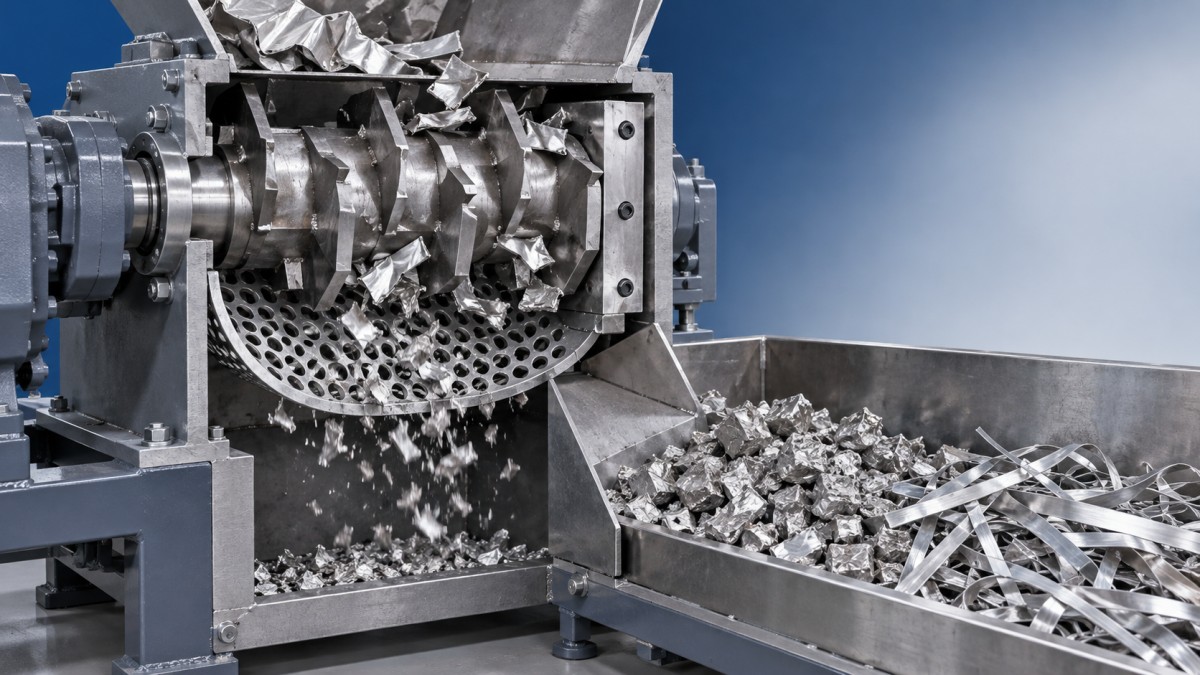
A useful diagram should distinguish the knife-to-counterknife cutting zone from the screen passage zone: one creates fragments; the other determines which fragments can leave.
Cutting geometry and clearance shape the output
Knife profile, exposed cutting edge, rotor arrangement, and counterknife geometry influence how material is gripped and divided. A configuration suited to bulky plastic components is not automatically appropriate for metal offcuts. Confirm that the machine is designed for the specific metal, thickness, and feed form before discussing discharge size.
Dull edges and excessive cutting clearance tend to encourage deformation and tearing rather than controlled shearing. With ductile sheet scrap, this may produce curled strips and ragged fragments. Those shapes behave differently at the screen from more compact pieces.
Reducing clearance indiscriminately is not the answer. Too little clearance can cause knife contact when bearing play, thermal expansion, or operating loads are considered. Use the manufacturer's settings and measurement procedure for the rotor and material involved. Compare clearance across the cutting width, not at just one convenient point, and isolate all energy sources before inspection.
Speed and feeding change the cutting conditions
Higher rotor speed does not automatically produce smaller or more uniform particles. It changes cutting frequency, material movement, power demand, and heat generation. The result depends on how effectively the knives engage the feed and how readily fragments reach the screen. Speed adjustments should stay within the machine's approved operating range.
Feed consistency is often a more useful starting point. An overloaded chamber can cause current spikes, repeated reversing, and uneven engagement. Insufficient or intermittent feeding creates a different operating condition again. Where a hydraulic pusher is fitted, its pressure and advance logic affect how firmly material is presented to the rotor.
Evaluate size distribution alongside throughput, motor load, reversal frequency, and energy per unit of processed material. A smaller screen may achieve the required fraction but create an unacceptable production bottleneck. A larger screen may increase capacity while transferring too much oversize to downstream equipment.
Material properties explain many apparent inconsistencies
Thin aluminum sheet, steel turnings, wire, and mixed equipment components will not produce equivalent discharge simply because they pass through the same machine. Thickness, ductility, hardness, initial shape, and bulk density affect cutting behavior. Long turnings and wire can wrap or entangle; compact sections may impose loads beyond a particular machine's design.
Mixed assemblies introduce another problem: the metal fraction may remain relatively coarse while brittle plastics generate fines. A single average particle size can conceal this difference. Separate material fractions during assessment when their downstream requirements differ. Batteries, pressurized components, and hazardous residues also require identification and appropriate removal before processing.
Mixed manufacturing sites should keep waste streams distinct. For example, JC INDUSTRY's Wet type PU coating line STENTER serves PU/PVC synthetic leather and fabric-coating applications, with configurable fabric preparation, coagulation, and washing stages supporting DMF exchange and removal. Such process residues need separate characterization; their handling requirements should not be inferred from a metal-scrap shredding specification.
Define discharge quality before running an acceptance test
“Output below the screen size” is an ambiguous acceptance criterion. Specify whether the requirement concerns sieve passage, maximum length, fines content, or suitability for a downstream separator. For elongated metal fragments, sieve analysis alone may not describe the dimension that causes conveyor blockages or feeding problems.
A practical trial agreement should record:
- Feed composition, thickness range, initial dimensions, and permitted contaminants.
- Screen aperture geometry, screen condition, knife condition, and measured clearance.
- Rotor speed, feeding settings, and the period of stable operation used for sampling.
- Sampling locations, sample quantity, and the agreed measurement method.
- Acceptable oversize and fines fractions, together with required throughput.
Name the applicable test standard where the contract or downstream process requires one. Otherwise, document a repeatable project-specific method rather than presenting an informal sieve check as universal compliance. Collect samples across steady operation, not just from a convenient handful at startup.
Inspect the machine before changing the specification
When output changes unexpectedly, check the feedstock, screen integrity, knife wear, and clearance before purchasing a different screen. Then review feeding behavior and operating settings, changing one variable at a time. This sequence helps distinguish maintenance problems from a genuine mismatch between machine configuration and material.
The same discipline applies to refurbished equipment. JC INDUSTRY combines machinery design, manufacturing, installation, commissioning, and consultation, and established its Used Machinery and Equipment Recycling Center in 2015. Its stated 24-month warranty covers both new and used equipment, but warranty duration is not a particle-size guarantee. For either route, document the rotor condition, screen fit, control functions, and representative-material trial results.
If a strict maximum fragment length is essential, a screened single-shaft shredder alone may not provide sufficient control. Downstream classification, recirculation, or a suitable secondary cutting stage may be necessary. Decide from measured output and downstream tolerances—not from nominal screen aperture alone.