









Send Us A Message
Will your existing mould fit a new injection moulding press?
Your existing mould can fit a new injection moulding press if its mounting dimensions, operating movements and processing requirements fall within the machine’s capabilities. Matching clamp tonnage alone does not establish compatibility. A mould may fit between the tie bars yet leave insufficient space for part removal, or mount correctly while requiring more injection pressure than the selected screw can deliver.
Before committing to a machine, assess three separate questions: can the mould be installed safely, can every movement complete without interference, and can the press reproduce the required production process? Each answer needs evidence from mould drawings, machine specifications and, where practical, a production trial.
Start with the mould as it actually runs
Use the current mould assembly drawing and proven production settings as your starting point. Record the complete tool dimensions, weight, mounting arrangement, resin, shot weight including runners, cycle time and auxiliary equipment. Include protruding connectors, hydraulic cylinders, lifting attachments and any plates added since the original drawing was issued.
The existing press provides useful operating evidence, but its nameplate is an incomplete specification for the replacement. A machine may have been selected with excess capacity, or production may rely on modifications that never reached the equipment records. Capture actual requirements rather than simply ordering an equivalent tonnage.
Check installation access before platen fit
A mould must pass through the available loading route before it can sit on the platens. Compare its complete installation envelope with horizontal and vertical tie-bar spacing, guarding openings and overhead access. Check the intended loading orientation and the clearance needed for lifting equipment. A tool that fits once installed may still be difficult or impossible to load using the planned method.
Then assess how the mould will be supported and secured. Platen dimensions do not automatically define the acceptable mould size: support area, bolt positions, clamp access and allowable mould weight also matter. An overhanging tool requires a specific engineering assessment.
Adapter plates can resolve some mounting differences, but they add thickness and weight and may affect nozzle reach or ejector connections. Include them in the complete compatibility calculation before approving their manufacture.
Mould height and opening space are different checks
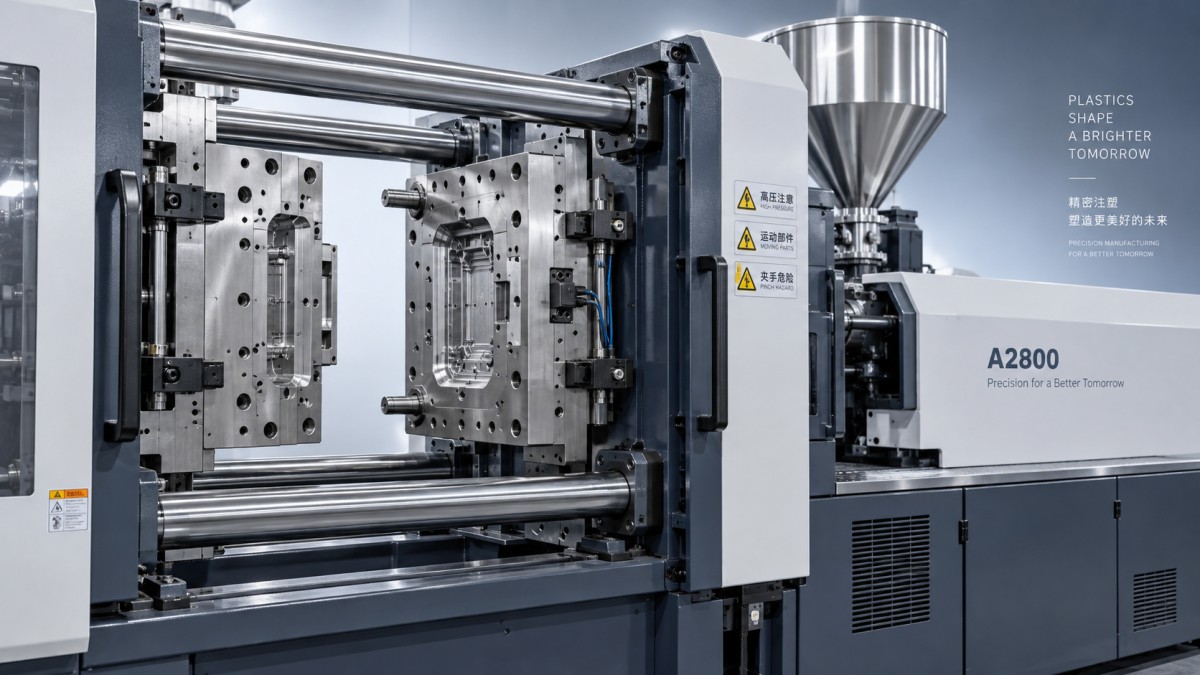
The closed mould thickness must fall within the press’s permitted mould-height range. A tool below the minimum may require an engineered spacer arrangement; one above the maximum may prevent the clamp from closing and locking correctly.
Opening space needs a separate assessment. Machine suppliers may distinguish between opening stroke and maximum daylight, so compare dimensions using the same reference points. The required gap depends on how the mould separates and how the component leaves it.
A deep component may need substantial clearance even when its mould is relatively compact. Three-plate tools, stripper plates, unscrewing mechanisms and extended cores can introduce additional movements. Robot entry and gripper withdrawal also consume space. Review the complete removal sequence, including the runner, rather than checking only whether the mould opens.
Ejection adds another interface: rod positions, coupling details, stroke and force must suit the tool. Confirm that the ejector can return fully and that return confirmation is available where required. Extra ejector stroke cannot compensate for insufficient space between the mould halves.
Can the injection moulding press reproduce the process?
Physical fit only establishes that the tool can be mounted. Reliable production also depends on clamp performance, the injection unit and control of the mould’s auxiliary functions.
Clamp force should follow cavity demand
The required clamping force depends on the projected area of the cavities and runners, together with the pressure acting inside the mould. A broad, shallow component can require more clamp force than its weight suggests. Thin walls, long flow paths and restrictive gates can increase pressure demand.
Use proven production data where available, supported by engineering calculations or process simulation when necessary. Excess clamp force can accelerate wear or impair venting, while insufficient force can allow the mould to separate and produce flash. The selected press should provide a usable operating margin without making maximum tonnage the sole selection criterion.
Compare injection units using the actual resin
Catalogue shot weights often use a reference material. Convert the requirement for the production resin and include every cavity, cold runner and sprue. Compare the resulting volume with the usable shot range for the selected screw.
A very small shot in a large barrel may create excessive residence time, especially with heat-sensitive materials. A shot close to the unit’s capacity can leave inadequate allowance for the operating cushion and normal process variation.
Injection pressure and injection speed must also be assessed together. A smaller screw may offer higher available injection pressure, while a larger screw provides greater shot volume; neither automatically suits the mould better. Check that the machine can deliver the required flow at the required pressure, then assess holding pressure, holding duration and screw recovery time against the intended cycle.
Auxiliary connections can determine the changeover cost
List every function the tool needs: hydraulic core pulls, pneumatic valves, hot-runner heating, valve gates, cooling circuits and position sensors. Compare connection types, available capacity and the machine’s ability to control the required sequence.
A spare hydraulic connection is useful only if its pressure, flow and timing suit the mechanism. Likewise, hot-runner compatibility includes controller capacity, thermocouple type, wiring and connector arrangement. Cooling depends on available flow and temperature control, not simply matching hose fittings.
Check how the press exchanges signals with robots, temperature controllers and other equipment. The control system must prevent conflicting movements and recognise the conditions required for safe operation. Agree responsibility for adapters, wiring changes and control integration before purchase, since these tasks can become critical to commissioning.
Evaluate refurbished machines against the same requirements
A refurbished press can be a suitable replacement when its configuration and condition support the intended mould. Obtain the specification for the actual machine being offered, including its installed screw, controller, core-pull circuits and any modifications.
Condition affects whether catalogue capability remains achievable. Platen condition and alignment, clamp operation, injection-unit wear and hydraulic performance deserve attention. Screw and barrel wear, for example, can undermine shot consistency even when the nominal shot capacity is sufficient.
JC INDUSTRY supplies both new and refurbished machinery and states a 24-month warranty for each. For an equipment transfer, pair that warranty with a written compatibility specification and agreed acceptance criteria. Warranty coverage and demonstrated process capability answer different purchasing questions.
Make purchase approval depend on a defined result
Classify each candidate as directly compatible, compatible with defined modifications, or unsuitable. For a machine requiring changes, include toolmaking, adapters, controls, auxiliary equipment, installation and production interruption in the comparison. A lower purchase price may be outweighed by adaptation work or a slower sustainable cycle.
The strongest acceptance trial uses the existing mould, production resin and intended auxiliaries. Assess dimensional and visual quality, shot consistency, part removal and stable cycle performance after the process has settled. A few acceptable components demonstrate less than a repeatable production run.
If a trial cannot take place before purchase, document the dimensional review and process assessment, assign responsibility for each modification, and specify how commissioning acceptance will work. Start the purchasing discussion with the mould drawing and production record: these establish what the replacement machine must actually deliver.