









Send Us A Message
Cold Retreading vs Hot Retreading: Equipment and Quality Trade-Offs
Cold and hot retreading can both produce dependable tyres, but they demand different levels of capital, process discipline, and quality control. The practical choice is usually clear once an operator defines its tyre mix and commercial model: cold retreading is often the stronger fit for mixed casings, regional service work, and flexible production volumes; hot retreading is better suited to standardized, high-throughput production where mould control and repeatability justify a more integrated plant.
The decision should not begin with the advertised capacity of a tyre retreading machine. It should begin with the casings available for retreading, the expected volume by tyre size, the target market, and the ability to control inspection, buffing, repair, curing, and final testing as one system. A technically capable curing press cannot compensate for inconsistent casing selection or poorly prepared bonding surfaces.
Where the two processes create different equipment demands
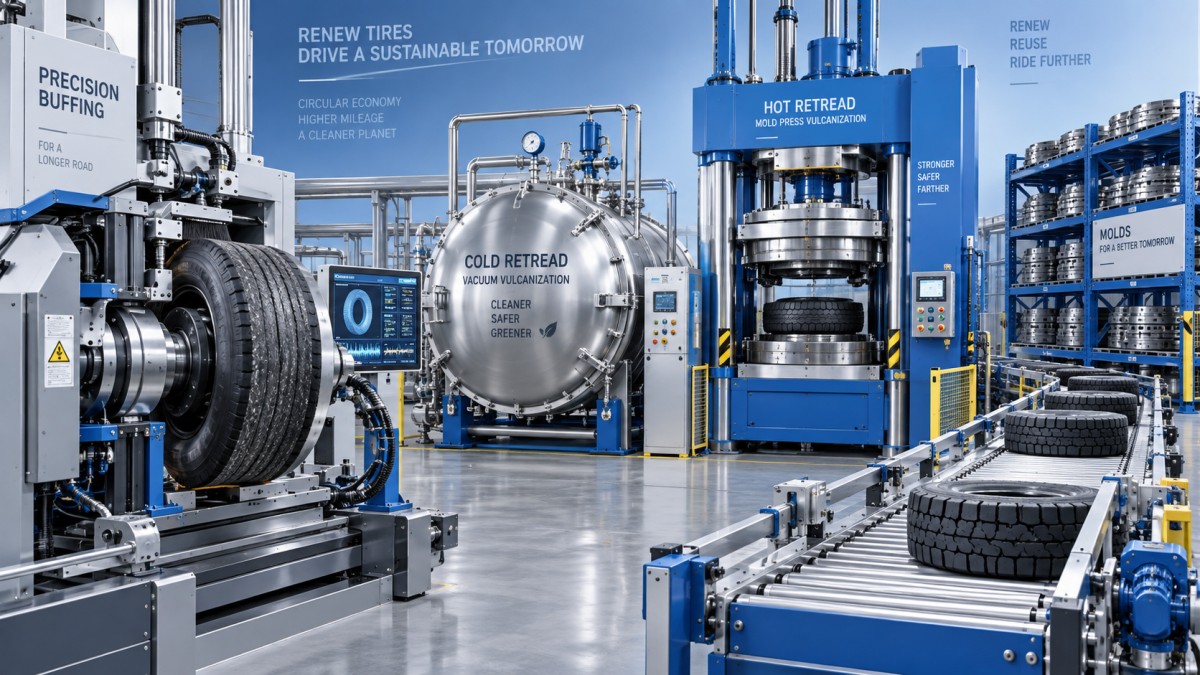
In cold retreading, the prepared casing receives a pre-cured tread strip. After cementing and application, the tyre is wrapped in an envelope and cured under vacuum and external pressure in an autoclave. The tread pattern has already been formed by the pre-cured strip, so the curing stage is primarily responsible for creating a reliable bond between the tread and the prepared casing.
This process generally separates the line into flexible stations: inspection, buffing, skiving and repair, cementing, tread application, envelope fitting, autoclave curing, and finishing inspection. It allows an operator to handle a wider range of tyre dimensions and tread patterns without changing a mould for every production requirement. That flexibility matters when a retreader serves fleets with varied truck, bus, agricultural, or specialty tyre requirements.
Hot retreading applies uncured rubber to the casing, then shapes and vulcanizes the tread in a mould during curing. The mould creates the tread pattern and sidewall appearance. Equipment therefore has a heavier dependence on mould sets, mould handling, curing presses, and accurate pressure-temperature-time control. The line can deliver a highly uniform finished appearance when its process is stable and the input mix is sufficiently standardized.
Hot retreading is not simply “better quality” because it uses a mould. It places more responsibility on mould condition, rubber compound management, loading consistency, and cure control. A worn, damaged, contaminated, or poorly matched mould can undermine the very consistency the process is intended to achieve. Cold retreading, meanwhile, depends heavily on the dimensional and compound consistency of purchased pre-cured tread, as well as the quality of the bonding operation.
Quality is decided before the curing stage
For either method, casing inspection and buffing are the first quality gates. Retreading can only extend the value of a sound casing; it cannot turn an unsuitable casing into a safe, durable product. The inspection process should identify structural damage, excessive oxidation, bead-area defects, sidewall damage, prior repair quality, and conditions that prevent reliable bonding or safe reuse.
Buffing deserves particular attention during equipment selection. The buffed surface must have the required texture, contour, and dimensional accuracy for the selected tread and bonding system. Excessive buffing wastes usable casing material and can reduce the remaining structural margin. Insufficient or uneven buffing can leave contamination, create poor bonding conditions, or produce an inconsistent tread profile.
A buyer comparing retreading equipment should ask suppliers to describe how the line controls these variables rather than focusing only on machine power or cycle time:
- How are casing dimensions measured and recorded before and after buffing?
- Can the buffing profile be repeated by tyre size and retread specification?
- How are dust, loose rubber, and surface contamination removed before cementing?
- What process records are retained for repairs, cure cycles, and final inspection?
- How are rejected casings segregated so that they cannot re-enter production?
Automation can improve repeatability, but only where the underlying process parameters have been defined. Automated material handling, programmable buffing profiles, barcode traceability, and monitored curing cycles are useful when they reduce variation or prevent operator error. Adding automation to an undefined repair standard or inconsistent casing acceptance rule simply makes an unstable process faster.
The capacity question: flexibility versus utilization
Cold retreading can offer a lower barrier to serving multiple tread designs because operators can change pre-cured tread without investing in a dedicated mould for each pattern and size. This is commercially useful for a regional operation with uncertain demand, a broad fleet customer base, or frequent changes in tyre specifications. It also allows capacity to be managed through autoclave loading, provided the operator can assemble enough compatible tyres for each curing cycle.
The limitation is that autoclave economics depend on utilization. An oversized autoclave that is routinely run with partial loads can raise energy use and delay turnaround. A small unit may create a curing bottleneck even if the preparation stations have adequate capacity. Decisions should therefore be based on the expected daily flow through the entire line, including inspection and repair time, rather than on a nominal autoclave cycle alone.
Hot retreading can make sense when demand is concentrated around a manageable set of tyre sizes and tread patterns. A plant producing repeat batches can keep moulds and presses productive, simplify work instructions, and maintain a more predictable appearance from tyre to tyre. The economic risk comes from too much variety: every additional pattern or size may require additional mould investment, storage, maintenance, and changeover time.
Energy, labour, and maintenance should be assessed as a line item
Comparing only the purchase price of a tyre retreading machine can distort the investment decision. Cold systems consume energy through autoclave heating and vacuum operation, while hot systems concentrate energy and mechanical demands around presses, mould heating, and uncured-rubber processing. The actual operating cost depends on load factor, cure schedule, heat loss, maintenance condition, and production planning.
Labour is equally process-specific. Cold retreading may require careful manual handling of tread strips, bonding cushions, envelopes, and rim assemblies. Hot retreading can reduce some finishing variation through moulding but may demand more disciplined material preparation and mould management. In both cases, a layout that forces repeated manual movement of heavy casings will reduce throughput and increase handling risk. Casing flow should be mapped before equipment is ordered, including quarantine areas for inspection failures and repair holds.
Maintenance planning should cover more than major curing equipment. Buffing drums, cutting tools, vacuum seals, envelopes, compressors, dust collection, temperature sensors, pressure instruments, and material-handling devices all affect uptime and quality. Buyers should clarify spare-part availability, calibration responsibilities, preventive-maintenance intervals, and the level of local technical support required before commissioning.
Do not overlook the waste stream
Buffing produces rubber residue, and its treatment influences both housekeeping and material recovery economics. Clean separation and collection reduce contamination in the work area and can create a more usable recovered-rubber feedstock. The value of that material depends on its cleanliness, particle-size requirement, and the downstream application, so it should not be treated as an automatic revenue source.
Where reclaimed rubber powder is part of the wider operating model, grinding equipment should be selected for controlled temperature, stable particle sizing, and effective collection rather than simply maximum throughput. For example, a Rubber powder crusher grinder designed for used rubber uses low-speed grinding, wind and water cooling, and cyclone collection to produce adjustable fine material while limiting heat exposure and dust loss. That is a separate process from retreading itself, but it can be relevant when buffing residue and end-of-life rubber are managed within the same facility.
A practical way to make the choice
Choose cold retreading when market responsiveness and tread-pattern flexibility are more valuable than maximum standardization. It is often appropriate for operators building a service-oriented retreading business, especially where tyre sizes and fleet requirements vary. The investment case improves when autoclave loads can be planned consistently and the operation has strong control over casing inspection and bonding preparation.
Choose hot retreading when the business has reliable volume in defined tyre categories, can support mould inventory, and wants tightly repeatable moulded output. It rewards disciplined production planning and becomes less attractive when demand is fragmented across many low-volume patterns.
Before committing to either route, run representative casings through the proposed process specification, define acceptance and repair limits in writing, and calculate capacity from actual work content rather than curing time alone. The most suitable retreading line is the one that matches the available casings and sales mix while giving the operator enough control to reject poor inputs before they become expensive finished-product failures.