










Send Us A Message
How platen temperature uniformity affects a vulcanizing press
How platen temperature uniformity affects a vulcanizing press
A vulcanizing press can reach its target temperature yet still produce inconsistent parts if heat is unevenly distributed across the platens. The controller shows what its sensor sees—not necessarily what every mold cavity experiences. For equipment evaluation, platen temperature uniformity is therefore an indicator of curing consistency, dimensional stability, and process reliability, rather than simply a heating specification.
The practical question is not just whether the press gets hot enough. It is whether the working area stays within an acceptable temperature band, with the intended mold installed, throughout a realistic production cycle. That distinction matters when comparing both new and refurbished equipment.
Uneven heat changes the usable curing window
Rubber cure rate depends on temperature, but the relationship varies with the compound and curing system. A colder cavity may need more time to achieve the required state of cure. Meanwhile, material in a hotter region receives a different thermal history. Depending on the formulation, excessive exposure can cause overcure or reversion; it should not be assumed that more heat always produces a better part.
Consider a multi-cavity mold producing sealing components. If cavities near one edge consistently run cooler, extending the cycle may improve those parts while unnecessarily heating the others. The result can be cavity-to-cavity differences in hardness, compression behavior, or dimensions after cooling. These symptoms are not proof of a heating fault, but they justify checking the temperature distribution before changing the compound.
Platen uniformity also affects cycle-time decisions. A process adjusted around the coldest position sacrifices output elsewhere. Raising the overall setpoint to compensate can reduce the operating margin at the hottest position. Neither adjustment removes the underlying imbalance.
The platen is a thermal and mechanical component
Machining quality, heating layout, and mold contact all influence heat transfer. A flat platen measured cold may behave differently at operating temperature. Unequal expansion, mounting constraints, or worn contact surfaces can change how effectively heat reaches the tooling. Temperature variation can therefore be both a cause and a consequence of poor contact.
Electric heating requires appropriate heater spacing, watt-density distribution, and sensor positioning. A sensor close to a heater may reach its setpoint before the surrounding metal has stabilized. Additional control zones can help, but only when their locations and tuning match the thermal behavior of the platen. More controllers alone do not guarantee greater uniformity.
With steam heating, passage layout, drainage, and condensate removal deserve attention. With circulating thermal fluid, flow distribution, supply temperature, and circuit condition matter. For either arrangement, checking only the inlet temperature leaves much of the heat-transfer system untested.
There is a design trade-off here: a thicker platen can spread heat and resist temperature swings, but it also takes longer to warm up and respond to corrections. The right choice depends on mold mass, operating temperature, production rhythm, and required recovery time—not thickness alone.
Measure a temperature field, not one convenient point
A useful acceptance test maps the usable working area on both platens. Include the center, edges, corners, and positions corresponding to critical cavities. Record the measurement coordinates so that a later maintenance check can reproduce the test.
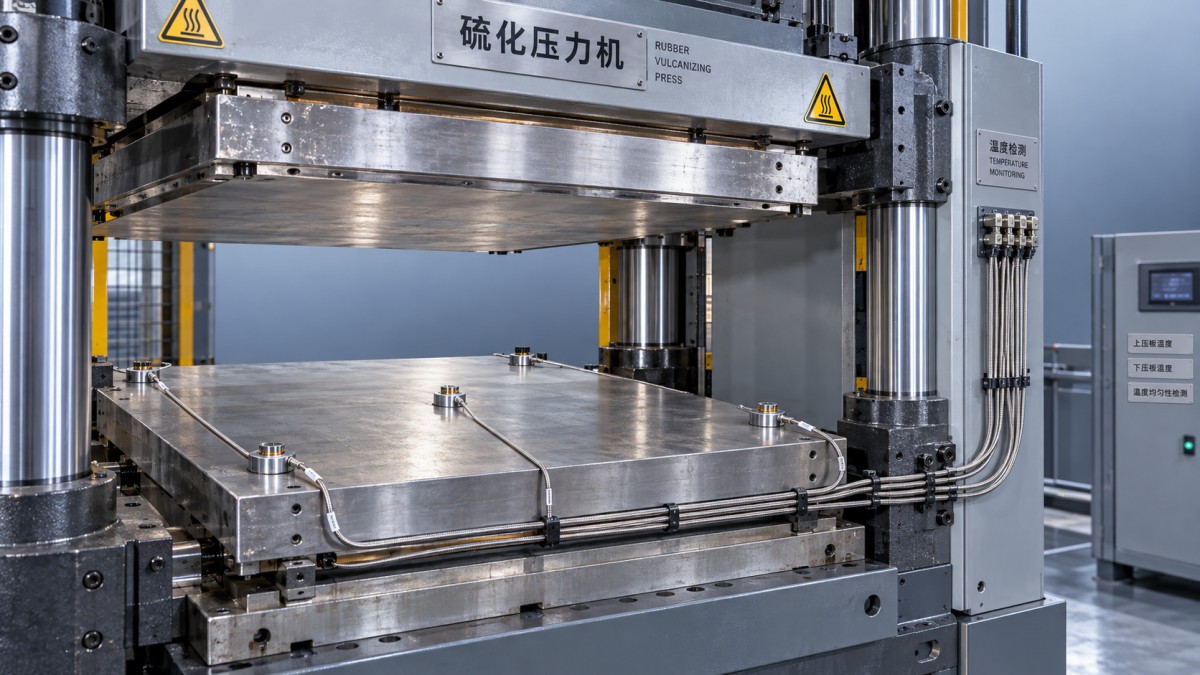
Report spatial variation and temporal stability separately. At a given instant, spatial spread can be expressed as the highest measured temperature minus the lowest. Temporal stability describes how a particular location changes over time. A single average hides both a persistent cold corner and controller cycling.
- Define the usable area, operating setpoint, stabilization criteria, and sampling interval.
- State whether measurements are taken unloaded, with representative tooling, or during production.
- Use calibrated sensors and document their attachment, contact pressure, and measurement uncertainty.
- Record recovery after opening, loading, and closing—not just the temperature after a long idle soak.
- Compare upper and lower platens rather than assuming their behavior is identical.
Infrared imaging is useful for locating suspicious regions, but reflective metal surfaces can give misleading readings because of emissivity and reflected radiation. Controlled surface preparation or suitable reference targets may be needed. Contact measurements also require care: a poorly attached thermocouple can measure its surroundings as much as the surface. Any instrumented closed-press test needs an approved method that protects personnel, wiring, and tooling.
Set acceptance limits from the process requirement
There is no single temperature-uniformity tolerance that suits every vulcanizing press and rubber product. A supplier’s “temperature accuracy” specification may describe controller performance at one sensor, not the distribution across the platen. Ask what the stated tolerance actually covers, including whether it means deviation from setpoint or total maximum-to-minimum spread.
Compound rheometer data, including tests using methods such as ASTM D5289, can help establish temperature sensitivity and curing behavior. It does not independently certify platen uniformity. Laboratory cure time also cannot be transferred directly to a thick molded part without considering heat penetration and the actual thermal cycle.
The acceptance document should identify the applicable test procedure, tooling condition, measurement locations, allowable variation, and recovery requirement. Where a customer specification or equipment standard applies, confirm its current edition and scope. A tolerance without a defined test method is difficult to enforce fairly.
Separate press faults from upstream variation
Before blaming the heating system, check compound consistency, preform thickness, loading temperature, and mold cleanliness. Uneven incoming stock can produce curing differences even when platen measurements look satisfactory. A defect that follows a cavity position suggests a different investigation from one that follows a material batch.
Upstream warming and sheeting therefore belong in the diagnosis. JC INDUSTRY’s used_second hand Open mixing mill includes roller temperature regulation and adjustable rollers among its listed features. These functions are relevant to stock preparation, but their settings must suit the compound. They cannot compensate for a cold zone in the press.
A refurbished press needs a fresh thermal baseline
For a refurbished machine, inspect heater condition, sensor seating, insulation, heating passages, and platen surfaces. Replacing the control panel does not establish thermal performance. Request a post-refurbishment temperature map and recovery test, rather than relying on the original machine specification.
JC INDUSTRY combines machinery manufacturing with installation, commissioning, and equipment refurbishment; its recycling center was established in 2015. Its stated 24-month warranty covers new and used equipment, but warranty duration and process acceptance remain separate matters. The purchase agreement should document the thermal performance to be demonstrated at commissioning.
The most useful evidence is a repeatable temperature map under representative conditions, supported by acceptable molded-part results. If the only evidence available is a stable number on the display, the press has demonstrated temperature control at one point—not uniform curing across its working area.