









Send Us A Message
Why does a bale cutter leave rubber blocks partially uncut?
A bale cutter leaves rubber blocks partially uncut when the blade cannot complete an effective cut through the material. The main causes are a worn or damaged cutting edge, insufficient hydraulic force under load, incomplete blade travel, and rubber blocks outside the machine’s cutting capacity. The remaining connection can also reveal a support or alignment problem: a thin web across the bottom calls for a different investigation from a thick section left on one side.
For maintenance teams, the most useful first distinction is whether the blade stops before its intended endpoint or reaches that endpoint without separating the block. Record the condition of the cut and the machine’s behavior before changing settings. Repeated cycles can obscure the original fault, heat the hydraulic oil, and add load without correcting the cause.
Use the unfinished cut to narrow the investigation
Inspect the block only after it can be accessed safely. Note where the rubber remains connected, whether the pattern repeats, and whether the fault affects every block or only particular materials and sizes. These observations help determine which checks deserve priority.
- A thin, continuous web across the bottom: check actual blade travel, the lower cutting interface, and the condition of any cutting pad or anvil fitted to the machine.
- An uncut section on one side: investigate uneven loading, blade alignment, guide wear, and uneven support beneath the block.
- A deep cut followed by a stall: investigate available cutting force, blade condition, material resistance, and mechanical binding.
- A ragged or stretched connection: inspect the cutting edge and material support. A dull edge can compress and drag rubber before separating it.
- A fault that develops as the machine warms: compare hydraulic pressure and motion under equivalent cutting conditions; temperature-related leakage or control behavior may be involved.
These patterns guide diagnosis; none proves a single cause. A dull blade can increase resistance enough to make a healthy hydraulic system reach its pressure limit. Conversely, a sharp blade may still leave a bottom web if the stroke ends too early.
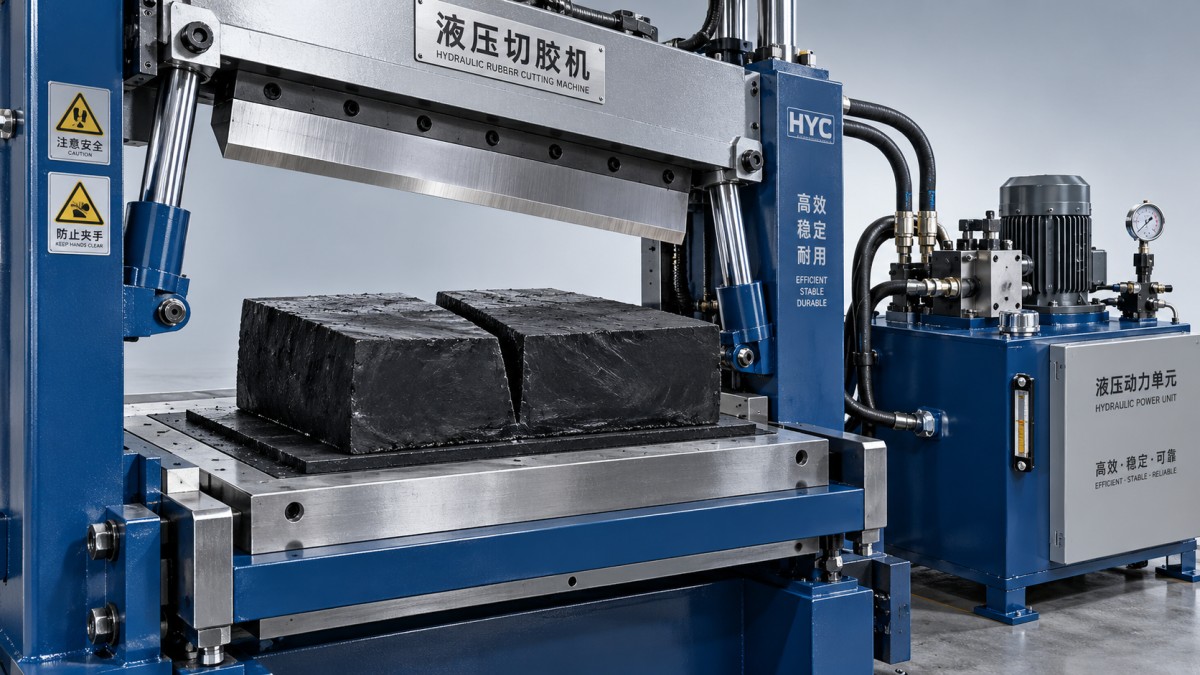
Before entering the cutting area, isolate and lock out the equipment, release stored hydraulic energy according to the manufacturer’s procedure, and secure the blade assembly with its specified mechanical restraint. Hydraulic pressure alone must not support a raised blade during maintenance. Keep diagnostic observations that require power separate from hands-on inspection, with guards and safety functions operating during powered checks.
Check blade condition and completed travel together
Inspect the full cutting edge for rounding, chips, local damage, and adhered rubber. Damage concentrated in one section may correspond directly to the uncut portion of the block. Also check blade mounting, guide condition, and accessible fasteners against the machine’s maintenance requirements. Movement at the blade holder or excessive guide clearance can change the cutting geometry under load.
Sharpening requires the specified edge geometry and minimum allowable blade dimensions. Removing material changes the edge position, so a sharpened blade may require an approved setup adjustment. Replacing the blade without checking its installed position can leave the original incomplete-cut problem unresolved.
Check the lower cutting arrangement for the specific machine design. Where a sacrificial cutting pad is used, grooves, compression, or uneven wear can prevent consistent separation. Where the blade works against an anvil or another cutting interface, inspect that interface and its specified adjustment. Do not assume the blade should strike a metal table or extend farther simply because rubber remains attached.
A control indication showing “stroke complete” does not establish that the cutting edge reached the correct physical position. Check for displaced limit switches, incorrect position settings, mechanical stops, accumulated material, and obstructions. Compare actual travel with the manufacturer’s setup reference using an approved measurement method.
If one side finishes cutting before the other, examine blade parallelism, guides, and support alignment. On machines with multiple cylinders, synchronization may also require investigation. Extending travel to compensate for misalignment can overload one side of the cutting assembly.
Establish whether hydraulic force falls short under load
When the blade slows or stops within the block, the pressure behavior during that part of the stroke matters more than the pressure shown while idle. Qualified personnel should use the designated test points and correctly rated instruments, following the machine’s hydraulic test procedure. Record pressure, blade movement, and oil condition during comparable cycles.
If pressure reaches the specified operating or relief limit while the blade stalls, the system may already be delivering its permitted force. Investigate an oversized or resistant block, a dull edge, or mechanical binding before adjusting hydraulic settings. Raising the relief setting beyond the approved value can overload cylinders, hoses, the blade assembly, or the frame.
If pressure fails to reach the expected value during a stalled cut, possible causes include an incorrectly functioning relief valve, pump wear, valve leakage, cylinder bypass, or another fault in the pressure circuit. The hydraulic schematic and targeted tests are needed to distinguish them. A low reading at one location does not identify which component has failed.
Slow motion also needs careful interpretation. Flow largely determines cylinder speed, while pressure acting over the effective piston area determines available force. A supply restriction can slow the blade without necessarily reducing its final force; pressure losses or leakage may affect both. Replacing a pump solely because the cutting cycle is slow can miss a control or mechanical problem.
Check oil level, the specified oil grade, filter indicators, visible leakage, foaming, and unusual pump noise. A fault that appears after warm-up can be consistent with increased internal leakage as oil viscosity falls, but it needs confirmation. Comparing similar blocks at different temperatures is more useful than comparing unrelated production cycles.
Confirm that the rubber block matches the cutting conditions
A machine that cuts one rubber bale successfully may struggle with another of similar external dimensions. Compound, temperature, construction, and the amount of material engaged by the blade can change cutting resistance. Colder or stiffer stock may require more force, while tacky material may adhere to the blade or move with it.
Compare the actual block dimensions and material condition with the cutter’s documented capacity. Bale weight alone is an incomplete guide: two blocks of similar weight can present different cutting sections. Stacked pieces, folded material, and off-center placement may also produce uneven loading or prevent stable support.
If the fault began with a material change, test an approved block size and material condition previously associated with satisfactory operation. Carry out the comparison through the normal guarded cycle. Where the manufacturer permits it, reducing the cutting section can help establish whether the problem depends on load. Success with a smaller block does not by itself prove that the machine meets its rated performance.
Do not introduce heating, lubricants, or blade coatings without checking the machine and process requirements. Such changes can affect rubber quality, handling, and downstream processing, while leaving a mechanical fault hidden.
Verify the repair under representative conditions
Choose the repair from the evidence collected: restore the cutting edge and its setup, correct the lower support, repair the travel control, or address the hydraulic fault identified by testing. Change one relevant variable at a time where practical so that the effect remains clear.
For refurbished equipment, check the installed configuration as well as component condition. A replacement cylinder, valve, blade, or position sensor must suit the intended cutting duty. A machine can cycle smoothly without a block yet lack the travel or force required under load.
Return-to-service checks should include complete separation, consistent travel, stable pressure behavior, and correct operation of guards and interlocks. Use representative approved rubber blocks and include operation at normal working temperature if the original fault appeared after warm-up. Record material dimensions, relevant conditions, the fault pattern, and the corrective work so the next service team has a usable baseline.
A successful repair produces repeatable separation within the machine’s approved settings and material limits. If cutting still depends on repeated strokes, extra pressure, or manual tearing, the cause remains unresolved.