









Send Us A Message
Reclaimed Rubber Processing: What Determines Devulcanization Quality?
A reclaimed rubber batch can look acceptable at discharge yet perform poorly during mixing, calendering, or extrusion. The usual symptoms are uneven plasticity, excessive gel content, unstable Mooney viscosity, odor from overheating, or variable tensile behavior in the final compound. In these situations, increasing throughput or extending processing time is rarely the right first response.
Devulcanization quality is determined by how selectively the process breaks sulfur crosslinks while limiting degradation of the rubber backbone. A capable reclaimed rubber machine must therefore control heat, mechanical shear, residence time, feed uniformity, and process atmosphere as one connected system. Technical evaluation should focus on whether those conditions remain stable from batch to batch, not only on nameplate capacity.
The quality target is selective bond cleavage
Vulcanized rubber contains a crosslinked network. Reclaiming aims to reduce that network enough to restore processability and allow blending with new rubber, fillers, oils, and curatives. The objective is not to break as many bonds as possible. Excessive treatment can shorten polymer chains, lower strength potential, increase tackiness, and create material that appears soft but has poor downstream reinforcement.
A practical quality assessment therefore looks for a balanced result: the reclaimed rubber should disperse reasonably in a new compound, show controlled viscosity, retain useful polymer structure, and exhibit low variation between samples. High softness alone is not proof of good devulcanization. It may instead indicate thermal or mechanical degradation.
Temperature control sets the processing window
Temperature is often the first variable reviewed because devulcanization reactions accelerate rapidly as heat rises. Yet the relevant question is not simply the maximum barrel or chamber temperature shown on a control screen. Evaluators should determine how closely the machine controls the actual material temperature across feeding, shearing, reaction, and discharge.
Localized overheating is especially damaging. It can occur where material accumulates near rotors, screws, restrictive discharge zones, or poorly cooled surfaces. A machine may report an acceptable average temperature while a portion of the rubber experiences a much higher peak. That fraction can become over-processed and later cause inconsistency during compounding.
Useful equipment checks include:
- independent temperature measurement points rather than a single external reading;
- heating and cooling capacity sized for the actual material load;
- stable control response when feed rate changes;
- insulated zones that reduce uncontrolled heat loss or gain;
- a defined high-temperature alarm and operating response procedure.
For material with high metal, fiber, or hard filler content, heat generation can be less predictable because friction rises sharply in restrictive sections. The machine should be evaluated under representative feedstock, not only with clean laboratory-like rubber granulate.
Shear must be intense enough, but not destructive
Mechanical shear helps open the crosslinked structure and distribute processing aids. Its effect depends on rotor geometry, screw profile, gap settings, rotational speed, fill level, and the friction characteristics of the incoming rubber. Two machines operating at similar motor power can produce very different shear histories.
Under-shearing leaves partially devulcanized particles and poor dispersion. Downstream mixers may show visible specks, unstable torque, or long homogenization times. Over-shearing can reduce molecular weight too far. The material may mix easily, but the final compound can lose strength, tear resistance, or dimensional stability.
During evaluation, ask whether shear intensity can be adjusted independently from throughput. A system that only increases shear by increasing production rate gives operators little room to correct material variation. Adjustable speed, controlled gaps, and load monitoring make it easier to maintain the required mechanical action without relying on operator judgment alone.
Residence time distribution matters more than nominal time
Every particle needs sufficient exposure to heat, shear, and chemical treatment. However, “sufficient” is not the same as a long average residence time. The concern is residence-time distribution: whether most of the material receives a similar treatment history.
Wide distribution produces a mixed output containing under-treated and over-treated fractions. This often happens when feed bridging, dead zones, irregular discharge, or unstable screw filling allow some rubber to pass through too quickly while other material recirculates. Batch processes can face similar problems when loading volume, mixing sequence, or discharge timing varies between cycles.
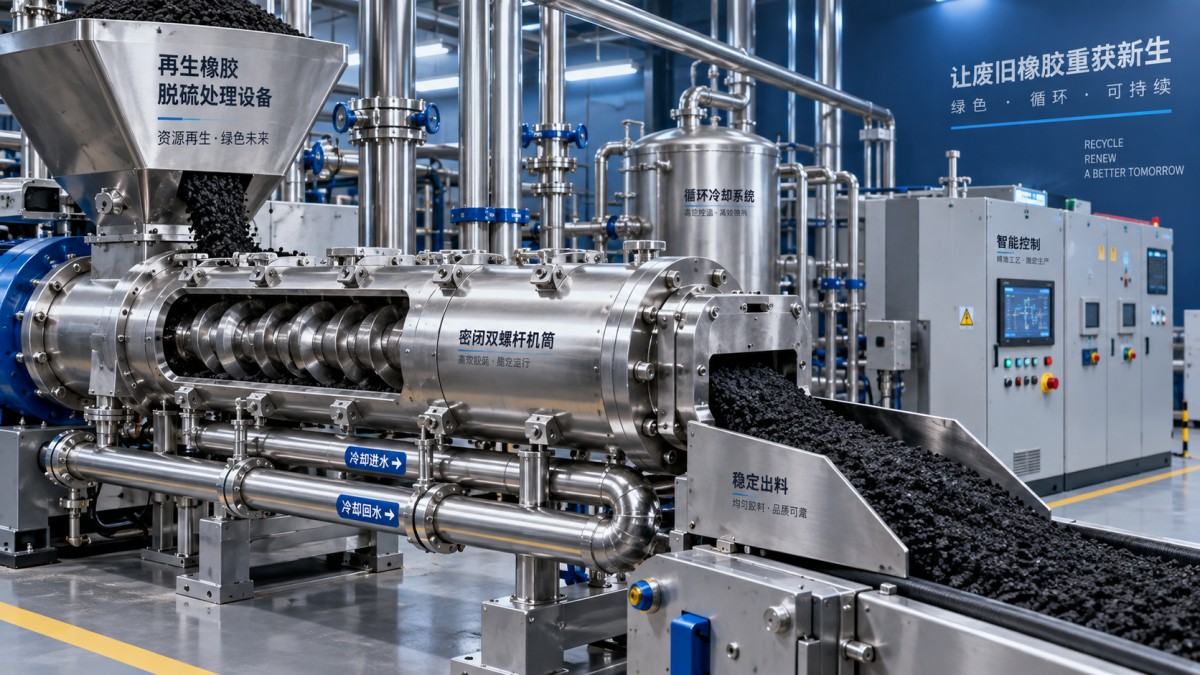
A sensible review includes tracing the material path from feed hopper to discharge. Look for pockets where sticky rubber can remain, locations where fines separate from larger particles, and zones difficult to clean after a material change. Equipment with repeatable feeding and controlled discharge supports a narrower processing distribution, which is usually more valuable than a short theoretical cycle time.
Feedstock preparation can limit the machine before processing begins
No devulcanization system can fully compensate for inconsistent scrap preparation. Feedstock may include passenger tire rubber, truck tire rubber, conveyor belt scrap, butyl-rich material, EPDM, NR/SBR blends, or mixed industrial rubber. These materials respond differently because their polymer structures, crosslink density, filler loading, textile content, steel contamination, and residual additives are different.
Particle size has a direct effect on heat transfer and shear exposure. Large, irregular pieces may retain an under-treated core, while excessive fines can heat too quickly and create dust-handling challenges. Steel and fiber removal are equally important. Metal fragments increase wear and may introduce local heating; textile contamination can affect feeding and leave visible defects in reclaimed rubber.
Before assigning a processing recipe, establish at least the feedstock category, particle-size range, moisture condition, contamination level, and expected composition variation. A reclaimed rubber machine should be judged by how well it handles the intended input range, not by a single result from an idealized feed.
Automation protects repeatability
Devulcanization quality often drifts when operators adjust speed, temperature, oil addition, or discharge timing based only on appearance. Experienced operators remain important, but repeatable production requires the machine to record and regulate key conditions.
PLC-based control can coordinate feed rate, drive load, heating zones, dosing, and safety interlocks. For technical acceptance, review which variables are automatically controlled, which are only displayed, and which can be logged by batch or production period. A screen that shows temperature is not equivalent to closed-loop material-temperature management.
The best control strategy also links machine signals to practical responses. For example, an unexpected rise in motor load may indicate higher feed hardness, excessive contamination, inadequate pretreatment, or a developing restriction. A falling load can indicate underfeeding or reduced fill. These signals become useful only when operating limits and corrective actions are defined.
Evaluate quality through downstream behavior
Laboratory testing should not stop at visual appearance or a single viscosity value. Reclaimed rubber is used because it must perform in a subsequent compound. The evaluation plan should reflect that purpose.
Useful comparative tests can include viscosity consistency, gel or sol fraction where applicable, ash content, contamination checks, dispersion in a reference compound, and cured-property comparison at the intended loading level. The exact test set depends on the rubber type and final application, but the samples must be taken across time rather than from one favorable discharge moment.
Where adjacent rubber equipment fits into the evaluation
Plants that process industrial rubber scraps may also manufacture or refurbish conveyor-belt products. In that setting, material handling and production equipment should be assessed according to its separate role. For example, a used_second hand Green belt building line is designed for laminating and preforming fabric rubber conveyor belts, with PLC control, constant-tension functions, and alignment correction. Those features can support stable belt construction, but they do not replace the temperature, shear, and residence-time controls required for devulcanization.
Keeping these functions distinct prevents a common evaluation error: assuming that good sheet forming, laminating, or belt-building performance confirms reclaim quality. Reclaimed rubber must first meet its own processing and compound-performance requirements.
A practical acceptance approach
When comparing equipment, run the intended feedstock through the proposed operating range rather than accepting a result at one optimized setting. Observe startup behavior, steady-state consistency, response to reasonable feed variation, and shutdown or cleaning practicality. Confirm that operators can identify abnormal load, temperature, and feeding conditions before a large volume of material is affected.
The strongest indicator of devulcanization quality is not maximum output. It is the machine’s ability to repeatedly deliver reclaim with controlled viscosity, acceptable dispersion, limited degradation, and predictable behavior in the next mixing stage. Equipment that makes those conditions measurable and adjustable provides a sounder technical basis for production decisions.