









Send Us A Message
Reducing Compound Contamination Risks in Rubber Machine Production Lines
Compound contamination rarely begins with one obvious failure. It often appears during a grade change, after a rushed cleaning cycle, or when a small amount of retained material enters the next batch through a hopper, conveyor, mill, extruder, or calender. The visible result may be specks, color variation, uneven cure behavior, surface defects, or an unexpected change in physical properties. By the time the defect is found at final inspection, the original source may already be several process steps upstream.
The practical answer is to control contamination as a line-wide material-segregation issue rather than a single machine-cleaning issue. A reliable rubber machine production line needs defined material routes, verified changeover procedures, controlled cleaning tools, and traceable release checks before the next compound enters production. The most effective controls are those that stop foreign or previous-compound material from entering the process in the first place.
Start with the contamination pattern, not the suspected machine
When a nonconforming rubber sheet, profile, or molded part is reported, the first question should be: what kind of material is present, and where does it first become detectable? This narrows the investigation faster than immediately dismantling equipment.
For example, black particles in a light-colored compound may point to retained carbon-black-filled stock, degraded residue on a heated surface, contaminated cleaning rags, or dust entering an open transfer point. A sticky surface may suggest plasticizer, process oil, release agent, or incompatible polymer carryover. Repeated defects at a regular interval can indicate buildup on a rotating roll, belt splice, screw, die, or feed device rather than contamination in the full batch.
- Isolated defects often originate from handling, packaging, cleaning tools, or a local equipment surface.
- Defects that increase after startup may be linked to material retained in dead zones or gradually released deposits.
- Defects present throughout a batch require review of weighing, storage, mixing, and batch identification.
- Defects only after a grade change usually indicate an incomplete purge, insufficient cleaning, or poor segregation of intermediate materials.
Keep suspect material physically separated while the review is in progress. Reintroducing questionable trim, rework, or sweepings into an active batch before identification is confirmed can spread a limited event across multiple production orders.
Where compound contamination usually enters the line
Material handling points deserve as much attention as mixers and processing machines. Bags, containers, transfer hoses, scoops, magnets, conveyors, and storage bins can all carry residue forward. Open handling is especially vulnerable when compounds of different colors, fillers, cure systems, or polymer families move through the same area.
Feed and storage areas
Incorrect labeling is a basic but serious risk. Similar-looking slabs or pellets may be placed in the wrong staging zone, while partially used containers may lose their batch identity. Each container should show the compound code, production status, and any restrictions on reuse. Dedicated containers are preferable for highly contrasting materials, such as white and black compounds, silicone-containing materials, sulfur-cured and peroxide-cured compounds, or materials with sensitive adhesive requirements.
Powder contamination also travels farther than expected. Dust from fillers, pigments, and curatives can settle on nearby surfaces and become airborne during cleaning or material movement. Vacuum systems designed for industrial dust collection are generally safer than dry sweeping, which can redistribute fine particles across work zones.
Mixing and downstream transfer
Internal mixers, drop doors, mills, batch-off units, and conveyors can retain compound in corners, seals, scrapers, and contact surfaces. A purge quantity alone is not proof of cleanliness. The purge material must be inspected against a defined acceptance standard, particularly after changes involving color, cure package, flame-retardant ingredients, or special additives.
Transfer equipment should be reviewed for difficult-to-access areas: flexible hoses, diverter valves, hopper throats, screw feeders, transfer chutes, and belt edges. A line can appear clean from the outside while residue remains in an internal ledge or under a guard.
Build changeover controls around the actual risk
Not every grade change requires the same response. Treating all changes identically may waste time, but treating a high-risk change as routine creates avoidable rejects. A risk matrix can classify transitions by factors such as color contrast, polymer compatibility, curative system, filler type, oil content, and end-use sensitivity.
A good changeover instruction identifies the machine sections to isolate, the tools permitted for cleaning, the purge material or procedure, the inspection point, and the person authorized to release the line. Vague instructions such as “clean machine thoroughly” leave too much to individual interpretation. The procedure should state where operators must look, including areas not visible during normal operation.
Cleaning can introduce contamination too
Cleaning materials are often overlooked. Shared brushes, cloths, scrapers, compressed-air hoses, and solvent containers can transfer debris from one machine or compound family to another. Tools should be assigned by area or material group and stored so that they remain clean between uses. Color coding can help, but only when it is supported by clear work instructions and routine checks.
Compressed air should not be used as a general substitute for cleaning. It can push particles into guards, bearings, electrical enclosures, or inaccessible machine cavities, where they later return to the product path. When air is necessary for a defined task, its use should be controlled and followed by direct inspection of the exposed product-contact area.
Cleaning agents also need compatibility review. Residual solvent, lubricant, or release material can affect compound surfaces and may create a safety issue near heated equipment. Use only approved products, allow drying or evaporation as required by the procedure, and prevent cleaning containers from being confused with process chemicals.
Use monitoring to make contamination visible earlier
Visual inspection remains useful, but it should not be the only barrier. Traceability records can connect raw-material lots, mixer batches, machine settings, changeover status, operator actions, and inspection findings. When a defect is discovered, this record helps determine whether the issue is limited to one roll, one batch, or a broader production window.
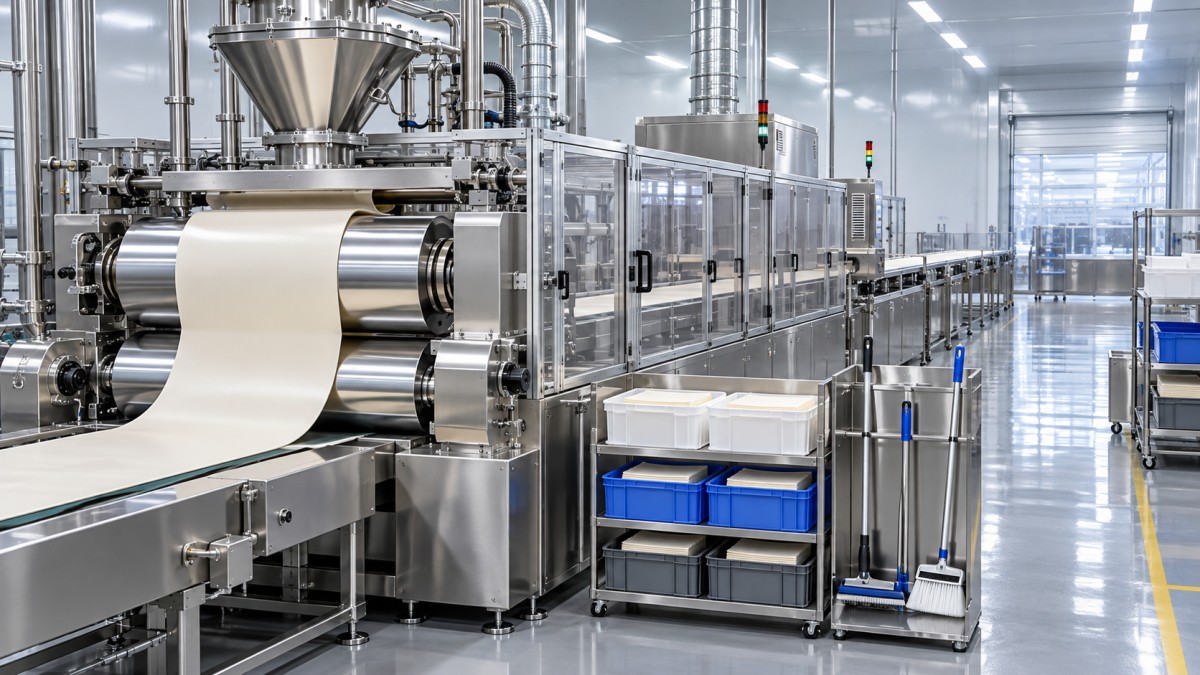
PLC-controlled equipment can support repeatable operation by recording relevant process conditions and helping standardize machine sequences. In calendering applications involving PU or PVC films, a Synthetic leather calender line can be specified with PLC programming control for easier operation and maintenance. Its available configurations cover calendering thicknesses from 0.05 mm to 0.5 mm and a range of working widths. For plants processing multiple materials, the important contamination question is not the control system alone, but whether recipes, cleaning release steps, and roll-surface inspections are incorporated into the operating discipline around the equipment.
At the quality gate, inspect the first acceptable material after every high-risk changeover before it is mixed with downstream production. The inspection method should match the defect risk: visual examination under consistent lighting, sample cutting, surface assessment, weight or thickness checks, and laboratory confirmation where the compound or end use requires it. Hold material when the source of an abnormality is not yet understood; passing it onward merely transfers uncertainty to the next process.
Make line clearance a verifiable release, not a verbal handoff
A robust line-clearance routine confirms more than machine cleanliness. It verifies that previous labels, containers, work orders, packaging, rework, tools, and unused materials have been removed or correctly identified. This is particularly important where several compounds are processed in close proximity or where shift handovers occur during changeover activity.
- Stop and isolate the material flow before cleaning begins.
- Remove remaining compound, trim, and temporary containers from the defined work area.
- Clean designated product-contact surfaces and inspect known retention points.
- Perform the required purge or trial run and evaluate the output against the release criteria.
- Confirm correct material identity, current production documents, and approved tools before restarting.
- Record the release and retain any required first-piece sample for traceability.
Contamination control becomes more dependable when deviations are reviewed as process signals rather than isolated operator mistakes. Repeated residue at the same roll edge, recurring foreign particles after a particular changeover, or frequent label discrepancies each indicate that the control method needs adjustment. Updating the cleaning point, container design, material route, or release criterion is more effective than simply asking personnel to “be more careful.”