









Send Us A Message
What causes ply wrinkles on a conveyor belt building machine?
Ply wrinkles on a conveyor belt building machine usually develop when the fabric enters the layup area with uneven tension, travels out of alignment, or reaches the building surface faster than it can be laid down. Trapped air, inconsistent rubber tack, and uneven consolidation pressure can create similar symptoms. For operators troubleshooting a belt buidling machine, the most useful question is not simply “How much tension should I add?” but “Where does the ply first lose its flatness?”
A wrinkle that begins at the unwind needs a different correction from one that appears only under the pressure roller. Finding that first point of distortion helps prevent wasted fabric, repeated adjustments, and defects hidden between layers.
Read the wrinkle before changing the settings
Watch the material path from a safe position, without reaching inside guards or approaching rotating equipment. Record whether the defect begins before the feed rollers, across the unsupported span, at first contact with the building surface, or during consolidation.
These patterns are clues, not proof. Several faults can produce the same appearance, so change one variable at a time and compare the result.
Uneven tension: why simply tightening the ply often fails
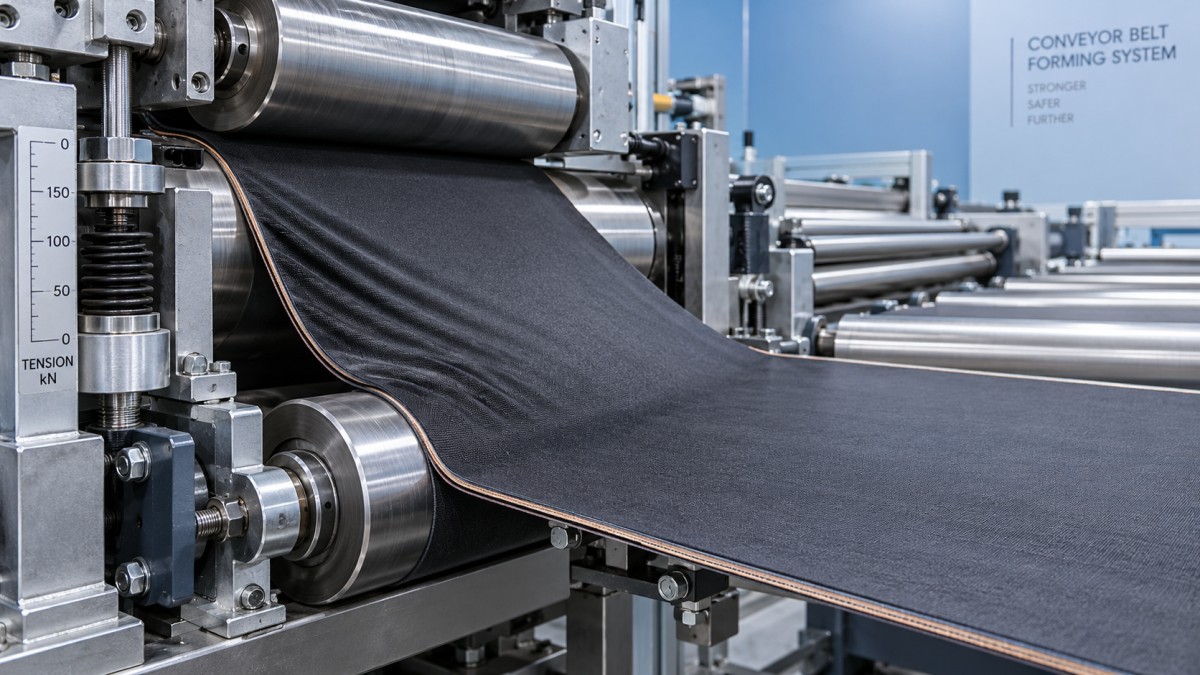
The fabric needs enough controlled tension to remain flat, but not enough to stretch or distort its reinforcement. Excessive tension can alter ply dimensions or fabric geometry; insufficient tension allows slack to collect before contact. More importantly, the average tension can appear acceptable while one side remains much looser than the other.
Common causes include an off-center supply roll, uneven winding, unwind shaft movement, sticking bearings, or unequal braking. A dancer or load-cell reading may also hide a cross-width imbalance because it does not necessarily show how tension is distributed across the fabric.
- Check that the supply roll is correctly seated and secured.
- Look for telescoped winding, damaged edges, or a roll that runs unevenly.
- Confirm that the unwind brake releases and applies smoothly.
- Review dancer movement for hunting, sticking, or reaching its travel limit.
Use the approved tension range for the fabric construction and machine recipe. There is no universal setting that suits every conveyor belt ply. If wrinkles disappear only after a large tension increase, investigate alignment and feeding rather than accepting the higher setting as a permanent solution.
Roller alignment and feeding errors can pull the ply sideways
A roller that is not parallel to the next roller can create different travel conditions across the web. The fabric may drift, tighten along one edge, and buckle along the other. Dirty or worn roller surfaces can add uneven traction, making the fault look like a tension problem.
Check the full material path, not just the roller nearest the wrinkle. A skew introduced upstream may become visible only when the ply meets the building surface. Maintenance personnel should verify roller parallelism, bearing condition, mounting security, and relevant runout against the machine’s specifications.
Edge guides deserve attention too. A guide should control position without forcing the fabric into a continuous sideways correction. Repeated steering movements may indicate incorrect threading, a displaced sensor, or an upstream alignment fault.
Compare actual material movement—not only displayed speeds
If the feed delivers more fabric than the building surface takes up, surplus material gathers into waves. If the take-up action is too aggressive, the ply can stretch or drag unevenly. Matching speed setpoints does not guarantee matching surface speeds: roller wear, slipping nips, encoder problems, and incorrect effective diameter settings can introduce differences.
Wrinkles concentrated at startup often point toward transient behavior rather than a steady-speed setting. Review acceleration ramps, unwind inertia compensation, and brake response with qualified controls personnel. Do not bypass interlocks or alter drive parameters outside authorized procedures.
When the ply is flat until it touches the building surface
If the fabric arrives flat but wrinkles during layup, focus on contact conditions, air escape, and consolidation. Air can become enclosed when the material touches in several separated areas before it is progressively pressed down. The result may resemble a fold, although the underlying issue is a pocket between layers.
Check whether the pressure roller contacts evenly across the working width. Unequal cylinder action, roller wear, an unsuitable gap, or excessive deflection can leave some areas unconsolidated while dragging others. Increasing pressure indiscriminately may distort the ply rather than remove the cause.
Follow the equipment’s specified laydown and air-release sequence. Where the machine provides a center-out consolidation function, verify that it operates as designed; do not improvise manual smoothing near moving nips.
Rubber tack also changes how the ply settles. Excessive or uneven tack can grab one section before neighboring material has aligned. Low tack may allow the ply to shift after placement. Review compound condition, storage history, permitted processing temperature, and surface cleanliness. Do not apply unapproved solvents, powders, or release agents to make feeding easier.
The material itself may be carrying the distortion
Not every recurring wrinkle originates in the machine. Fabric can arrive with bowed yarns, skew, edge damage, thickness variation, or creases caused by storage and handling. Rubberized plies may also release unevenly from their liner.
A useful distinction is whether the defect follows a particular roll or remains at the same machine location across different approved rolls. Inspect incoming material under the plant’s quality procedure and compare it with a known acceptable roll where practical. Record the material batch and orientation rather than relying on memory.
A controlled troubleshooting sequence for the next shift
- Contain the defect. Identify affected material and follow the quality procedure for disposition. Do not assume later curing will eliminate a fold.
- Capture the conditions. Record ply number, material batch, speed, tension recipe, wrinkle position, and whether it occurs during steady running or speed changes.
- Isolate before physical inspection. Apply lockout/tagout and the required stored-energy controls before cleaning, measuring, or adjusting guarded components.
- Check basic mechanical conditions. Verify threading, roll seating, roller cleanliness, alignment, and unobstructed material travel.
- Run an authorized trial. Use approved operating conditions, change one setting at a time, and inspect the result before continuing production.
If wrinkles return at regular intervals, compare their spacing with rotating component circumferences. A repeating defect can help maintenance locate contamination, damage, or eccentricity, although the pattern still needs verification.
Keep equipment support matched to the process
For persistent faults, give the equipment supplier photographs taken safely, recipe records, material details, and the exact point where distortion begins. JC INDUSTRY’s work in rubber machinery, installation, commissioning, and equipment refurbishment provides a relevant basis for discussing mechanical condition and control-system checks. For a refurbished building machine, request alignment records, tension-control verification, and trials using representative material.
Equipment purpose matters when reviewing a broader rubber-processing line. JC INDUSTRY also offers the used_second hand Tolerance testing machine, a two-position truck and bus tire endurance and high-speed testing system with a specified maximum drum surface speed of 200 km/h. It is separate tire-testing equipment—not a conveyor belt building machine or a remedy for ply wrinkles.
The most reliable correction starts where the ply first changes shape. Establish that point, separate material problems from machine problems, and verify each adjustment. A stable process should keep the ply flat without relying on excessive tension, excessive pressure, or repeated operator intervention.